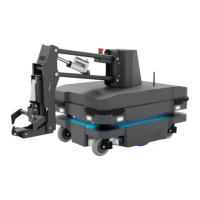
5. Product presentation
MiR100 User guide (en) 09/2019 - v.1.4 ©Copyright 2019: Mobile Industrial Robots A/S. 35
7. CAN bus connection for Battery
Management System, logging
data e.g. no of charge cycles. See
MiR Robot Interface 2.0
Reference guide.
16. Transient protection - provides
circuit protection for the power
supplies by absorbing voltage
spikes from battery or top
mounted applications
8. Router - local network, 2.4 and 5
GHz
17. DFI Computer
9. Battery with connector - main
power to the robot
MiR100 internal parts
5.5 Sensor system
Collaboration between the robot’s internal and external sensors ensures that the robot can
navigate in the environment and most importantly secures that it can operate safely among
people and objects, like furniture, machines, pallets etc.
This section describes the functionality of the different parts of the sensor system.
Safety laser scanners
The safety laser scanners on MiR100 are of the type SICK S300. In this guide, the term safety
laser scanner is used.
Scanner functions
Two safety laser scanners, diagonally placed on front and rear corners of the robot, scan
their surroundings. Each safety laser scanner has a 360° field of view up to 1 meter around
the robot, providing visual protection around the robot.
The safety laser scanners serve three purposes:
• They are used for mapping, see also MiR Robot Interface 2.0 Reference Guide.
• They are used to localize the robot in the environment and plan routes between points.
• They continuously scan the surroundings when the robot operates, thereby avoiding
collision with objects and people.
The safety laser scanners detect objects in a plane approximately 200 mm above ground.
Objects above or below are not detected by the safety laser scanners.


 To Next Page