Need help?
Do you have a question about the Monarch NICE 5000 and is the answer not in the manual?
Overview of the NICE5000 controller integrating elevator controller and AC drive functions.
Details advanced technology, ease of use, and safety features of the NICE5000.
Lists safety precautions for installation and wiring, categorizing risks as DANGER and CAUTION.
Covers precautions for residual current devices, motor insulation, thermal protection, and disposal.
Shows the system components and their interconnections via CANbus and Modbus.
Explains the naming convention and details the designation rules and nameplate information.
Lists available NICE5000 models with their power capacity, current, and motor power ratings.
Provides detailed specifications for carrier frequency, motor control, speed, overload, and environment.
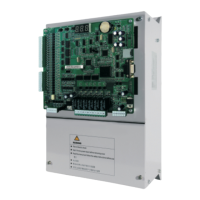
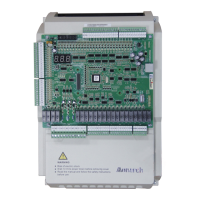
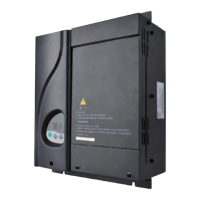
Shows physical appearance and mounting dimensions for different power classes of the NICE5000.
Lists optional parts like braking units and PG cards with their functions and remarks.
Guides on selecting an appropriate motor based on voltage, current, and power considerations.
Details installation environment requirements, clearance, and mounting methods for the controller.
Explains terminal arrangements and main circuit wiring for the NICE5000 controller.
Covers dimensions, installation, and wiring details for the CTB board.
Describes common types of display boards (HCB) and their appearance and installation.
Details appearance, dimensions, installation, and input/output terminals of the CCB board.
Explains selection and wiring of MCTC-PG cards for different encoder types.
Provides guidance on selecting regen. resistors and braking units based on controller models.
Details connection and selection of peripheral devices like circuit breakers, contactors, and reactors.
Explains the importance and arrangement of shaft position signals for accurate elevator control.
Refers to a diagram showing the overall electrical wiring of the control system.
Describes the appearance, buttons, and basic functions of the onboard keypad.
Explains connection and operation of the LED operation panel for parameter modification and monitoring.
Outlines the commissioning procedure, including checks before starting and trial runs.
Lists essential checks for mechanical and electrical readiness before starting commissioning.
Details motor auto-tuning, trial running at inspection speed, and trial running at normal speed.
Explains how to commission the door machine controller and check its signals and operation.
Discusses factors affecting riding comfort and how to adjust parameters for improvement.
Explains how to set and manage user and factory passwords for parameter access.
Details system functions like emergency evacuation and parallel control of elevators.
Explains the structure of function codes, parameter meanings, and modification properties.
Lists the different groups of function codes used for system configuration and operation.
Provides a comprehensive table of function codes, their ranges, defaults, and properties.
Explains basic parameters like control mode, command source, and running speeds.
Details motor parameters such as voltage, current, frequency, and auto-tuning settings.
Covers parameters for speed and current loop control in vector control mode.
Explains parameters for startup speed, acceleration, deceleration, and emergency evacuation.
Details parameters related to leveling adjustment, floor height, and current floor position.
Describes functions for input terminals (X1-X28) and output terminals (Y1-Y9).
Covers parameters for top/bottom floors, service floors, and elevator functions like VIP and fire emergency.
Parameters specialized for elevator commissioning, including auto-tuning and test functions.
Details parameters for pre-torque, nuisance, overload, and load cell functions.
Parameters related to idle time, fan/lamp operation, and motor running time.
Parameters for security, display settings, and product information.
Parameters for door control, protection times, and service floors for door machines.
Parameters related to storing and displaying brief fault information.
Parameters for setting up parallel control between multiple elevators.
Parameters for customizing floor display codes and highest digit displays.
Parameters for encoder type, pulses, wiring mode, and zero drift.
Defines functions for input and output terminals on HCB and CTB boards.
Parameters to enable and record leveling adjustment values for accurate floor stopping.
Parameters for monitoring pre-torque current, logic information, speed, voltage, and communication status.
Covers routine and periodic maintenance tasks, including cleaning and component checks.
Details daily/weekly checks for noise, vibration, environment, fan, and overheating.
Outlines periodic inspections for air filters, screws, corrosion, terminals, and insulation.
Discusses service life and replacement criteria for cooling fans and electrolytic capacitors.
Provides instructions for proper storage of the controller to maintain its condition.
Explains the five-level grading system for faults based on severity and impact.
Lists common fault codes, their possible causes, and corresponding solutions for troubleshooting.
Defines EMC, first environment, second environment, and controller categories.
Discusses EMC directive compliance and installation environment considerations.
Details requirements for external EMC filters, cables, and AC reactors for compliance.
Guides on selecting and installing EMC input filters and AC input reactors.
Provides precautions for installing EMC filters on the power input side for optimal performance.
Explains requirements and precautions for using shielded cables to minimize interference.
Offers solutions for common interference types like leakage protection tripping and controller interference.
Contact information for the service department.
 General
| Brand | Monarch |
|---|---|
| Model | NICE 5000 |
| Category | Controller |
| Language | English |

 To Next Page