5
Overview of PROFIBUS
Section 1-1
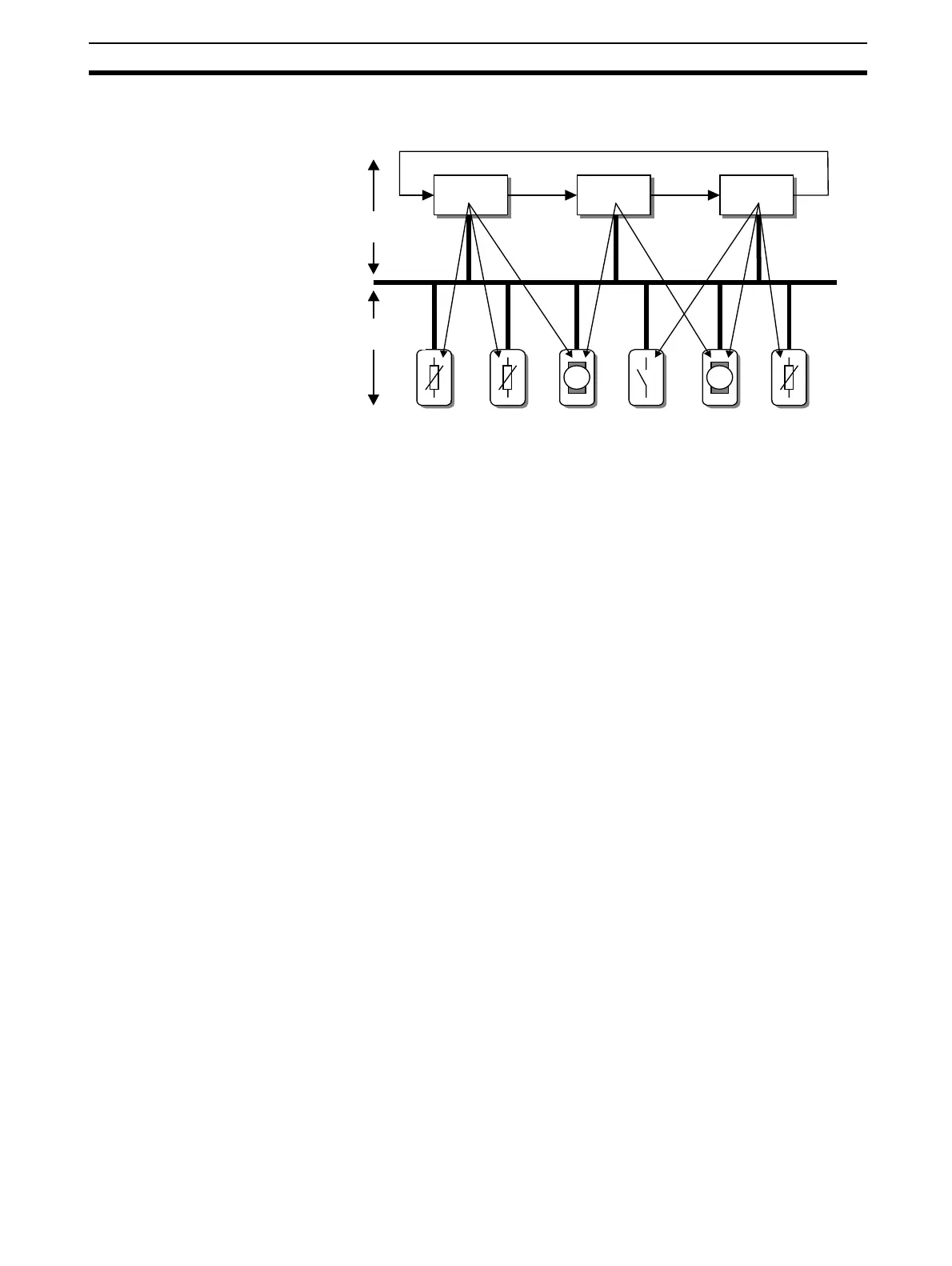
The three masters form a logical token ring. When an active station receives
the token message, it can perform its master role for a certain period of time.
During this time it can communicate with all assigned slave stations in a mas-
ter-slave communication relationship, and a DPM2 master can take the initia-
tive to communicate with DPM1 master stations in a master-master
communication relationship.
Multi-peer communication In addition to logical peer-to-peer data transmission, PROFIBUS-DP provides
multi-peer communication (broadcast and multicast).
Broadcast communication In the case of broadcast communication a master station sends an unac-
knowledged message to all other stations (masters and slaves).
Multicast communication In the case of multicast communication a master station sends an unacknow-
ledged message to a predetermined group of stations (masters and slaves).
1-1-5 Diagnostic functions
Extensive Diagnostics Extensive diagnostic functions defined in PROFIBUS-DP enable the fast loca-
tion of error at slave devices. Diagnostic messages are transmitted over the
bus and collected at the master. Three levels of diagnostic messages are
defined:
Device Related
Diagnostics
• Messages concerning the general operational status of the whole device,
e.g. over temperature, low voltage.
Module Related
Diagnostics
• Messages indicating that an error is present in a specific I/O range of a
station, e.g. an 8-bit output module.
Channel Related
Diagnostics
• Messages indicating an error at a given input or output, e.g. short circuit
on Output 5.
DPM1 DPM2 DPM1
Token Passing
Polling
PROFIBUS
Passive stations
Slave devices
Active stations
Master devices



 To Next Page