34
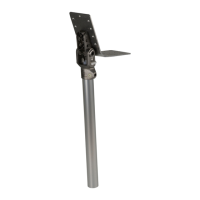
7) Pull fibreglass roving through the holes in the cleaned lamination plate.
8) Close the threaded holes in the lamination plate with plasta tape.
9) Position the lamination plate on the plaster positive.
10) Pull 2 layers of nylon stockinette over the plaster positive.
→ The 7th and 8th layers of nylon stockinette are applied.
11) Apply carbon fibre mesh in the area of the sitting surface and lamination plate.
12) Apply carbon fibre mesh offset at 45° to the first layer of carbon fibre mesh in the area of the
sitting surface and lamination plate.
13) Pull 2 layers of nylon stockinette over the plaster positive.
→ The 9th and 10th layers of nylon stockinette are applied.
14) Apply carbon fibre mesh in the area of the sitting surface and lamination plate.
15) Apply carbon fibre mesh offset at 45° to the first layer of carbon fibre mesh in the area of the
sitting surface and lamination plate.
16) Pull 2 layers of nylon stockinette over the plaster positive.
→ The 11th and 12th layers of nylon stockinette are applied.
5.9 Finishing the Prosthesis
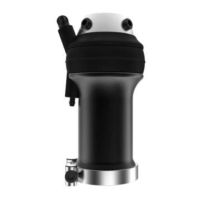
The 3S107* (for 3R60 + 3R106) or 3S27* Foam Cover (for 3C98-2 + 3B1) can be used to finish
the prosthesis. When cutting to length, include a 60mm compression allowance (lower leg length
+30mm, thigh length +30mm).
Use the 710D4 Torque Wrench and secure the grub screws with 636K13 Loctite® when finishing
the prosthesis. Observe the following torque values when finishing:
Screws / grub screws Torque
501S72=M10* Flat Head Screws on the lamin
ation plate (with socket heads)
35Nm (hexagon screwdriver, 6mm)
501F9=*M8 Flat Head Screws on the lamina
tion plate (with star heads)
25Nm (709Z11 T40 Bit)
501T39-M4* Cap Screw (area bottom plate –
intermediate piece – lamination plate)
2Nm (709S10=2.5 Hex Key)
Grub screws on the rotation adapter 10Nm / torque above the rotation adapter
All other grub screws 15Nm
Finally verify the gait pattern one more time while the patient walks with the prosthesis. If neces
sary, readjust the prosthesis to compensate for influences of the foam cover.
6 Gait Training
Only with adequate instruction and gait training can the patient fully benefit from the features of
the prosthetic hip joint system. Gait training is essential for learning how to use the prosthesis
safely. The following aspects are especially important:
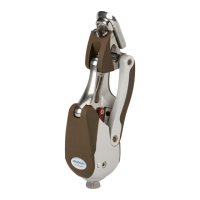
► The prosthesis wearer steps down with the prosthetic hip joint in flexion, which is extended
with damping during the stance phase.
→ Unlike with conventional prosthetic hip joints, the prosthesis wearer does not have to per
form a quick backward tilt of the pelvis. Extension of the prosthetic hip joint can be
dampened during the entire stance phase, thereby reducing an abrupt backward tilt of the
pelvis upon weight bearing. This is initially unfamiliar for experienced prosthesis wearers
in particular and has to be practiced consciously.


 To Next Page
 Loading...