68
CB 240 Climbing Formwork
Instructions for Assembly and Use – Standard Configuration
C1 Planning and Work Preparation
Use on Circular Structures
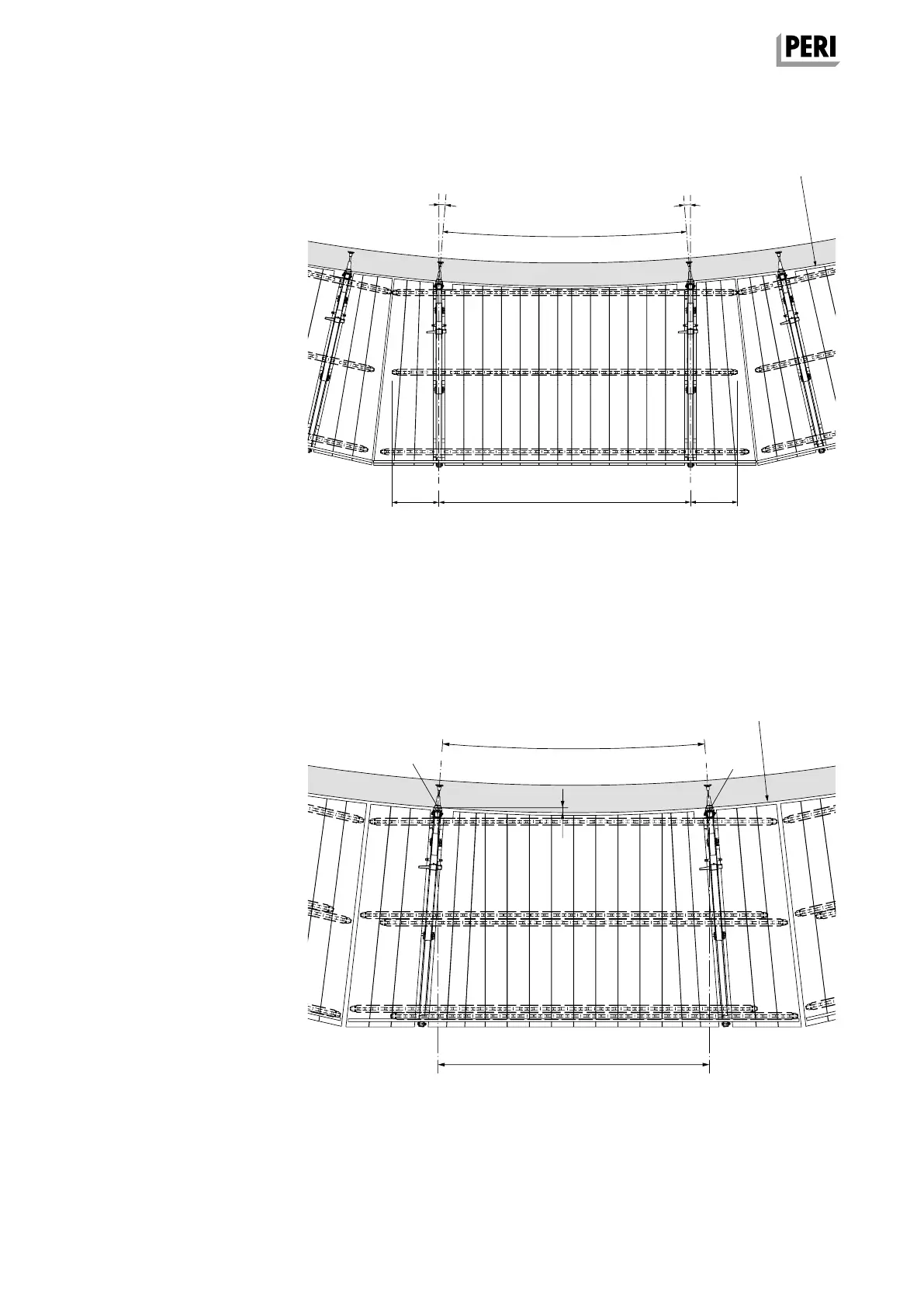
Parallel Arrangement of Brackets
Depending on bracket spacing c, brackets
can be positioned parallel to each other
beginning from a certain radius of the
building.
The maximum twist in the scaffold
mounting ring is 5°.
The pressure point of the bracket is
wedged to compensate for the angle.
(Fig. C1.17)
Advantages:
The carriage can be used for moving for-
ward and retracting the formwork.
Requirements for the radius of the buil-
ding:
available R ≥ 5.72 x actual c.
System statics are verified with the ap-
plication diagrams according to the type
test.
c
d
α
R
s
c
Fig. C1.17
β β
R
cd d
Fig. C1.18
R
c
Wedge
Wedge
available bracket spacing = anchor spacing
middle girder cantilever
= 2 x rotation angle β
Radius of the building
Arc rise of the building curvature
Anchor spacing
Radially-Positioned Brackets
Disadvantages:
The carriage can no longer be used for
moving forward and retracting the form-
work.
Wedges for compensating the angle
have to be fitted between the girder and
mounting plate. If the arc rise s of the
building edge is too big, the innermost
girder must be additionally moved out-
wards by means of packing in order to
provide sufficient space between the
girder and the building.
(Fig. C1.18)
The same applies to the finishing plat-
forms.
Special measures have to be undertaken
if scaffold tube units are installed.
Static proof is to be carried out separa-
tely.
α < 10°
10α < °
s
AuV CB 240 EX.indb 68 29.06.16 09:46


 To Next Page