Lead Selection 4 ECG and Arrhythmia Monitoring
53
Lead Selection
It is important to select a suitable lead for monitoring so that a QRS complex can be accurately
detected. The guidelines for lead selection are as follows:
For non-paced patients:
• QRS complex should be tall and narrow (recommended amplitude > 0.5mV).
• R-wave should be above or below the baseline (but not biphasic).
• P-wave should be smaller than 1/5 R-wave height.
• T-wave should be smaller than 1/3 R-wave height.
NOTE To prevent detection of P-waves or baselines noises as QRS complexes, the minimum detection level
for QRS complexes is set at 0.15 mV, according to AAMI-EC 13 specifications. If the ECG signal is
too weak, you may get false alarms for asystole.
For paced patients with internal/transvenous pacemakers, in addition to the above, the pace pulse
should be:
• not wider than the normal QRS complex.
• large enough to be detected (half the height of the QRS complex), with no re-polarization artifact.
NOTE Adjusting the ECG wave size on the display does not affect the ECG signal which is used for
arrhythmia analysis.
Lead Choices
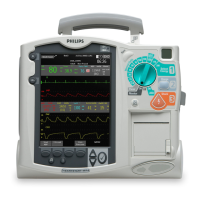
Available monitoring leads vary depending upon what type of ECG cable is connected to your
HeartStart MRx and its configuration. Table 4 shows the choice of leads available for 3-, 5-, and 10-
lead ECG sets.
Table 4 Lead Choices
If you are using: These leads are available:
a 3-electrode ECG set I, II, III
a 5-electrode ECG set I, II, III, aVR, aVL, aVF, V
a 10-electrode ECG set I, II, III, aVR, aVL, aVF, V1-V6


 To Next Page