Section 12: BRAKE AND AIR SYSTEM
16 X3-45 Commuter PA1593 DOB 2400-2489 Section 12 Updated Sept. 2015
27.2 BRAKE PADS AND DISCS MINIMAL
TOLERANCE LIMITS
27.2.1 Brake Pads
The thickness of the pads must be checked
regularly dependent on the usage of the vehicle.
The pads should be checked corresponding to
any legal requirements that may apply. Even if a
wear indicator is fitted and connected, this must
be at least every 12 months.
MINOR BREAKOUTS AT THE EDGES ARE PERMITTED
MAJOR BREAKOUTS ON THE SURFACE OF THE
BRAKE PAD ARE NOT PERMITTED
If the thickness of the friction material at its
thinnest point is less than 0.079 inch or 2 mm
(measurement C), the pads must be replaced.
Overall thickness of new brake pad: 1.18
in (30 mm)
Back plate SN7 type: 0.354 in (9 mm)
Minimal thickness of friction material:
0.079 in (2 mm)
Minimum allowed thickness in worn
condition for back plate and friction
material: 0.433 in (11 mm)
27.2.2 Brake Disc
Measure the thickness of the brake disc at the
thinnest point. Be aware of possible burring at
the edge of the disc.
Total thickness of the brake disc
New condition = 1.77 in (45mm)
Worn condition = 1.457 in (37mm) (the disc
must be replaced)
If the disc dimension E ≤ 1.535 in (39mm),
it is recommended that the disc should be
renewed when the brake pads are
changed.
Refer to Knorr-Bremse Pneumatic Disc Brake
SN7 Service Manual included on the technical
manuals CD for additional brake disc visual
checks.
27.3 CALIPER RUNNING CLEARANCE
The Knorr/Bendix air disc brake is designed to
move freely, with minimal force. By pushing and
pulling the caliper in an axial direction by hand
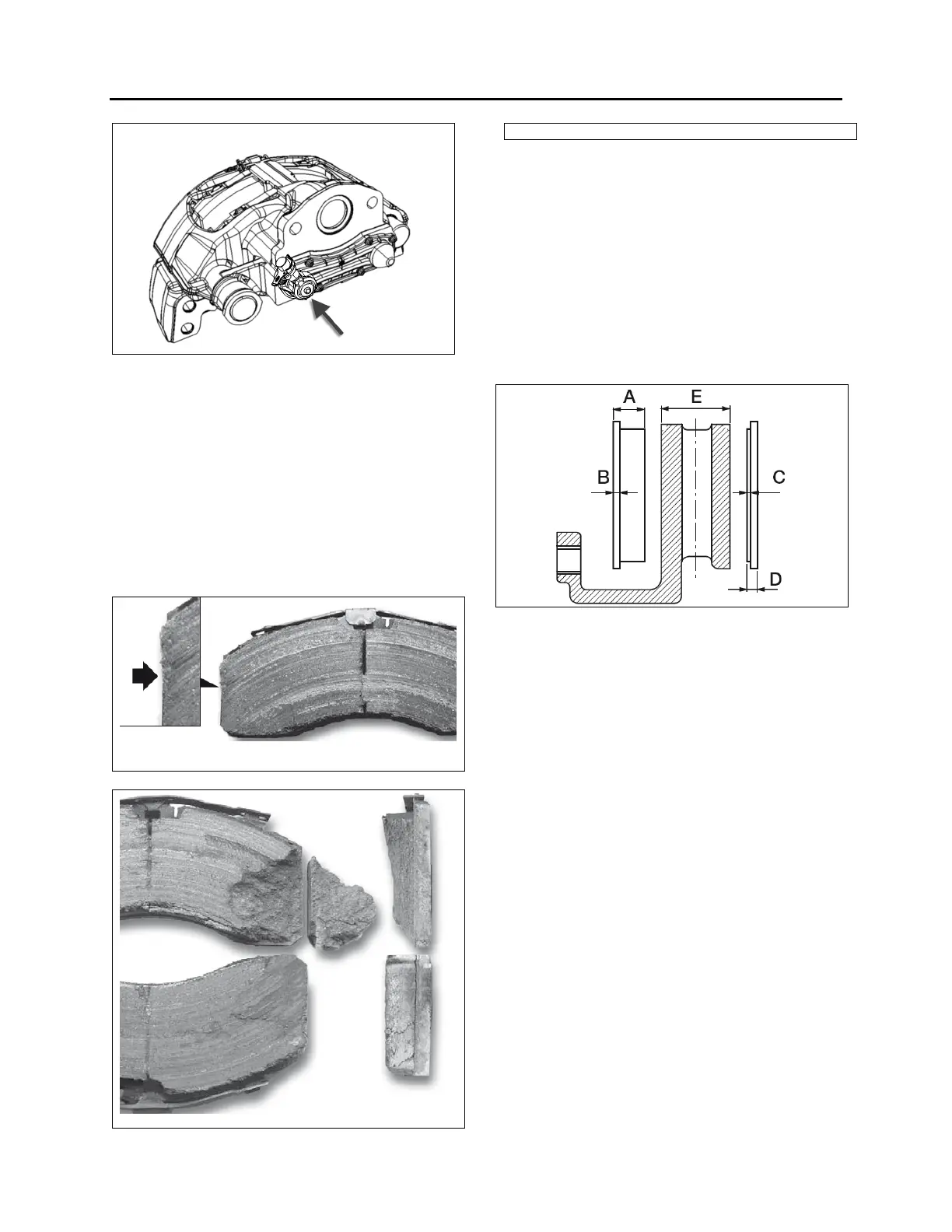
(see arrow A in Figure 26), a movement of 0.6 -
1.1 mm must be possible.






 To Next Page