
 Need help?
Do you have a question about the Rain Bird LXME2 and is the answer not in the manual?
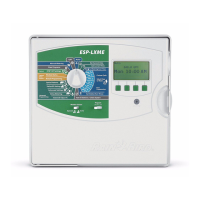
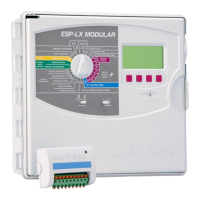
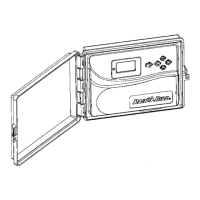
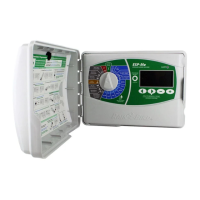
Provides an overview of the Rain Bird LXME2 controller, designed for commercial use and 12 to 48 stations.
Lists key features like large LCD, hot-swappable modules, dynamic station numbering, and surge protection.
Lists all components included with the LXME2 controller package for installation.
Specifies compliance standards for 120VAC and 230VAC LXME2 models.
Explains that valves/stations are controlled by the controller according to irrigation programs.
Explains the controller's programming structure, including programs, start times, run times, and watering days.
Details the controller's display, buttons, and dial positions for navigation and operation.
Provides a step-by-step guide for initial controller setup and programming tasks.
Describes how to identify, view, and address alarm conditions on the controller.
Configures the controller for master valves (NOMV or NCMV) or pump start circuits.
Explains how to set up a local weather sensor to influence irrigation based on conditions.
Details how to configure individual stations, including priority, master valves, and sensors.
Covers advanced station programming options like Cycle+Soak, Station Delay, and SimulStations.
Allows copying station run times from one program to other programs for efficiency.
Allows selecting specific days of the week for irrigation to occur.
Sets irrigation to occur at regular chosen intervals, regardless of the calendar date.
Configures watering based on even, odd, or odd days excluding the 31st of the month.
Tests all connected stations sequentially to verify proper operation after installation or for troubleshooting.
Quickly tests for shorted stations, open wires, or faulty valve solenoids.
Allows verification of programmed start times and run times for programs and stations.
Provides a summary of run times, start times, and water days for all programs.
Displays a complete summary of the LXME2's programming, allowing for review and changes.
Reviews the total run time for an individual program, including cycle times.
Reviews the total run time for all stations across different programs.
Reviews the status, type, and MV Water Window inclusion of installed master valves.
Displays the current status of the local weather sensor (On or Off).
Tracks month-to-date and last month water consumption when Flo-Watch is enabled.
Resets the flow history data on the controller back to zero.
Sets up and views alarms for high or low flow conditions, and FloZone flow alarms.
Sets a seasonal adjustment percentage for each individual irrigation program.
Adjusts irrigation percentages for specific months of the year.
Discontinues irrigation for a set number of days after a period of heavy rain.
Suspends irrigation on specific calendar dates, up to 15 days per year.
Specifies allowed times of day/night for irrigation to occur, complying with local regulations.
Guides on setting the open and close times for program-specific watering windows.
Highlights the controller's flow-related features for efficient system utilization.
Explains FloZones as groups of stations connected to the master valve, supporting one FloZone.
Details the two main groups: Flo-Manager for hydraulic management and FloWatch for alarms.
References the setup procedure for flow sensors, similar to the main Setup menu.
Allows setting or automatically learning flow rates based on real usage.
Ensures run times are set for stations before including them in a Learn Flow exercise.
Manually sets or views the desired flow rate for individual stations.
Sets maximum flow rates for FloZones, used by Flo-Manager.
Displays user-entered or learned flow rates and their source for each station.
Displays user-entered or learned flow rates and max GPM for each FloZone.
Clears previously learned or user-entered flow rates to start over.
Enables hydraulic management features to allocate water capacity based on station needs.
Guides on setting up master valves, FloZones, and learning/entering flow rates for Flo-Manager.
Turns Flo-Manager on or off, impacting station sequencing and water allocation.
Unleashes the controller's true power by monitoring flow and taking actions based on settings.
Details requirements and steps for setting up FloWatch, including flow rate entry.
Enables or disables the FloWatch feature on the controller.
Defines high and low flow thresholds and actions for excessive or low flow conditions.
Sets thresholds, settling times, and actions for high and low flow conditions.
Defines actions like diagnose, shut down, or alarm for high or low flow events.
Displays current flow rates and compares them to learned or user-entered rates.
Sets measurement units (GPM, LPM, etc.) and pipe size for flow management.
Saves irrigation programs as Contractor Default and recalls them later.
Restores the LXME2 controller to its original factory default settings.
Provides information on firmware versions, front panel, and cartridge details.
Manually starts a specific station for a set duration, pausing current programs.
Manually starts a selected irrigation program.
Sets a window to allow manual watering via master valves when not irrigating.
Opens master valves for a short, unscheduled duration for manual tasks.
Adjusts the controller display contrast value from 1 to 12 for better visibility.
Closes all master valves, disabling all irrigation functions.
Guides on mounting the LXME2 controller on a wall and connecting the wiring.
Recommends criteria for choosing an optimal and accessible location for the controller.
Details the process of physically mounting the controller onto a surface using a template.
Explains how to connect power supply wires to the controller's transformer.
Describes how the controller detects and displays module configuration and station mapping.
Guides on connecting valve wires to station modules and common terminals.
Details wiring a local weather sensor directly to the controller or via a wireless receiver.
Explains connecting a flow sensor using a Pro Smart Module for advanced features.
Checks the electrical installation and tests valves, even without water availability.
 General
| Number of Zones | 2 |
|---|---|
| Stations | 2 |
| Voltage | 24 VAC |
| Display | LCD |
| Rain Sensor Input | Yes |
| Weight | 1.5 lbs |
| Type | Irrigation Controller |
| Power Source | AC |
| Programming | Flexible |
| Mounting | Wall |
| Enclosure Rating | Indoor/Outdoor |



 To Next Page
