Regenerative Braking
The energy recovery braking (Cooperative Regenerative
Braking System, abbreviated as CRBS) function is utilized
in the vehicle during braking or coasting processes to
convert the generated kinetic energy into electrical energy
stored in the power battery. This enhances the vehicle's
endurance range.
Selecting Energy Recovery Intensity
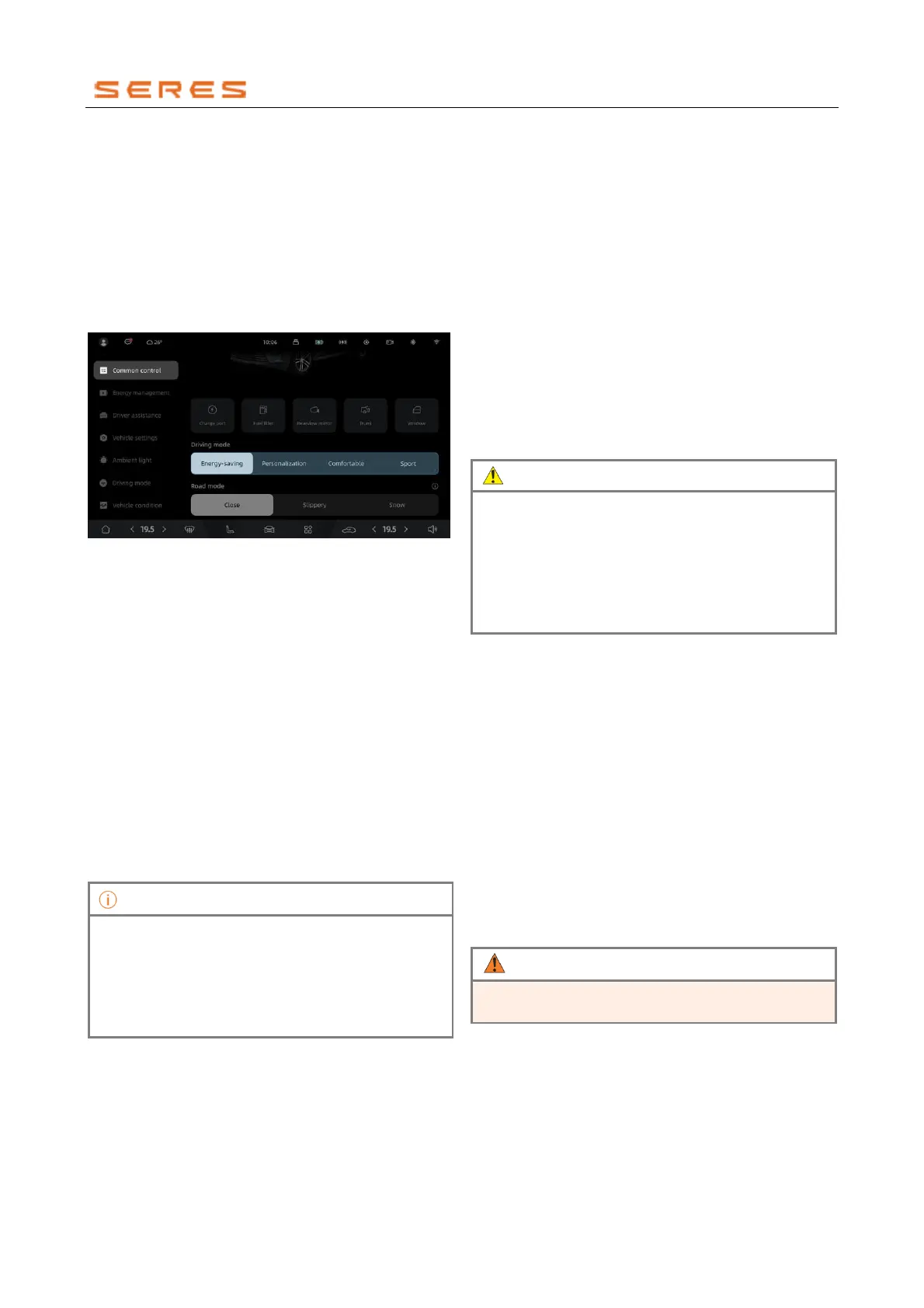
1. Go to Vehicle Setting > Common Control on the
central control screen.
* The image is for reference only; please refer to the actual
product
2. Click to select the corresponding driving mode.
● Eco: In this driving mode, the energy recovery
intensity is enhanced. When you release the
accelerator pedal, the vehicle decelerates
rapidly, reducing the frequency of using the
brake pedal and replenishing more energy to
the power battery.
● Custom: In this driving mode, you can
customize the energy recovery intensity, with
the default set to standard.
● Comfort: In this driving mode, the energy
recovery intensity is standard. When you
release the accelerator pedal, the vehicle
decelerates relatively quickly, providing slightly
longer coasting distance compared to Eco
mode.
● Sport: In this driving mode, the energy recovery
intensity is the same as comfort mode.
The brake energy recovery function is activated when
the driver brakes. During this process, especially when
braking at low speeds, the driver may hear a slight
"tata" sound from the right side of the cabin, and there
will be a very mild sensation on the brake pedal. This is
the normal sound and phenomenon of the brake energy
recovery function working.
Electronic Stability Control
The Electronic Stability Control (Electronic Stability
Control, abbreviated as ESC) helps stabilize the vehicle
during excessive or insufficient steering. The
Electronic Stability Control is default set to ON.
Functure Introduction
When there is excessive or insufficient steering, the
system enhances vehicle stability by applying brakes to
specific wheels or reducing motor torque. The
Electronic Stability Control includes the following sub-
functions:
● Electronic Brake-force Distribution (EBD)
● Anti-lock Braking System (ABS)
● Body Dynamic Control System (VDC)
● Traction Control System (TCS)
● Hill Hold Control (HHC)
● Hydraulic Brake Assist (HBA)
● Hydraulic Brake Booster (HBB)
● Emergency Brake Warning (HAZ)
● Rollover Mitigation Function (RMF)
● Hill Descent Control (HDC)
• The Body Stability System is an auxiliary system
and cannot replace the role you play when Driving
Operation. Therefore, please drive the vehicle
carefully and responsibly.
• Avoid aggressive driving behaviors such as
slamming the accelerator pedal when the vehicle
is sliding or making sharp turns, as it may result in
injury or damage to the vehicle.
Electronic Brake Force Distribution
Electronic Brake Force Distribution (EBD) automatically
adjusts the rear brake pressure during vehicle braking to
ensure that the rear wheels do not lock up before the front
wheels, guaranteeing optimal braking force output. It works
in coordination with ABS to enhance braking stability,
ensuring smooth vehicle operation.
Antilock Brake System
The vehicle is equipped with an Antilock Brake System
(Antilock Brake System, abbreviated as ABS), which
prevents wheel lockup during emergency braking or
braking on wet or slippery surfaces. This helps avoid
skidding or fishtailing, maintaining the stability of the
vehicle.
After each vehicle start, the ABS system performs a self-
check during driving, which may result in a brief clicking
sound or slight movement of the brake pedal. This is
considered normal.
ABS may not effectively work under the following
conditions (including but not limited to):



 To Next Page