• Use of tires with insufficient traction.
• High-speed driving on wet, slippery, muddy,
sandy, or snow-covered roads.
• When driving on a bumpy or uneven road surface.
• ABS is not designed solely to shorten the vehicle's
braking distance. Please maintain a proper
distance from the vehicle in front of you while
driving.
Body Dynamics Control System
The Vehicle Dynamics Control System (Vehicle Dynamics
Control, abbreviated as VDC) works by assessing the
driver's steering intentions based on information such as
steering wheel angle and vehicle speed during driving. It
continuously compares this information with the actual
vehicle conditions. If the vehicle deviates from the normal
driving trajectory, the system will correct it by applying
brakes to specific wheels or reducing the motor torque,
helping the driver control skidding and maintain stability
during driving.
Traction Control System
The Traction Control System (Tracking Control System,
abbreviated as TCS), also known as the Tracking Control
System, prevents drive wheel slip during acceleration by
reducing motor power and, if necessary, applying brake
force control. When the TCS effectively controls brake
pressure and motor power, the " " indicator on the
instrument display screen for the Vehicle Dynamics
Control System may flash.
Hill Hold Assistant
On an incline, the Hill Hold Control (Hill Hold Control,
abbreviated as HHC) system automatically applies the
brake for approximately 1s~2s. This prevents the vehicle
from sliding when transitioning from the brake pedal to the
accelerator pedal.
If you haven't activated the automatic parking function,
the HHC will stop working after 1s2s, and the vehicle
may slide. Therefore, move your foot from the brake
pedal to the accelerator pedal, as relying on HHC for an
extended period (more than 1s2s) to prevent vehicle
sliding can lead to collision accidents.
Hydraulic Brake Assist
The role of Hydraulic Brake Assist (Hydraulic Brake Assist,
abbreviated as HBA): When the driver quickly steps on the
brake pedal, the system recognizes that the vehicle is in
an emergency state and rapidly increases the brake
pressure to the maximum. This allows the Antilock Brake
System to intervene more quickly, effectively reducing the
braking distance.
Hydraulic Power Brake Assist
The Hydraulic Power Brake Assist (HBB) function is
designed for vehicles equipped with a hydraulic brake
system. It assists the vehicle in actively boosting pressure
during dynamic braking, amplifying the driver's braking
request under specific driving conditions.
Emergency Braking Warning
The role of Emergency Braking Warning (Hazard Warning,
abbreviated as HAZ): When the vehicle speed is greater
than 50 km/h and the driver engages in emergency
braking, the system recognizes the emergency braking
state. It sends an emergency braking signal to the body
controller, and the hazard warning indicator on the
instrument display screen remains on. Additionally, the
Hazard Warning Flashers flash to warn vehicles behind,
serving as a hazard warning.
Rollover Mitigation Function
The Rollover Mitigation Function (RMF) determines the
body's driving status by detecting the body's tilt angle and
tilt rate. While driving, if the system detects a risk of
rollover, it applies appropriate brake force to one or more
wheels to reduce speed and minimize the risk of rollover
until the vehicle regains stability.
ESC Operating Instructions
If the " " indicator lamp on the instrument display screen
is flashing, it indicates that ESC (Electronic Stability
Control) is active.
Deactivate ESC:
If the vehicle is stuck in snow or mud, ESC may reduce
power from the motor to the wheels. In such situations, you
may need to deactivate the system to free the vehicle.
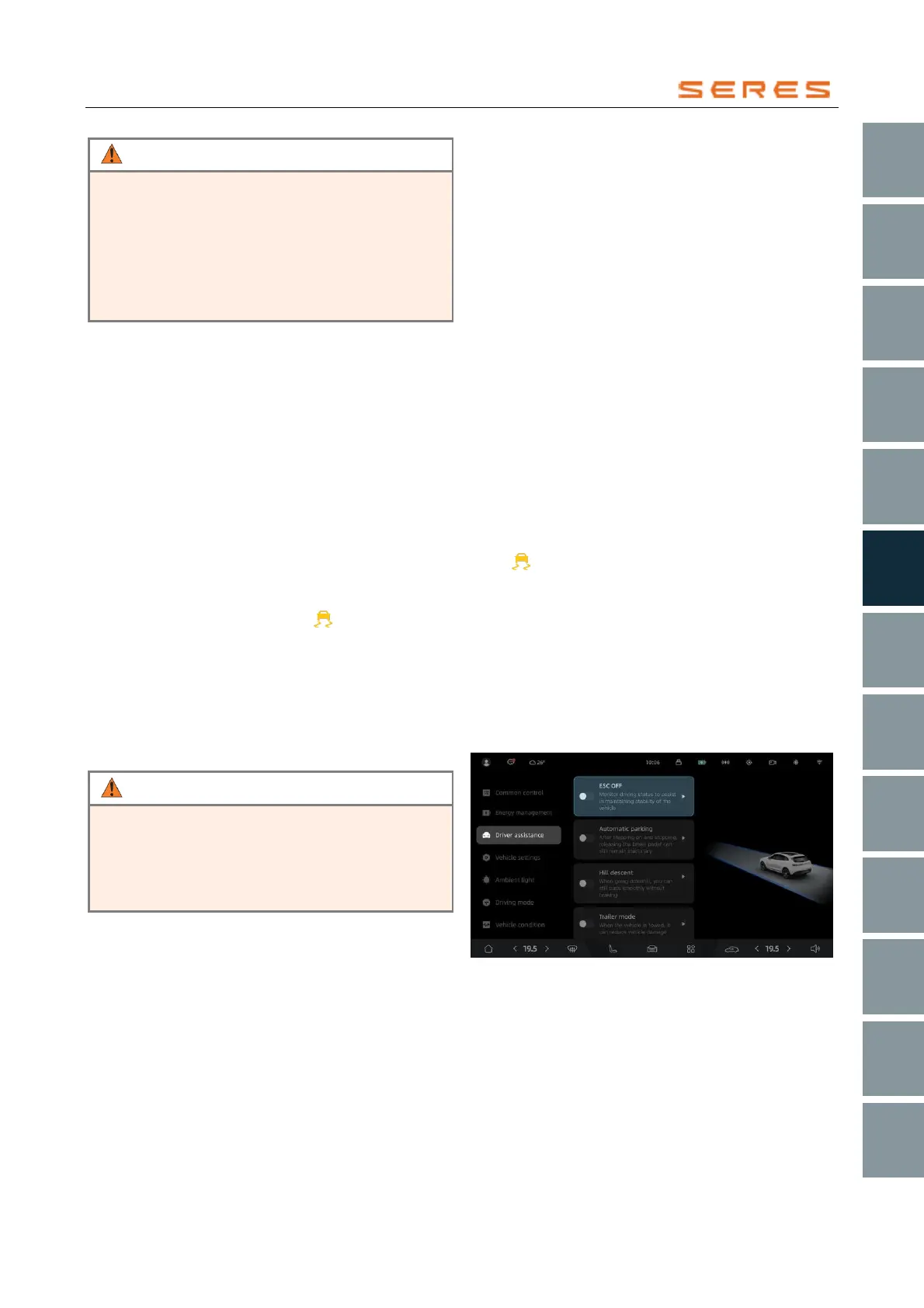
Activate or Deactivate the Body Stability System
In the central control screen, go to Vehicle Setting >
Driving assistance to activate or deactivate the Body
Stability System.
* The image is for reference only; please refer to the actual
product
When ESC is activated:
If the ESC indicator lamp is flashing, drive with caution.
Careless driving may lead to accidents.



 To Next Page