S=1600mm/s×T+8×(d–14mm)
✓
If t
he new value is S>500mm, use the newly calculated value as the minimum
distance.
✓
If the new value S is ≤ 500mm, then use 500mm as the minimum distance.
4.3.8 Access protection
Overview
In a s
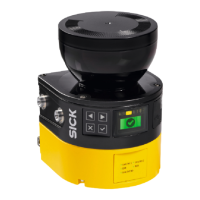
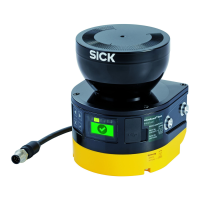
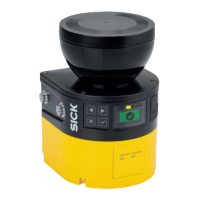
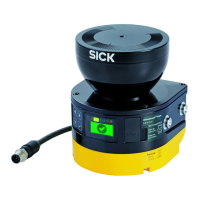
tationary application, for example on a machine where the point of access to the
hazardous area can be physically defined, the safety laser scanner is mounted with a
vertical scan plane. For access protection, the safety laser scanner detects an intrusion
by a whole body. The protective field is orthogonal to the person’s direction of approach.
Figure 33: Stationary application in vertical operation for access protection
Important information
DANGER
H
azard due to lack of effectiveness of the protective device
Persons and parts of the body to be protected may not be recognized in case of
non-observance.
►
Use a resolution of 200 mm or finer. Otherwise, protection will not be ensured
during access protection.
►
Use double sampling during access protection. Under certain circumstances, a
person could pass through the protective field without being detected when using
higher multiple sampling.
►
Use the contour of the environment as a reference to protect the protective device
from inadvertent adjustment or tampering (see "Reference contour monitoring",
page 30).
4 PROJECT PLANNING
44
O P E R A T I N G I N S T R U C T I O N S | microScan3 – EtherNet/IP™ 8020200/1NTM/2024-06-03 | SICK
Subject to change without notice




 To Next Page