EasyManua.ls Logo

SICK microScan3 - User Manual

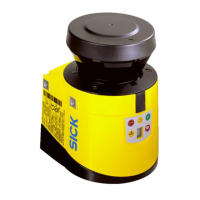
SICK microScan3
212 pages
Print Icon
To Next Page IconTo Next Page
Loading...
O P E R A T I N G I N S T R U C T I O N S
microScan3 – PROFINET
Safety laser scanners

Table of Contents

Other manuals for SICK microScan3

Questions and Answers

  • C
    Christine StewartSep 14, 2025
    Why does SICK Scanner show a dazzle warning?
    • M
      Mr. Robert LopezSep 14, 2025
      If your SICK Scanner is showing a dazzle warning, it indicates that an external light source might be interfering with the scan plane. To resolve this, check for any potential light sources and then remove or cover them.
  • J
    Jacob JenkinsAug 25, 2025
    How to resolve a 'Fault in the reset input' on my SICK Scanner?
    • L
      Laura CervantesAug 25, 2025
      If an invalid signal is applied at a reset input because the reset button has been pressed for too long, too frequently, or is defective, check whether the reset pulse fulfills the requirements.
  • G
    George HunterAug 25, 2025
    Why is my SICK microScan3 Scanner showing an incompatible configuration and what should I do?
    • N
      Nicholas ShawAug 26, 2025
      If the configuration in the system plug does not match the device’s functionality, check the device variant. You may need to replace or reconfigure the device.
  • S
    Stephen WebbAug 26, 2025
    How to restart SICK microScan3 when safety function stopped?
    • K
      karen28Aug 26, 2025
      If the safety function on your SICK Scanner has stopped and all safety outputs are in the OFF state, you can restart the device using the keypad or Safety Designer.
  • T
    Taylor ThomasSep 15, 2025
    What to do if SICK microScan3 Scanner displays a contamination warning?
    • P
      Paul JohnsonSep 15, 2025
      If your SICK Scanner is showing a contamination warning, you should clean the optics cover.
  • D
    Debbie JohnsonSep 23, 2025
    What to do if SICK Security Sensors show correctable error (e.g. CIP connection interrupted)?
    • J
      Joshua LeeSep 23, 2025
      If there is a correctable error such as a CIP connection interruption, reestablish the CIP connection.
  • B
    brownjamesSep 7, 2025
    What to do if my SICK Scanner displays 'Warnings exceed tolerance time'?
    • S
      Scott GarrettSep 7, 2025
      If the combination of multiple warnings has resulted in a fault because the tolerance time of 1 s has been exceeded, use Safety Designer to check what warnings exist.
  • D
    Drew MooreSep 8, 2025
    What to do if my SICK Scanner displays a temperature error?
    • C
      Crystal BaileySep 8, 2025
      If the Safety laser scanner’s operating temperature has exceeded or fallen below the permitted range, check whether the safety laser scanner is being operated in accordance with the permissible ambient conditions.
  • W
    williamsdanielSep 2, 2025
    What causes a SICK microScan3 Scanner to show a 'Current too high at an OSSD' error, and how to fix it?
    • M
      Mallory KeithSep 2, 2025
      If the current is too high at an OSSD because the limit has been exceeded for the current allowed short-term or permanently, check the connected switching element.
  • M
    Mrs. Brianna HallAug 31, 2025
    What to do if my SICK Scanner has OSSD short-circuit to 24 V?
    • A
      Anita CooperAug 31, 2025
      If there is a short-circuit to 24 V at an OSSD, check the wiring.

Summary

About this document

Function of this document

Describes the purpose and content of the operating instructions.

Scope

Defines the products and document identification covered by the manual.

Target groups of these operating instructions

Identifies intended readers and relevant chapters.

Further information

Points to additional resources available online from SICK.

Symbols and document conventions

Explains symbols, notes, and instructions used throughout the document.

Safety information

General safety notes

Provides essential safety information regarding product integration and laser class.

Intended use

Specifies the permissible applications and limitations for the safety laser scanner.

Inappropriate use

Warns against improper applications and consequences of misuse.

Cybersecurity

Discusses cybersecurity threats and the need for a comprehensive concept.

Requirements for the qualification of personnel

Outlines the necessary expertise for safe handling and operation.

Product description

Device overview

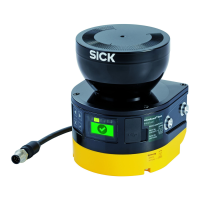
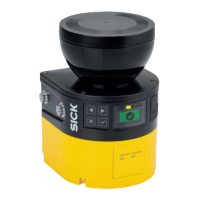
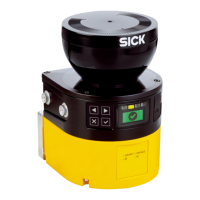
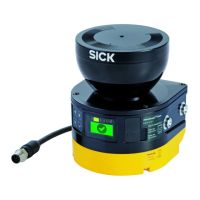
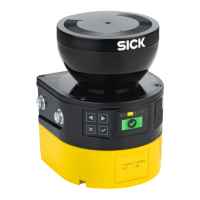
Details the physical components and layout of the safety laser scanner.

Setup and function

Explains the working principle and basic operation of the device.

Product characteristics

Describes variants, connection types, and scanning ranges of the device.

Example applications

Illustrates typical use cases like hazardous area and point protection.

Project planning

Manufacturer of the machine

Addresses safety considerations for the machine manufacturer during project planning.

Operator of the machine

Outlines responsibilities and safety aspects for the machine operator.

Assembly

Covers crucial prerequisites and considerations for mounting the device.

Integrating the equipment into the electrical control

Provides essential information for electrical installation and system integration.

Mounting

Safety

Details critical safety precautions and requirements for mounting the device.

Unpacking

Instructions for checking components and handling the device during unpacking.

Mounting procedure

Describes available mounting options and essential installation guidelines.

Electrical installation

Safety

Highlights safety requirements and electrical connection guidelines for the device.

Connection overview

Shows system plugs and their respective connections for different variants.

Pin assignment

Details the pin configurations for voltage supply and Ethernet connectors.

Configuration

Delivery state

Specifies the initial unconfigured state of the device.

Safety Designer configuration software

Guides through installing and using the configuration software.

Overview

Explains the Safety Designer overview dialog and device information.

Network settings

Covers PROFINET addressing, naming, and communication parameters.

Reading configuration

Describes how to read and verify device configuration settings.

Identification

Details how to assign names and information for project and device identification.

Protocol settings

Explains PROFINET protocol settings, including F-destination address.

Application

Allows selection of application type (Stationary/Mobile) and display language.

Monitoring plane

Covers configuration of monitoring planes, tasks, and object resolution.

Reference contour field

Describes how to define and use reference contours for monitoring.

Fields

Details the use of the field editor for creating protective, warning, and contour fields.

Inputs and outputs

Explains how to configure input sources and restart behavior for network outputs.

Monitoring cases

Covers the setup and configuration of different monitoring cases and switching sequences.

Simulation

Describes how to visualize the configured safety functions and fields.

Data output

Explains how to configure data output via UDP or TCP/IP.

Transfer

Guides on transferring and verifying device configurations.

Starting and stopping safety function

Details manual control of the safety function.

Reports

Describes how to generate and save device configuration reports.

Service

Covers device restart, factory settings, password management, and access control.

Commissioning

Safety

Highlights safety precautions and checks before and during commissioning.

Alignment

Describes options for precisely aligning the safety laser scanner.

Switching on

Details the device's internal tests and start-up process after power on.

Check during commissioning and modifications

Ensures hazardous area monitoring and prevention of access during setup.

Operation

Safety

Emphasizes safety precautions for maintenance, alignment, and fault diagnosis.

Regular thorough check

Specifies checks to ensure hazardous area monitoring and access prevention.

Status indicators

Explains the meaning of LEDs and display information for device status.

Maintenance

Safety

Highlights safety precautions against improper work and product modification.

Regular cleaning

Provides instructions and precautions for cleaning the optics cover.

Replacing the optics cover

Details the procedure and calibration required after replacing the optics cover.

Replacing the safety laser scanner

Guides on replacing a damaged or defective safety laser scanner.

Replacing the system plug

Describes the procedure for replacing a damaged or defective system plug.

Regular thorough check

Ensures the protective device monitors the hazardous area and prevents access.

Troubleshooting

Safety

Emphasizes immediate machine shutdown and securing if faults are unclear.

Detailed diagnostics using the display

Explains how to navigate menus and view device information via pushbuttons.

Fault indication on the display

Details fault types, causes, and troubleshooting steps shown on the device display.

Diagnostics using Safety Designer

Covers diagnostic tools like data recorder, event history, and PROFINET status.

Diagnostics using the control

Explains access to process map, I&M data, and alarms via the control.

Decommissioning

Disposal

Provides guidance on the proper disposal of unusable devices.

Technical data

Variant overview

Lists device variants, type codes, and ordering information.

Version numbers and functional scope

Details functional scope based on version numbers and device labels.

Data sheet

Provides detailed features, safety-related parameters, and interfaces.

Response times

Explains how scan cycle time, interference, and sampling affect response time.

Sensing range

Details protective field ranges based on variant, scan cycle, and object resolution.

Data exchange in the network

Covers process images, available data, and communication protocols.

Dimensional drawings

Provides mechanical dimensions and mounting details for different connection types.

Ordering information

Scope of delivery

Lists the items included in the product package.

Ordering information

Provides part numbers and specifications for ordering different device variants.

Spare parts

Safety laser scanner without system plug

Lists spare parts for safety laser scanners without the system plug.

System plug

Details part numbers for system plugs based on connection type.

Additional spare parts

Lists spare parts like optics covers and cover plates with part numbers.

Accessories

Brackets

Lists ordering information for various mounting kits and brackets.

Alignment aid

Provides ordering information for the alignment aid accessory.

Cleaning agent

Lists ordering information for anti-static plastic cleaner and lens cloth.

Test rods

Provides ordering information for test rods and holders.

Additional accessories

Lists reference targets and testing equipment for collision protection.

Glossary

Annex

Conformities and certificates

Provides information on obtaining declarations of conformity and certificates.

Note on standards

Lists relevant standards and their regional equivalents.

Checklist for initial commissioning and commissioning

A checklist for manufacturers and installers for initial setup and inspection.

Mounting methods for protection from interference from systems in close proximity

Details mounting methods to prevent interference between safety laser scanners.

List of figures

List of tables

SICK microScan3 Specifications

General IconGeneral
Scanning angle275°
Power supply24 V DC
Supply voltage24 V DC ± 20%
Enclosure ratingIP65
Resolution70 mm
Protective field range5.5 m
Number of fields128
InterfaceEthernet
Safety integrity levelSIL3
Performance levelPL e
Ambient temperature+50°C
Scanning range5.5 m

Related product manuals