* If you do not connect a sub woofer, select
“NO”. This activates the bass redirection
circuitry and outputs the LFE signals from other
speakers.
* In order to take full advantage of the Dolby
Digital bass redirection circuitry, we
recommend setting the sub woofer’s cut off
frequency as high as possible.
The parameters below are for the advanced
speaker settings. They appear in the display
window only when you set “MENU EXPAND”
to “ON” in the CUSTOMIZE menu (page 44).
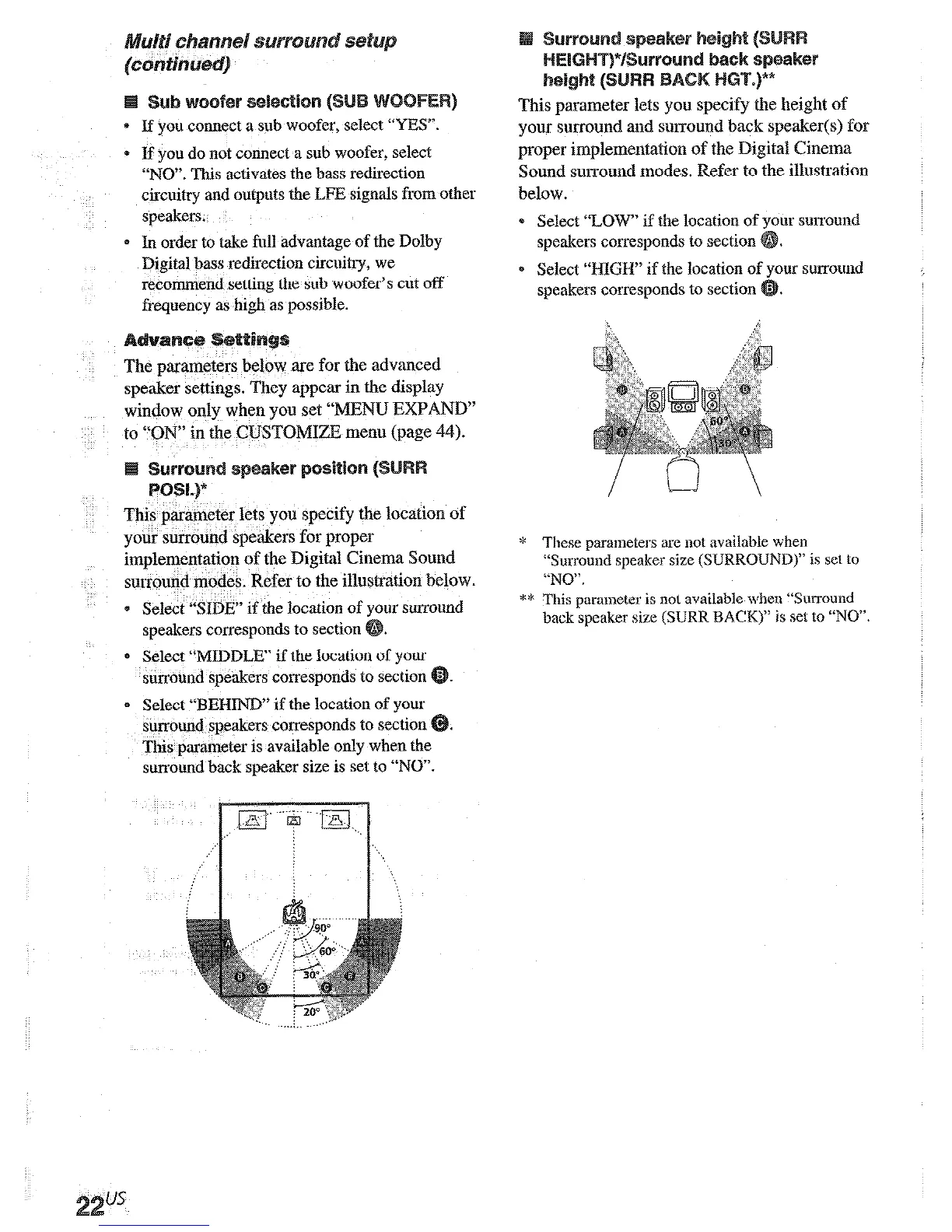
This parameter lets you specify the location of
your surround speakers for proper
implementation of the Digital Cinema Sound
surround modes. Refer to the illustration below.
e Select “SIDE” if the location of your surronnd
L- Select “BEHIND” if the location of your
This parameter is available only when the
snrround back speaker size is set to “NO”.
your surround and surround back speaker(s) for
proper in~plemeiltatiotl of the Digital Cinema
Sound surround modes. Refer to the illustration
below.
*
Select “LOW” if the location of
speakers corresponds to section
*
Select “HIGH” if the location of your surround
speakers corresponds to section
4
These parameters are not availabIe when
“Surround speaker size (SURROUND)” is se1 to
“NO”.
*:k This parameter is not available when “Surround
back speaker size (SURR BACK)” is set to “NO”.
surround/surround back speaker position
parameter is designed specifically for implementation
of the Digital Cinema Sound modes with virtual
elements.
With the Digital Cinema Sound modes, speaker
position is not as critical as other modes. All modes
with virtual elements were designed under the
premise that the surround speaker would be located
behind the listening position, but presentation remains
fairly consislent even with the surround speakers
positioned at a rather wide angle. However, if the
speakers are pointing towards the listener from the
immediate left and right of the listening position, the
sound fields with virtual elements will not be
effective unless the surround speaker position
parameter is set to “SIDE”.
Nevertheless, each listening environment has many
rlariables, like wall reflections, and you may obtain
better results using “BEHIND” or “MIDDLE” if your
speakers are located high above die listening position,
even if they are to the immediate lefl and right.
Therefore, although it may result in a setting contrary
to the “Surround speaker position” explanation, we
recommend that you playback multi channel surrotmd
encoded software and listen to the effect each setting
has on your listening environment, Choose the setting
that provides a good sense of spaciousness and that
best succeeds in forming a cohesive space between
the surround sound from the surround speakers and
the sound of the front speakers. If you are not sure
which sounds best, select “BEHIND” ‘and then use
the speaker distance parameter and speaker level
adjustments to obtain proper balance.
~~~~~
Set the distance from
your listening position lo
distance from your listening position to
the center speaker. Center speaker distance
should be set fro
distance equal to the front
on page 20) to a distance
1.5 meters (5 feet) closer to your listening
position (
on page 20). When this range is
exceeded, the display flashes. If you make the
setting while the display flashes, you cannot
fully enjoy the surround effect.





 To Next Page