L.
: Lights up when the disc being played
ba
ontains the LFE (Low Frequency
Effect) channel. When the sound of the LFE
channel signal is actually being reproduced,
the bars underneath the letters lights up to
indicate the level. Since the LFE signal is not
recorded in a31 parts of the input signal the bar
indication will
fluctuate
(and may turn off)
: Lights up when sub woofer selection is
o “YES” (page 22) and the audio signal is
output from the SUB WOOFER jacks.
FSE The letters
(L, C, R, etc.) indicate the channels being
played back. The boxes around the Letters
vary to show how the receiver downmixes the
source sound (based on the speakers settings).
When using sound fields like “DIGITAL
CONCERT HALL”, the receiver adds
reverberation based on the source sound.
L (Front Left), R (Front Right), C (Center
(monaural)), SL (Surround Left), SR
(Surround Right), S (Surround (monaural or
the surround components obtained by Pro
Logic processing)), SB (Surround
surround back components obtained by 6. I
marrix decoding))
Recording format (~ron~s~o~lnd): 312
Output channel: Surround speakers absent
Sound Field: AUTO DECODING
ml
~~~~~~~: Lights up when using the
tune in radio stations, etc. See
1 for tuner operations.
ml
Lights up when sleep timer is
activated.
a
np when the equalizer functions.
@I
: Lights up when dynamic range
compressron is activated. See page 38 to
adjust the dynamic range compression.
Lights up when DTS signals are input.
When
playing a DTS format disc, be sure that
you have made digital connections and that
INPUT MODE is NOT set to “ANALOG 2CH
FIXED” (page 27).
El
F: Lights up when headphones are
inserted or the SPEARERS A/B button is set
to “SPEAKER OFF”.
(liiil LIDi: Lights up when Dolby Digital signals are
input.
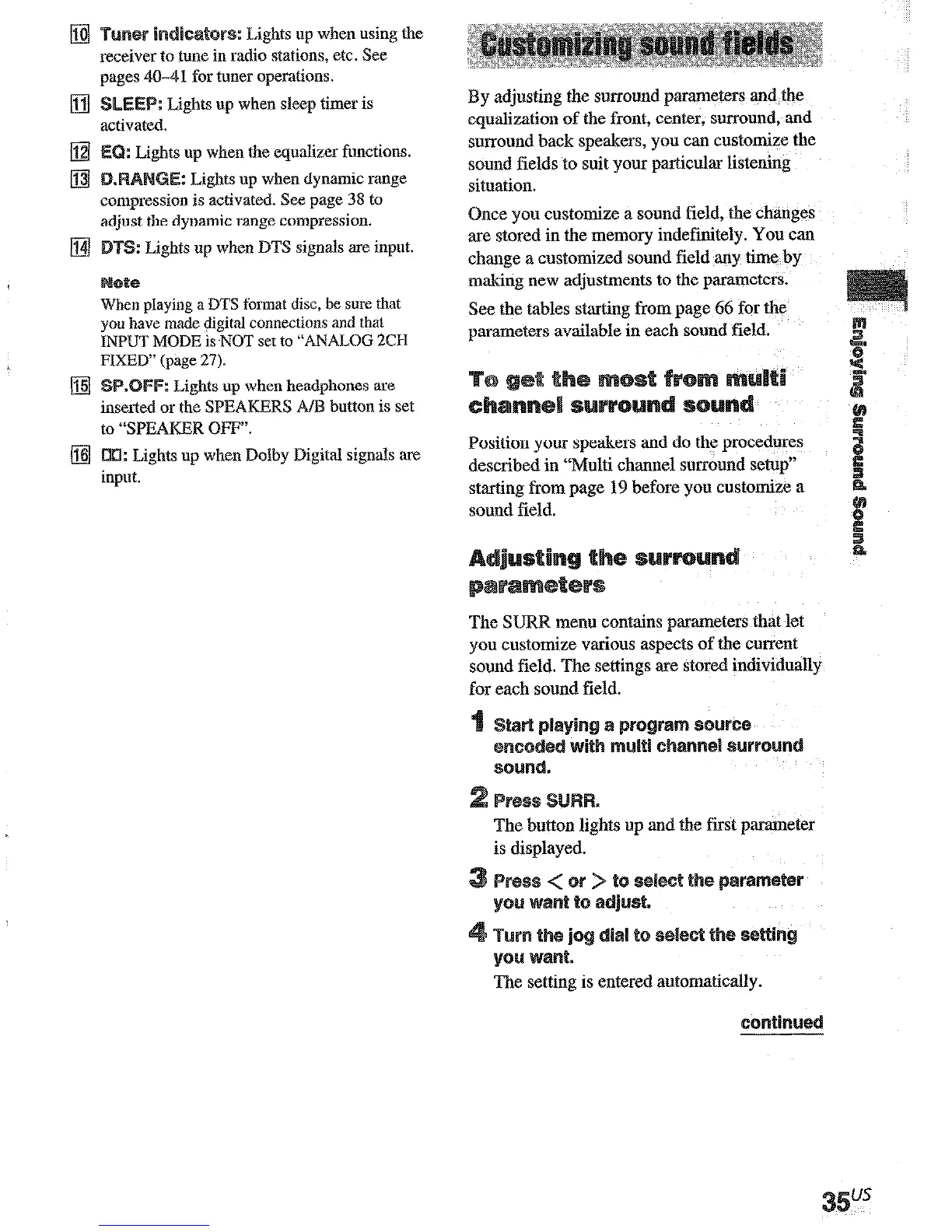
By adjusting the surround parameters and the
equalization of the front, center, surround, and
surround back speakers, you can customize the
sound iields to suit your particular listening
situation.
Once you customize a sound field, the changes
are stored in the memory indefinitely. You can
change a customized sound field any time by
making new adjustments to the parameters.
See the tables starting from page 66 for the
parameters available in each sound field.
Position your speakers and do the procedures
described in “h4ulti channel surround setup”
starting from page 19 before you customize a
sound field.
The SURR menu contains parameters that let
you customize various aspects of the current
sound
field. The settings are stored in~vidually
for each sound field.
The button lights up and the first parameter
e setting is entered automatically.





 To Next Page