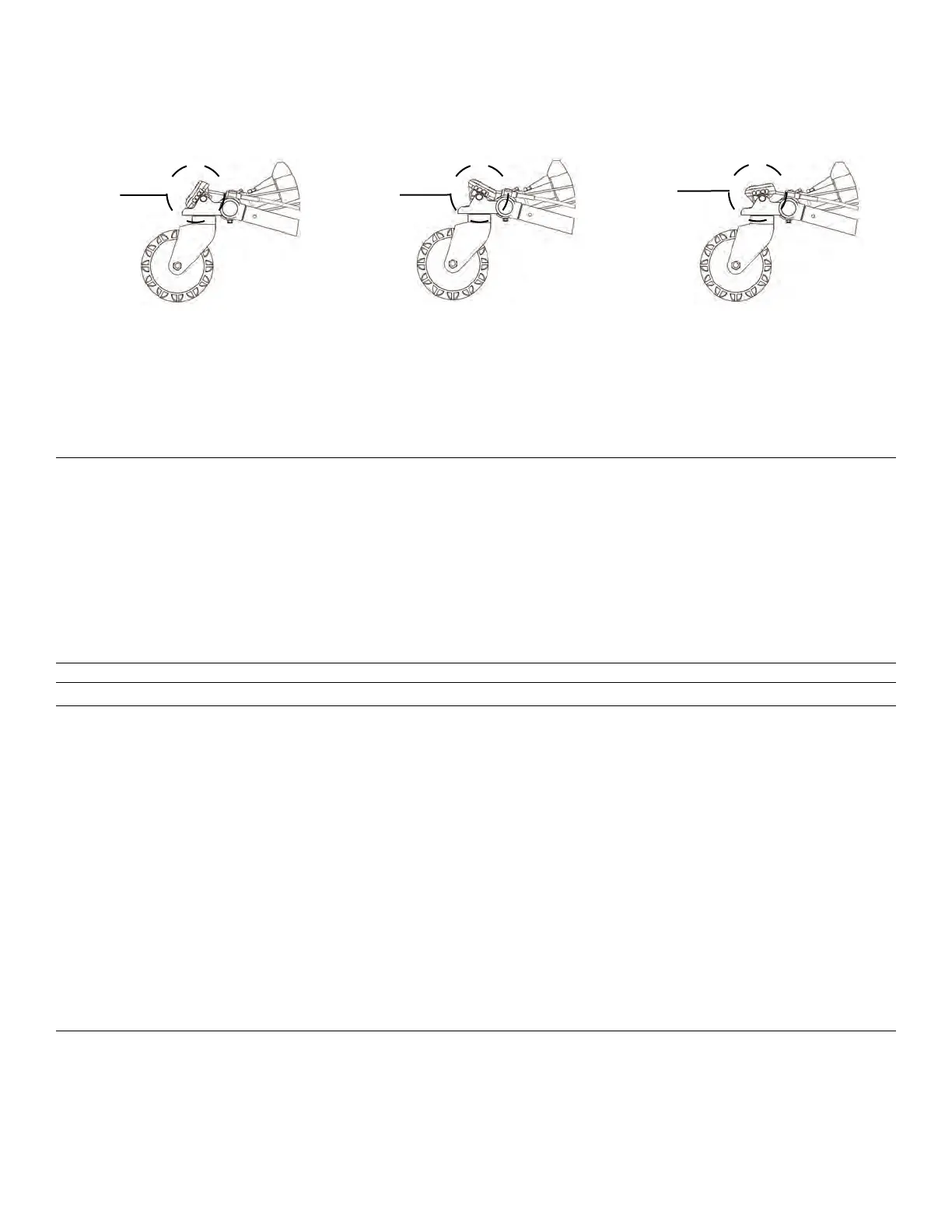
To release a wheel lock or SStteeeerr--LLoocckk (C), press down on the top of the pedal with your foot or lift up on the pedal with your
toe. The top of the pedal will rest against the caster frame when you release the wheel lock or SStteeeerr--LLoocckk (Figure 13).
NNoottee -- You can apply a wheel lock or SStteeeerr--LLoocckk from the head end or foot end of the cot.
FFiigguurree 1111 –– WWhheeeell lloocckk oonn
FFiigguurree 1122 –– SStteeeerr--LLoocckk oonn
FFiigguurree 1133 –– WWhheeeell lloocckk aanndd SStteeeerr--
LLoocckk ooffff
RRoolllliinngg tthhee ccoott wwiitthh aa ppaattiieenntt
WWAARRNNIINNGG
• Always transport the cot at transport height or the lowest possible height to reduce the risk of a cot tip. If possible, obtain
additional assistance or take an alternate route.
• Always avoid high obstacles, such as curbs, steps, or rough terrain to avoid the risk of a cot tip or injury.
• Always center the patient and equipment or accessories. Lock adjustable features and intended lift points before you
transport a patient on the product.
• Do not apply a wheel lock when a patient is on the product or when you move the product to avoid the risk of a cot tip or
injury.
• Always use the specified push/pull locations to reduce the risk of a cot tip or injury.
• Always stow and latch the transport handle before you load, unload, or use the transport handle to lift the cot.
CCAAUUTTIIOONN -- Do not use siderails as a patient restraint device.
To roll the cot with a patient:
1. Press the release or transport height button.
NNoottee
• For patients who weigh 500 lb (227 kg) or less, use the transport height feature.
• For patients who weigh more than 500 lb (227 kg), transport at the lowest possible height.
2. Position one operator at the foot end and one operator at the head end of the cot.
3. Apply SStteeeerr--LLoocckk (see
Applying or releasing a wheel lock or Steer-Lock
(page 29)).
4. Check that the litter is perpendicular when you approach door sills or other low obstacles.
5. Lift each set of transport wheels over the door sill or obstacle separately.
PPuusshhiinngg oorr ppuulllliinngg tthhee ccoott wwiitthh tthhee ttrraannssppoorrtt hhaannddllee
WWAARRNNIINNGG
• Always transport the cot at transport height or the lowest possible height to reduce the risk of a cot tip. If possible, obtain
additional assistance or take an alternate route.
• Always avoid high obstacles, such as curbs, steps, or rough terrain to avoid the risk of a cot tip or injury.
EN 30 6507-009-001 Rev AB.3




 To Next Page