10 TEGAM WAY • GENEVA, OHIO 44041 • 440-466-6100 • FAX 440-466-6110 • sales@tegam.com
3-2
The 1750 factory settings are usually adequate to meet the needs of most manual, low inductance,
resistance measurement applications. However, in high-speed, automated resistance measurement, it
is often desirable to optimize the instruments settings to obtain the highest accuracy and throughput.
For this reason, the Model 1750 offers 13 user-defined test parameters. In-depth information for any
of these Setup options may be found in Section 4, Operating Instructions. Before changing any of these
factory default settings, it is highly recommended that Section 4 is thoroughly reviewed and understood.
Special attention should be directed toward allowing adequate settling times for high resistance
measurement applications and defining the proper reference current in fuse testing applications.
The front keypad is setup for maximum functionality. Each key has multiple functions assigned to it.
These functions are labeled according to their primary and secondary functions. To access the Setup
options, simply press the [MENU] button on the front panel. The message “
Menu Number?” will
appear on the screen. From this display, you can access any of the 11 menu options labeled with teal
text located below the key. Pressing any of these buttons will allow you to access the instrument’s Sub-
Menu for entering custom settings. You can modify instrument Sub-settings by either pressing the [▲]
or [▼] scroll keys or by manually entering a numeric value.
See Section 4 for an in depth description of the keypad functionality and how to store and recall custom
settings.
TEST LEAD REQUIREMENTS
The Model 1750 microohmmeter measures resistance by using the four-wire Kelvin technique. This type
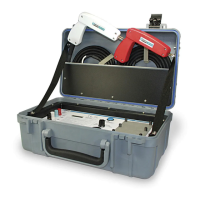
of measurement virtually eliminates lead resistance error. A set of Kelvin Klip™ leads or Spade Lug
Adapters are supplied with the new instrument. In addition, optional sorting fixture or Kelvin Probes
are available. These accessories are designed to function with the Model 1750 in all operating currents
and ranges.
In certain applications, the need arises for a custom assembled test connection or fixture. When
constructing a solution of this type, detail has to be directed towards the maximum allowable series
lead resistance. There is a specific series lead resistance limit established for each current range. If
these limits are exceeded, a significant amount of error may be introduced into the measurement.
Detailed information on Kelvin-type measurements and lead resistance error may be found in Section
1 under the “Test Lead Requirements” section. See Table 1.7 for maximum allowable series lead
resistances.
MEASURING RESISTANCES LARGER THAN 200KΩ
For stable resistance measurements on resistances greater than 200 kΩ, it is recommended that the
GUARD terminal on the rear panel be connected to the DUT test fixture GROUND terminal. The actual
resistance being measured should be shielded within a grounded test fixture.
If it is unknown whether the test circuit is inductive or capacitive in nature, the delay time should be
set to a minimum of 100mS in order to allow adequate measurement settling time. This settling time
should be increased as the measured resistance value is increased.


 To Next Page