EN
19
2.12.3 Refs. 769501-769502 WI-FI Antennas
The ONT provides a MIMO 2x2 topology Wireless antenna capability.
The ONT has internal, Omni-directional antennas with a gain of 1.6dBi.
2.13 Multiple QoS per VLAN
The Refs. 769501-769502 supports 802.1p QoS per VLAN services in which several ows (one per allowed pbit) are embedded in the same VLAN.
According to the applied conguration, the Refs. 769501-769502 performs a per-ow QoS policy: dropping trac marked with not allowed pbits
and limiting to the congured value the data rate of the allowed ows.
The Refs. 769501-769502 performs transparent VLAN translation. It is transparent to upper layer protocols, such as ARP, RIP, DHCP, IGMP, PPP, etc.
2.14 Policing/Rate Limiting
2.14.1 Downstream QoS
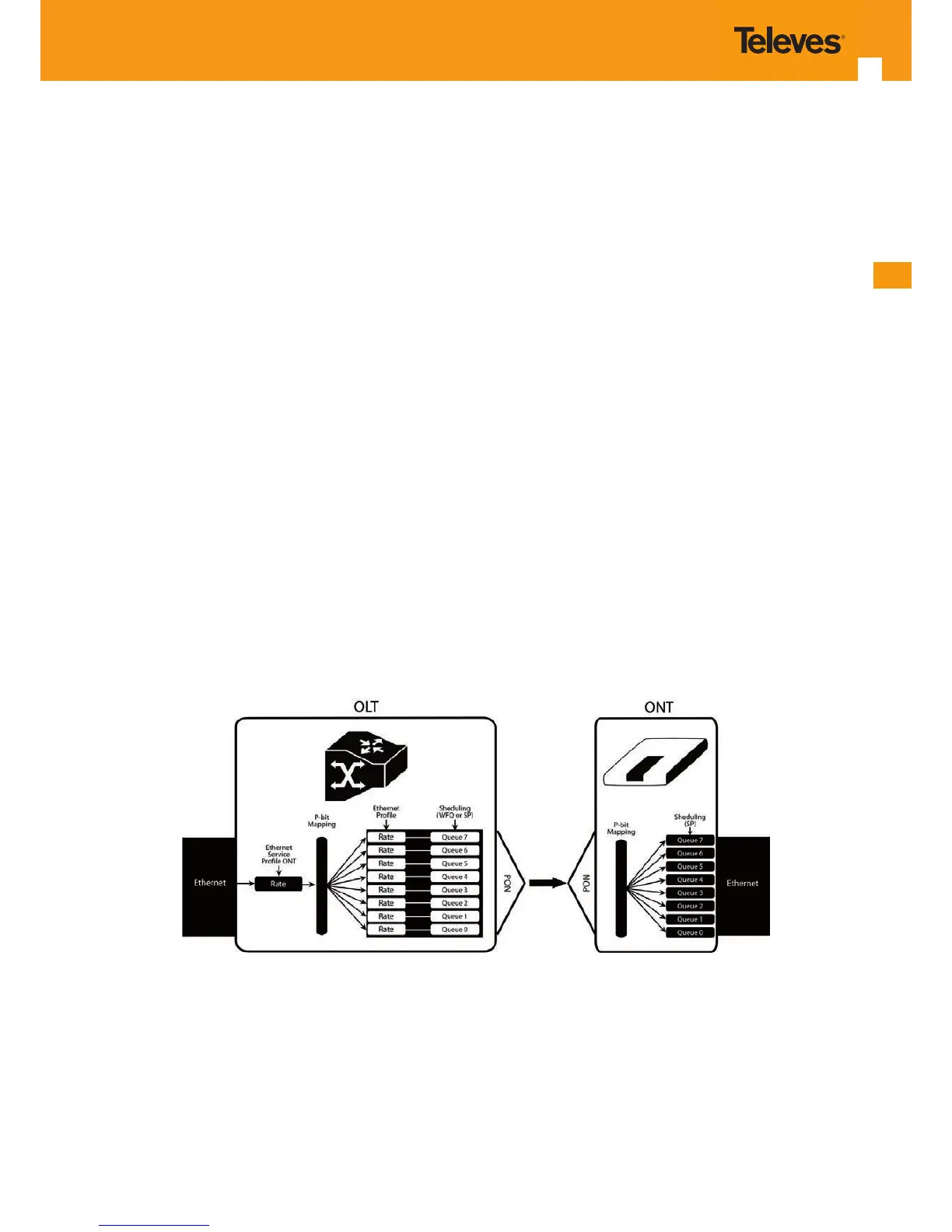
The OLT system provides several QoS mechanisms, that can be targeted to the ow characterized by one or two VLAN according with the type of
service, or can be targeted to the packets priority, where each p-bit is mapped in one of eight queues of each port.
For each OLT ports are associated eight queues, for each of these queues is possible to congure the p-bit mapping in one of the queues, the
scheduler type (Strict Priority or Weighted Fair Queuing) and the minimum and maximum bandwidth of each queue.
In the downstream direction the ingress trac rst passes by a policer congured to each ONT service, which is dened by one or two tags. After
this the trac is put in a queue according with the p-bit/queue mapping. Each of these queues is associated with a scheduler and a policer. Then
the trac ows to the GPON interface and when it arrives to the ONT it will pass by a mapping block which will map the trac in one of the eight
queues according with the p-bits, these queues have a Strict Priority scheduler in order to guarantee that the most prioritized trac passes rst.
Figure 2-10: Downstream QoS Diagram
2.14.2 Upstream QoS
In the upstream direction, for each T-CONT the ingress trac in the ONT passes by a mapping block that maps the trac in one of the eight queues
according with the p-bit, these queues have a Strict Priority Scheduler. The ONT “waits” until the OLT assigns a transmission timeslot for that T-
CONT, so that the most prioritized queues are the ones that transmit rst. In the OLT ingress, the trac is put into a queue according with what
is dened in the queue/p-bit mapping. Each of these queues has an associated scheduler and policer that control the trac sent to the uplink.


 To Next Page