28
GPON ONT
3.4 Optical metering
The equipment measures the downstream received power from the OLT in 1490nm and reports this value through OMCI. The accuracy of the
measurement is +/- 3dBm, maximum. Optionally, Refs. 769501-769502 has also the chance to have an embeded optical reective component
in order to increase the FTTH probing capabilities in a 50 centimeters resolution factor, which turns to have a single probing system to probe all
GPON network ONTs even when its number increases over Million customers.
3.5 Wavelength ltering
The optical interface has WDM lters that allow GPON coexistence with RF video services (1550-1560nm) and the new generation of NGPON1
technology, according to G.984.5 Recommendation.
ITU-T Rec. G987.1 is also granted for XGPON, (following FSAN NG-PON2).
In order to face the nal user´s demands, current GPON networks have to confront the rst evolution in terms of terminal equipments and actual
infrastructure. Migration will be available through a new wavelength planning, by allowing the co-existence of two dierent technologies over
the same ber. The ITU-T Rec. G987.1 provides a mechanism for GPON to XGPON migration with the possibility to achieve 2.5Gbps upstream path.
Nominally downstream will be 10 Gbps.
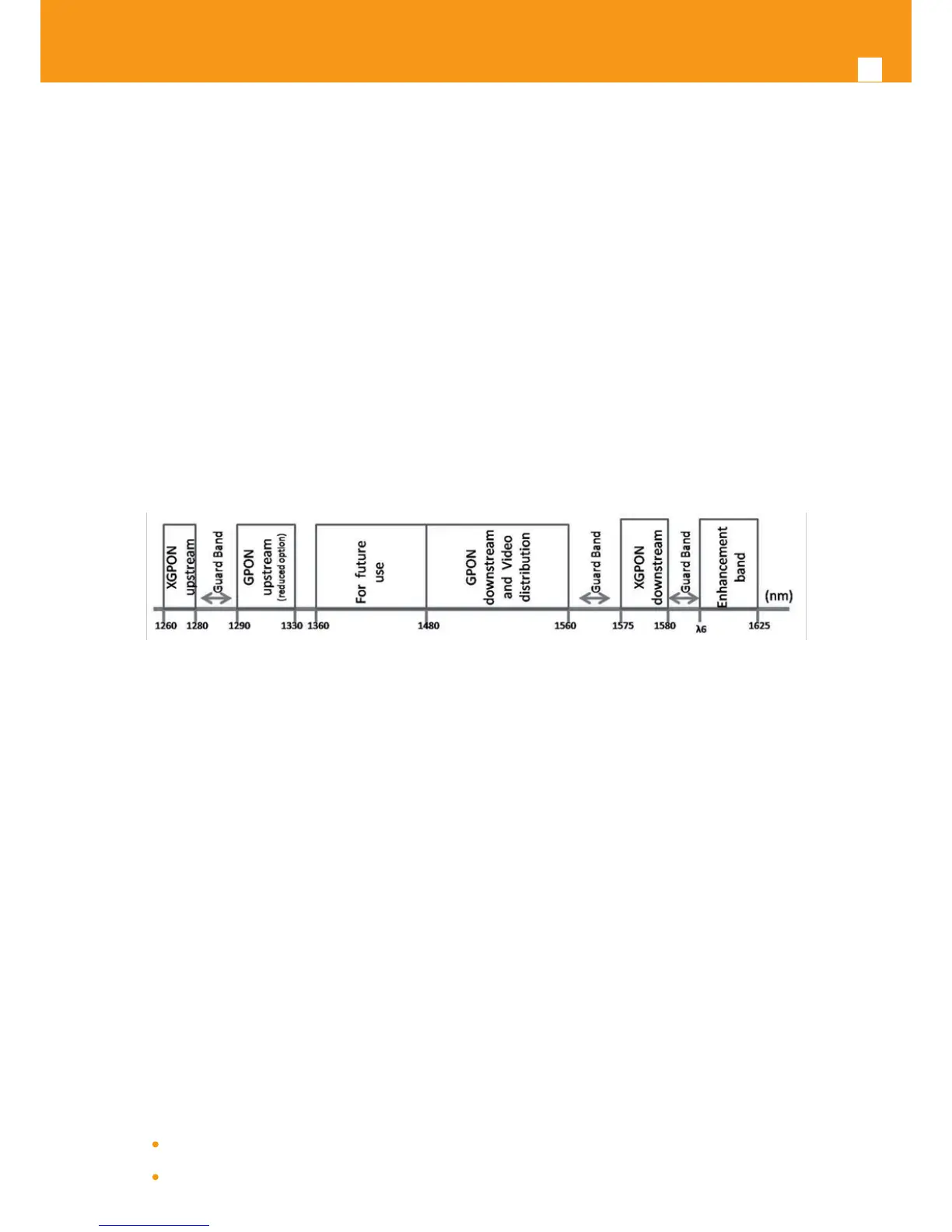
The next gure depicts the wavelength planning of ITU-T Rec. G987.1:
Figure 3-1: Wavelength planning
In order to accomplish to that plan, the upstream wavelength for GPON must be restricted to ONU (ONT) equipment based on the ordinary DFB
lasers, while the XGPON downstream signal range is dened from 1575 nm to 1580 nm and the XGPON upstream signal from 1260 nm to 1280
nm. For the coexistence of XGPON and GPON over the same ber, the CO requires a WDM lter that combines the downstream signal (1490 nm,
1555 nm and 1577 nm), isolating the 1310 nm and 1270 nm upstream signal, with the video signal. Also the wavelength of 1650 nm, used for ber
monitoring, has to be handled.
In addition, ONT devices require the use of a triplexer type transceiver that include an integrated lter or a discrete WDM lter to distinguish the
dierent signals that may be present on the ber. The current networks, equipped with ONT in accordance with the current ITU-T Rec. G984.5, will
be easily updated to XGPON.
Class B+ optical budget are the nominal requirement for coexistence of GPON and XGPON over the same optical ber. Taking this requirement
into account, the ber network architecture will not limit the future of the service provider business since GPON architectures, respecting B+ class
of the GPON, are easily updated by placing newest terminal equipments, namely XOLT and XONT, and by replacing the current WDM lter by the
new one in order to handle the new XGPON signals.
XGPON must support/emulate all GPON legacy services in case of total migration.
Like GPON, XGPON is required to support triple play services (data, voice and video), as well as mobile backhauling (accurate frequency/phase/
time synchronization) application through its high quality of service and high bit rate feature capabilities. Access to Ethernet services such as
point-to-point, multipoint-to-multipoint and rooted-multipoint Ethernet Virtual Connection services should be provided. Finally, as a global re-
quirement, XG-PON needs to support IPv6.
3.6 GPON/Ethernet characteristics
GPON/Ethernet characteristics supported, both functional level and GTC-OMCI conguration, corresponds with the general mandatory character-
istics dened in ITU-T G.984.3, G.984.4 and G.988 Recommendation:
PON interface: downstream operating rate 2.488 Gbits/s, upstream operating rate 1.244 Gbits/s;
32 T-CONT and 256 simultaneous GEM ports;


 To Next Page