Specifications and Requirements
43-06955 - Rev Q Page 17
Communications Interface
RS-232 Serial Interface
Serial Port Features
The serial port features are as follows:
Baud Rates 300, 600, 1200, 2400, 4800, 9600, 19.2K, 38.4K, and 57.6K
Bit Patterns 8-bit no parity; 8-bit odd; 8-bit even; 7-bit no parity; 7-bit odd;
7-bit even
Flow Control DTR and XON/XOFF
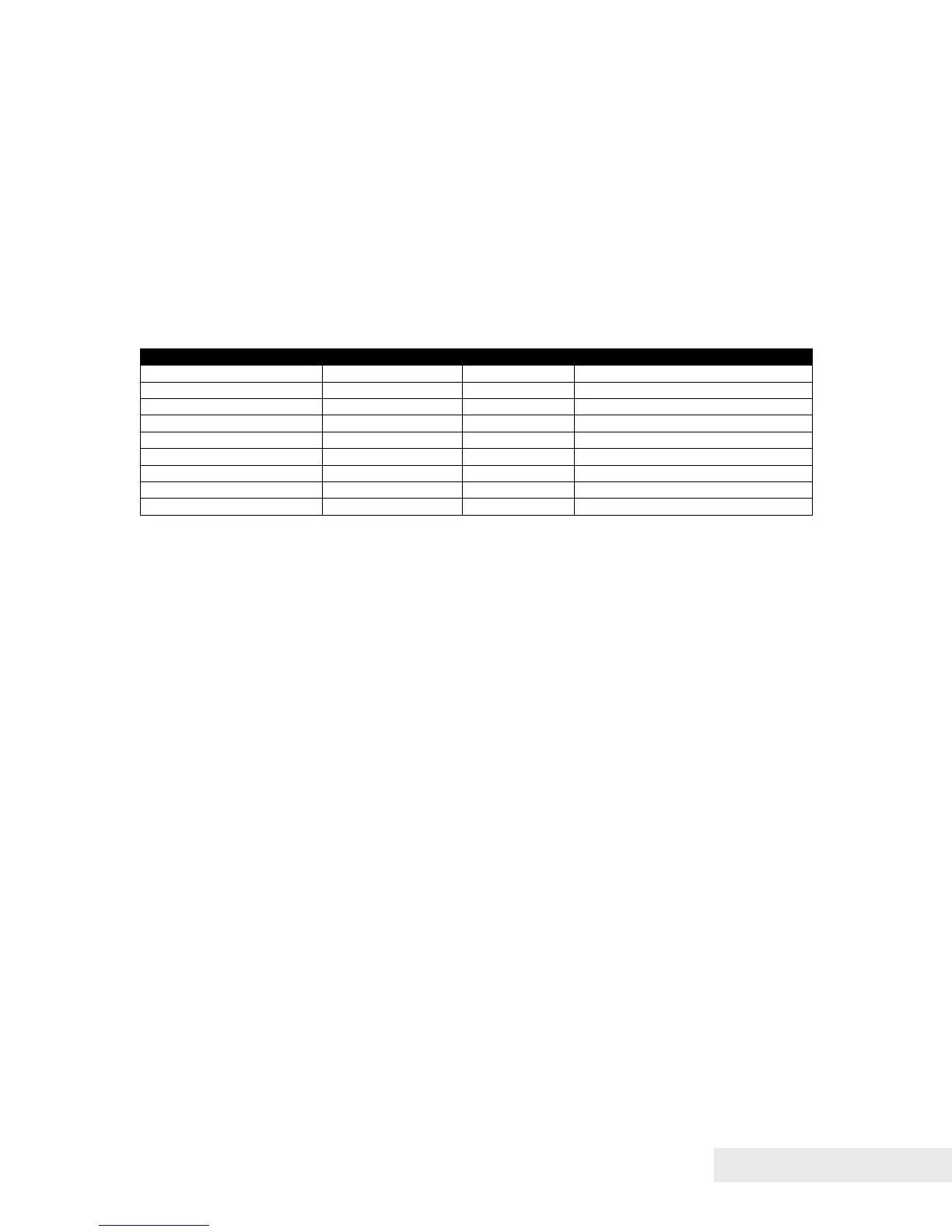
Table 1 Serial Interface Pin-outs
Signal Voltage and Current levels
The serial interface meets EIA RS232 interface specifications:
Voltage Levels Max +-15 Volts
Min +- 3 Volts
Mark = Off = -3 to –15 Volts
Space = On = +3 to +15 Volts
Because both the host and printer are DTE's (Data Terminal Equipment), they
use the same serial port pin-outs. If the cable that is used to connect the host
to the printer is a pin-to-pin inter-connect, it will not work. Therefore, a null
modem or turn-around cable must be used to interconnect the host and the
printer.
USB Interface
The USB interface is a Version 1.1 interface that is Version 2.0 compliant.
The standard USB interface is implemented through a Standard Series "B"
Receptacle as defined in the USB Specification. The does not draw power
from the standard type B USB interface cable but from a separate power
supply cable.
The Standard USB Type B connector has the following pin functions:
Pin Signal
1 Vbus (+5 V dc) (Not used in the POSjet
®
1000)
2 Minus data
3 Plus data
4 Ground


 To Next Page