Minimum cable cross-sectional area ≥6mm
2
Minimum MCB specification ≥63A
The length of the cable connected inside the cabinet is about 0.6m
2.1.4 Personnel
The construction personnel must have basic safety operation knowledge and must be professionally trained to
master the correct operation method. The construction personnel must pass the startup and debugging certification of
Vertiv small UPS DPG\air-conditioner and have a certificate.
Notices
Vertiv does not assume any responsibility for damage to individuals and equipment caused by the construction personnel who
obtained the above certification.
2.2 Equipment Installation
2.2.1 Moving and Handling
Transportation
When transporting cabinet components, air conditioner indoor units and outdoor units, it is recommended to choose
rail transportation or shipping. If you choose to transport by a vehicle, you should choose a road with better road
conditions to prevent excessive bumps.
Moving and Handling
The user needs to transport the cabinet, air conditioner and components to the nearest location to the installation
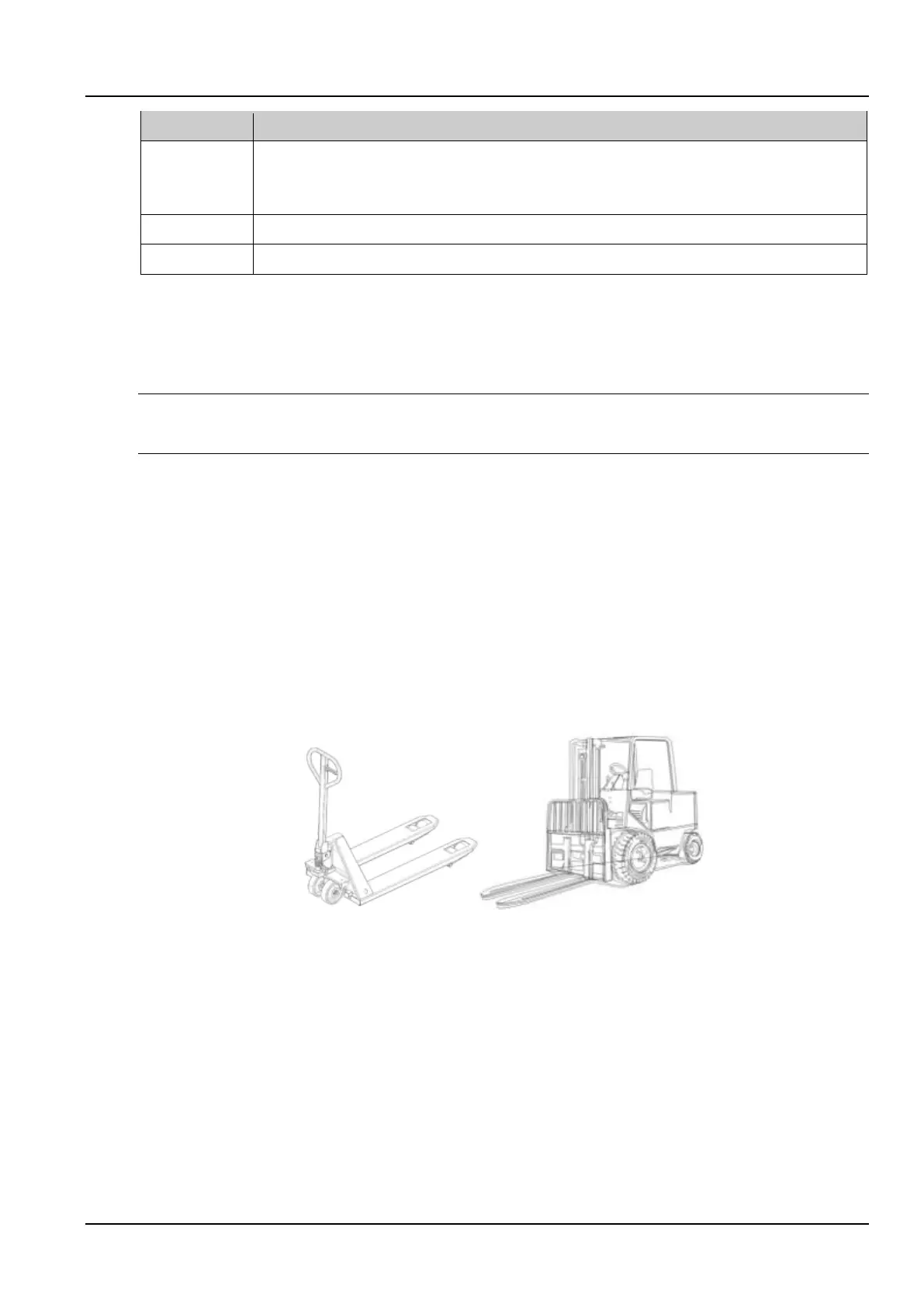
site. Due to the heavy weight, it is recommended to use mechanical handling tools, such as pallet trucks (commonly
known as “land cows”) or electric forklifts, as shown in Figure 2-2.
Figure 2-2 Hand Pallet Truck & an Electric Forklift
When unloading and transporting with “land cow” or electric forklifts, it is recommended that the fork is at the center of
gravity to prevent tipping, as shown in the Figure 2-3.



 To Next Page