13
3.2 Component function description
Filter with manometer:
First 1µ lter, is to ensure ltration of particles that can have an adverse eect on our operating components and to help extend the lifetime and
operational stability of the entire system.
The manometer is to monitor the supply pressure at full load.
Softener:
Hard water is softened by removing the calcium, magnesium and dissolved Iron it contains. When hard water passes through the softening system
resin bed, the calcium and magnesium (hardness) ions are removed through an ion exchanger process, so only softened water passes through.
Once the resin bed lls up with hardness ions, it must be regenerated (cleaned). Salt is used in the regeneration process and restores the resin to a
clean state so the process can begin again.
All our softening systems are double system, so it can provide you with soft water at all time.
Carbon lter:
The main purpose is to remove chlorine from the supply water, due to it´s harmful eect on the RO-membranes, and to remove odor.
Second lter:
Second lter is to prevent bigger particles to pass on to the highpressure system or to the RO, in case of failure on prelter, carbon or softener.
When looking at the color of this lter during service, it also gives good indication if the interval for prelter change should be increase.
RO (Reverse Osmosis):
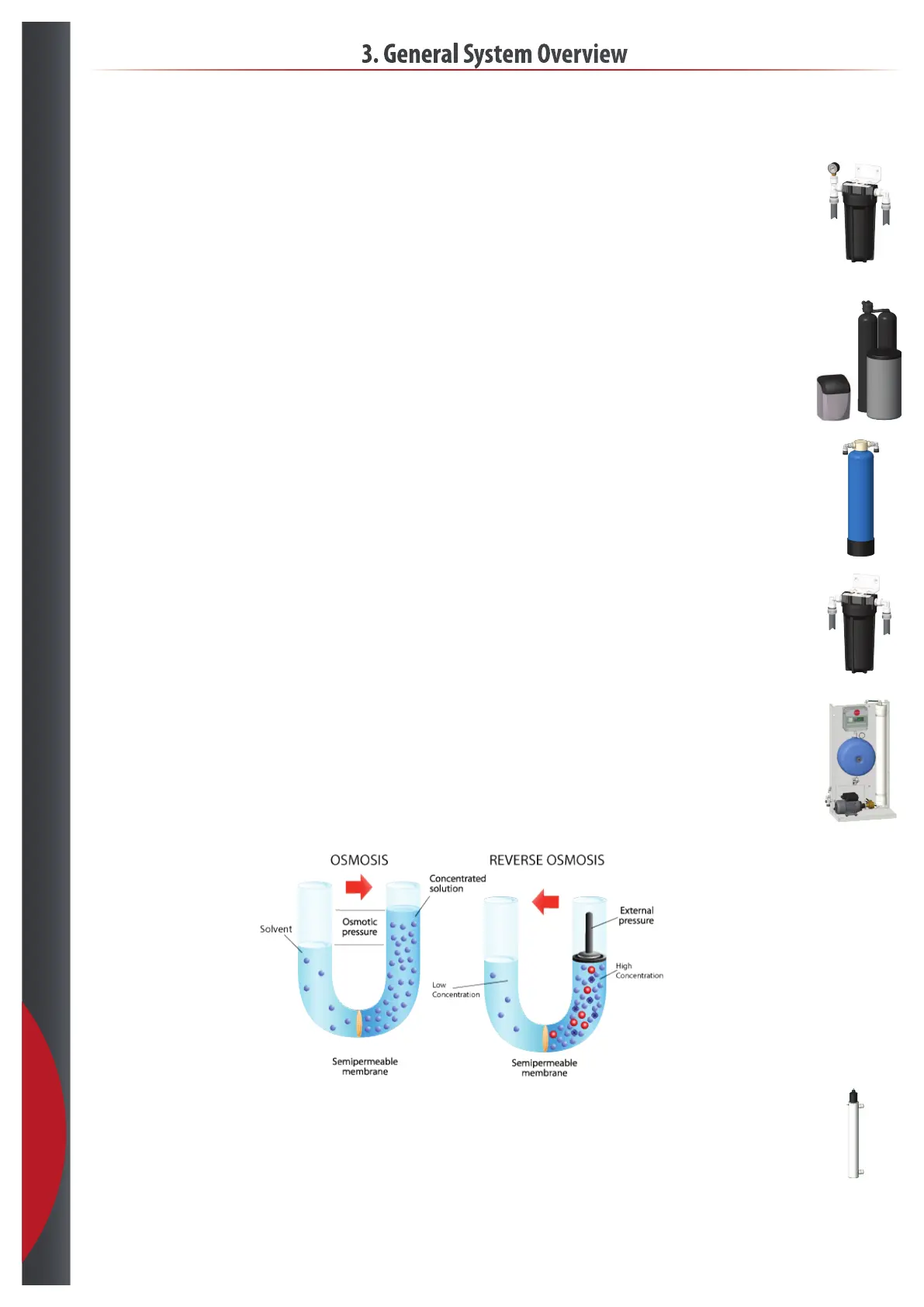
Reverse osmosis water purication is capable of removing dissolved salts, and up to 98 % of all solids, bio soil, viruses and bacteria.
Reverse osmosis is a demineralization process of water that relies on a semipermeable membrane to eect the separation of dissolved solids.
Pressure higher than the osmotic pressure, is applied on the water that contains the high-concentrate solution and the water is forced through a
membrane to the oppsite side with the low-concentration solution.
UV:
When the UVC rays hit the microorganisms and penetrate the cell, the DNA is destroyed in the cells and prevents the cell’s ability to reproduce. This
prevents the cell from multiplying itself to an infection in a host. It also prevent groth of biolm.
3. General System Overview
201218



 To Next Page