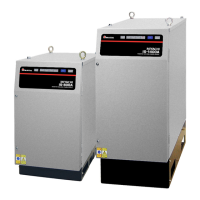
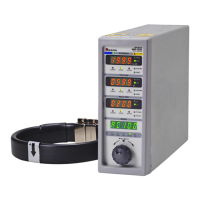
IS-300A
4. How to Operate Screens
4-8
(Note) Control method of the inverter-type welding power supply
Control
method
Feature Application Control mechanism
Primary
constant-current
control
(PWM effective
value control)
Requires no connection
of toroidal coil on the
secondary side of the
transformer. Requires
turn ratio setting of the
inverter-type transformer.
The loss inside the
transformer is not
considered.
Used for welding in
a robot or an
environment where
the weld head
moves and that
causes
disconnection of
toroidal coil and
cable.
Detects the primary current by
the current sensor mounted
into the power supply to
compare the measured current
obtained by calculating with
each control frequency to the
primary current obtained by
“set current ÷ turn ratio”, and
controls pulse width so that
there is no difference in these
values.
Secondary
constant-current
control
(PWM effective
value control)
Compared to the primary
constant-current control,
the current accuracy is
high since the welding is
directly controlled, being
detecting the welding
current.
Commonly used for
general welding.
Detects the welding current
with toroidal coil to compare
the measured current obtained
by calculating with each control
frequency to the set current,
and controls pulse width so
that there is no difference in
these values.
Secondary
constant-power
control
(PWM effective
value control)*
Controls so that the
power between
electrodes becomes
constant.
Responds to change in
workpiece state during
welding to make heat
input constant.
Used when you
want to reduce
explosion in early
welding, shunt
current is occurred
at welding, or make
heat generation
constant.
Detects the welding current
with toroidal coil and the
voltage between electrodes
with the voltage detecting cable
to compare the power
calculated by the measured
current obtained by calculating
with each control frequency
and voltage to the set current,
and controls pulse width so
that there is no difference in
these values.
Primary
constant-current
peak value
control
(PWM peak
value control)
Requires no connection
of toroidal coil on the
secondary side of the
transformer. Requires
turn ratio setting of the
inverter-type transformer.
The loss inside the
transformer is not
considered.
Compared to the
effective value control,
the rise of the current is
fast, but the effective
current changes
depending on how large
the current ripple is.
Used for welding of
coated metal or
dissimilar metal.
Sets the primary current
obtained by the set current and
the transformer turn ratio as
current limiter, and controls
pulse width so that the
switching is turned off when the
primary current detected by the
current sensor mounted into
the power supply has reached
to the current limiter.
Secondary
constant-voltage
control
(PWM effective
value control)
Controls with the voltage
between electrodes.
Provides welding without
expulsion by making
voltage from the rise
constant and reducing
the current.
Used for welding of
high specific
resistance material,
welding of high
contact resistance
workpiece such as
cross wire, and
projection welding,
which has
resistance change
in early welding to
reduce explosion.
Detects the voltage between
electrodes with the voltage
detecting cable to compare the
measured current obtained by
calculating with each control
frequency to the set voltage,
and controls pulse width so
that there is no difference in
these values.


 To Next Page