
 Need help?
Do you have a question about the Applanix POS MV V4 and is the answer not in the manual?
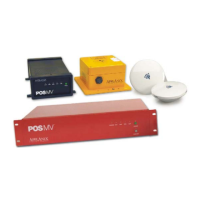
Provides an overview of the POS MV system's components, including PCS, GNSS receivers, and IMU, detailing its models and product family.
Details the two primary operating modes of the POS MV: Standby Mode for initialization and Navigate Mode for active operation.
Describes the three main subsystems: POS Computer System (PCS), Inertial Measurement Unit (IMU), and GNSS receiver cards.
Explains the GAMS subsystem, which uses two GNSS receivers to improve heading measurement accuracy.
Lists advanced functions offered by POS MV, such as motion measurement, TrueHeave, and Ethernet data logging.
Details the MV-POSView Controller program, essential for system configuration and operational monitoring.
Explains crucial handling precautions for IMU, PCS, and GNSS antennas to prevent damage during installation.
Provides instructions for unpacking POS MV components and proper storage procedures to maintain system integrity.
Guides users on preparing the installation site, considering component layout and location for efficient and accurate system setup.
Specifies electrical power requirements and recommends using an Uninterrupted Power Supply (UPS) for clean and reliable power.
Details environmental limitations for GNSS antennas and IMU installation, including temperature, humidity, and immersion ratings.
Describes the POS MV 10/100BaseT Ethernet interface, its four ports, and data transmission protocols (UDP/TCP).
Details the analog interface hardware option for outputting roll, pitch, and heave information to multi-beam sonar equipment.
Explains the five RS-232 serial ports for communication with external equipment and their default configuration settings.
Lists ten NMEA sentence formats available for outputting data, specifying their content and usage.
Describes various output string formats for attitude data using binary formats like TSS1 and Simrad.
Covers serial digital ports for GNSS receivers, providing access for firmware upgrading and configuration.
Provides step-by-step instructions on how to power on the POS MV system and its front/rear panel components.
Details initial considerations for power-on, including AutoStart feature and the necessity of entering installation parameters.
Explains the installation and usage of the MV-POSView Controller program for system configuration and monitoring.
Covers the process of entering physical installation parameters and the automatic fine-tuning of configuration data.
Guides users on consulting installation parameters measured during physical installation for POS MV configuration.
Details initial configuration steps, including lever arm distances and mounting angles measurement and input.
Explains automatic calibration procedures for GAMS and sensor mounting, emphasizing the Calibration Control window.
Explains the AutoStart feature for enabling standalone operation after power-on without operator intervention.
Details how to configure COM ports for various applications and data formats using the MV-POSView software.
Describes how to adjust heave filter characteristics, such as bandwidth and damping ratio, for optimal heave measurement performance.
Covers GNSS receiver configuration and automatic reconfiguration features, including setting Auto Configuration status.
Explains how to save POS MV parameters to Non-Volatile Memory (NVM) for persistence across power cycles.
Describes the password protection feature to secure critical settings from unauthorized access, including default password and operation.
Details the MV-POSView Controller program's interface and how to use it to operate the POS MV system.
Explains the two operating modes: Monitor mode for data viewing and Control mode for system configuration and saving.
Discusses the MV-POSView Controller's connection to the PCS via Ethernet, including IP address selection and connection status.
Describes how to monitor the POS MV system's status and data through the controller's main window.
Details the different regions of the MV-POSView Controller main window: Title, Menu, Tool, POS MV Status, and Status bar.
Explains the POS MV status display, including POS Mode, IMU Status, Nav Status, and GAMS status.
Provides information on POS MV status, including operational modes, IMU status, GNSS reception quality, and GAMS status.
Displays angles of roll, pitch, and heading in degrees, along with their estimated accuracy boundaries.
Shows latitude, longitude, and altitude solutions in degrees and metres, referenced to the WGS-84 ellipsoid.
Displays velocities in longitudinal, lateral, and downward components in metres per second, along with accuracy estimates.
Displays vessel dynamics such as angular rates and linear accelerations in degrees per second and m/s².
Provides visual indication of measurement accuracy thresholds using colored lights for Attitude, Heading, Position, and Velocity.
Explains how to access the Fault Detection window and Message Log for system diagnostics and fault identification.
Introduces TrueHeave as an advanced heave filter solution that provides a zero phase response across a specific frequency range.
Provides a step-by-step procedure to enable the TrueHeave feature, ensuring user accuracy values are acceptable.
Explains how POS MV configures GNSS receivers and how to send configuration messages manually via Tools, Configure GNSS.
Describes how to send a reset command to GNSS receivers as a troubleshooting step for inexplicable behavior.
Covers control and display diagnostic functions for system debugging and parameter selection, providing a debugging function.
Explains how to enter and enable diagnostic values for digital or analog ports, which replace real-time attitude information.
Allows operators to view selected POS MV real-time internal data for debugging system problems, organized by subsystem.
Provides important maintenance procedures for subassemblies and components, emphasizing qualified personnel and intervals.
Details maintenance procedures for the IMU, emphasizing care, cable checks, and handling precautions to prevent damage.
Outlines maintenance procedures for GNSS antennas, including cleaning, inspection, and warnings about signal attenuation.
Refers to Technical Support and Service information and procedures for obtaining assistance.
Lists the subsystem components of POS MV: Inertial Measurement Unit (IMU), POS Computer System (PCS), and GNSS antennas.
Explains how POS MV uses FDIR for fault detection and how front panel lights and controller program indicate issues.
Details procedures for removing and replacing system components like IMU, GNSS Antenna, and POS Computer System.
Covers categories of system failure, including total system failure, initialization failure, and communication problems.
 General
| Data Rate | 200 Hz |
|---|---|
| Input Voltage | 10-36 V DC |
| Operating Temperature | -20°C to +55°C |
| Storage Temperature | -40°C to +70°C |
| Waterproof | IP67 |
| GNSS | Dual-frequency GPS, GLONASS, BeiDou, Galileo |
| Position Accuracy | 0.02 m RMS |
| Velocity Accuracy | 0.01 m/s |
| Heading Accuracy | 0.02° RMS |
| Roll Accuracy | 0.01° |
| Pitch Accuracy | 0.01° |
| Heave Accuracy | 5 cm or 5% of measured heave (whichever is greater) |
| Latency | < 1 ms |
| Enclosure | Aluminum |
| Interfaces | Ethernet, RS-232, CAN, USB |
| Integration | Compatible with Applanix POSPac software and third-party systems |

 To Next Page
