ATI Series D12 Toxic Gas Transmitter with H10 Smart Sensor
Revision N (7/15) 13
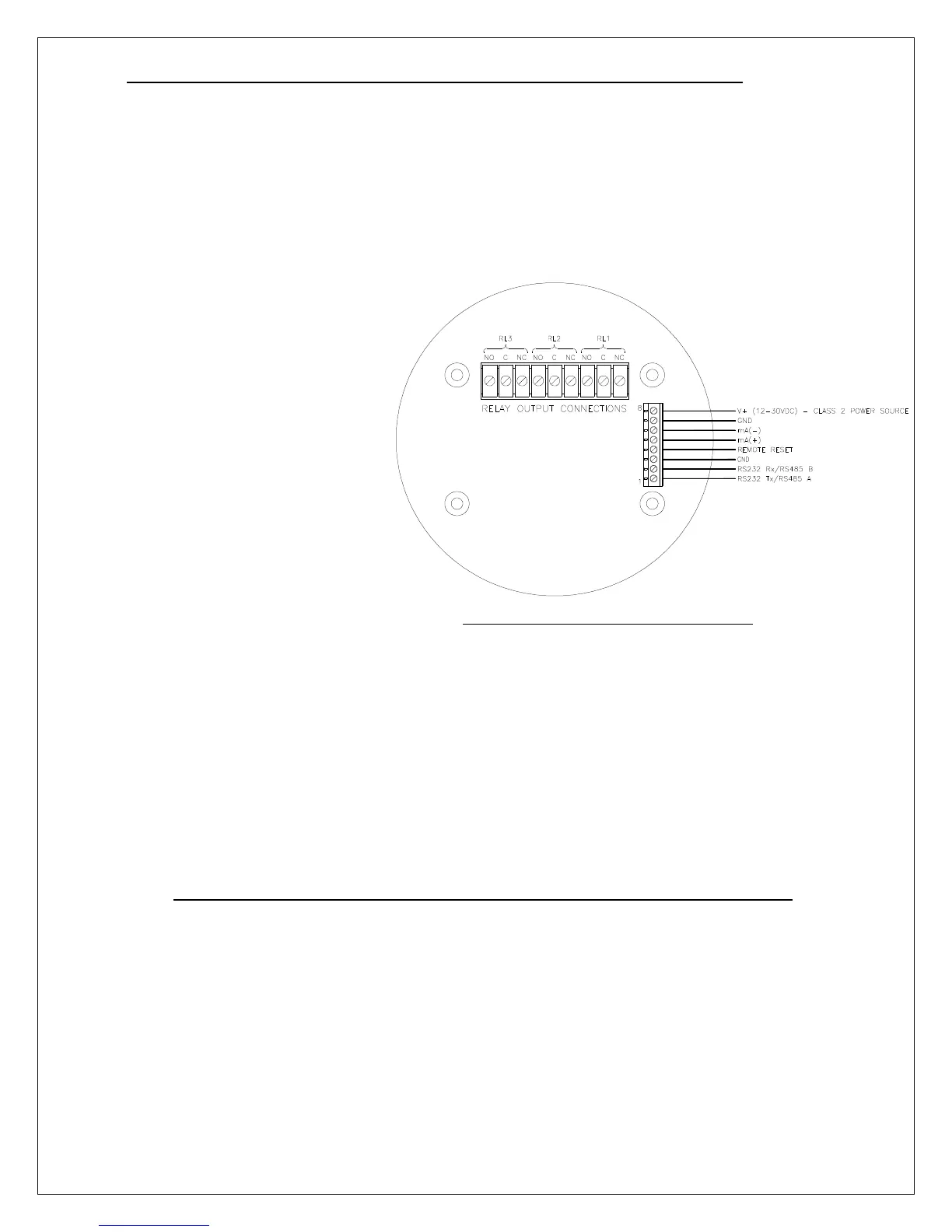
Power Supply Board Connections
Electrical connections are made to terminal blocks on the Power Supply board. Power, current loop,
(optional) digital communications, and remote alarm reset, are connected at TB1. Connections to the
three (optional) relays are made at TB2.
Current loop operation requires 12-30 VDC power supplied on the mA(+) terminal, from which the
transmitter sources a 4-20mA current loop output signal on the mA(-) terminal. The transmitter can
operate from current loop power alone, but without relays, LCD backlighting, and RS232/RS485
communications.
Loop-powered operation requires a
maximum current of 25 mA, while
transmitters wired in 3-wire mode
will require a maximum of 250
mA, with all relays active. Power
supplies operating multiple units
should be sized for twice the
calculated current requirement to
allow for start-up inrush current
requirements.
Figure 8. Power Supply Board Connections
The transmitter has limited space for wire; therefore, use the smallest gauge wire available that is
compatible with electrical code and current requirements. When powering a group of transmitters in 3-
wire mode from the same power supply, 12 AWG wire is recommended for long runs, with drops of
higher gauge wire to each transmitter.
Internal relays are best used as pilot relays if heavy load switching is desired. Use suitable arc
suppression devices across loads switched through internal relays.
The transmitter housing is normally grounded through explosion proof conduit. In the absence of such
conduit, use a suitable grounding strap to bond the transmitter’s housing to earth ground.
Always follow wiring practices governed by local, state, and national electrical codes.


 To Next Page