ATI Series D12 Toxic Gas Transmitter with H10 Smart Sensor
Revision N (7/15) 5
INTRODUCTION
COMPONENTS
D12 Toxic Transmitter
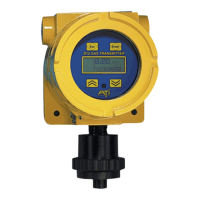
The D12 Toxic Transmitter is used to monitor for gas leaks near storage cylinders, process piping, or
gas feed equipment in virtually any type of industrial plant environment. The transmitter housing is
explosion proof, and is rated for use in hazardous locations (see specifications). The transmitter features
an H10 Smart Sensor, a non-intrusive four button user interface with a back-lighted graphics display,
three level alarm system with three (optional) alarm relays, high-resolution 4-20mA current loop
output, real-time clock, data-logger, and optional HART™ or Modbus™ communication interface. In
addition, the transmitter offers several optional H10 gas generators for automatic, timed testing of H10
sensors.
H10 Smart Sensor and C18 Gas Generator
H10 Smart Sensors and C18 generators contain non-
volatile memory to store information about the target gas
they were designed to monitor, or generate. They contain
general information about the target gas, such as the name,
range, units, alarm settings, along with specific calibration
information, such as response to gas, mA-Hr of usage, and
calibration history. Information is transferred into the
transmitter at startup, and whenever one of the
components is inserted into a live transmitter. Because all
calibration data is stored in the memory, sensor modules
may be calibrated using a spare transmitter in the shop,
and subsequently installed into a field transmitter,
eliminating the need for field calibration.
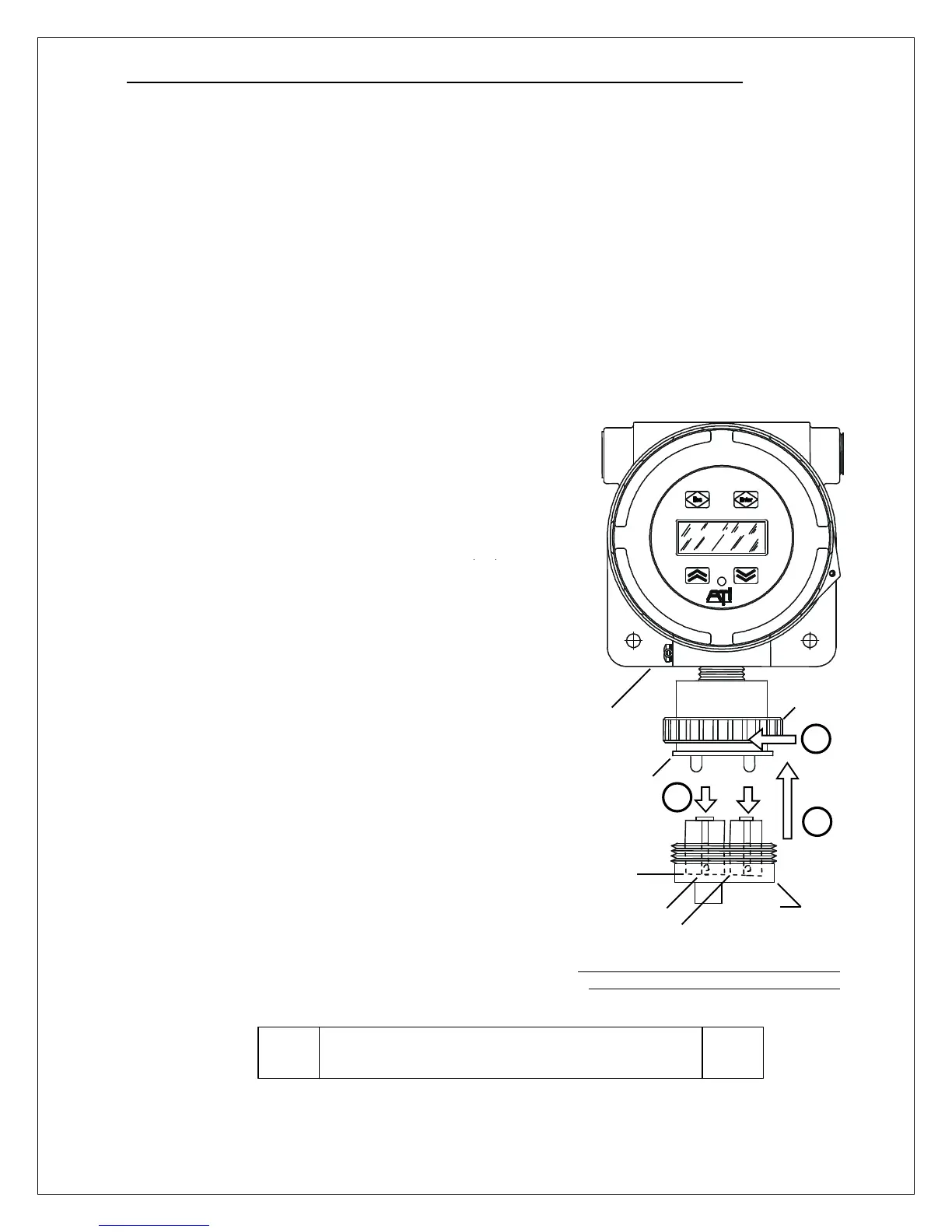
Sensors and generators plug into the external housing at
the base of the transmitter. They are easily removed, and
installation is simplified by way of molded carrier that
aligns each connector for a perfect fit. Once installed, a ¼
turn locking ring secures the carrier in place. Simply
install the sensor and generator into the carrier (1), slide it
onto the alignment pins (2), and twist the ring ¼ turn
counter clockwise (3).
Sensors and generators are designed for use in ambient air
at temperatures of -30° to +60° C, at a relative humidity
between 20 and 98 %RH (some sensors are rated to -40°
C, oxygen sensors are rated to -10° C).
Figure 1. Transmitter, sensor, generator
(carrier shown rotated 90° for clarity).
Operating H10 sensors in extremely dry air or in
condensing gas streams is not recommended.
Carrier
Sensor
Generator
D12
Transmitter
D12 GAS Transmitter


 To Next Page