SECTION 3 OPERATING THE BIS VISTA MONITORING SYSTEM
______________________________________________________________________
3-37
3.10.1 Bispectral Index (BIS)
Range = 0 – 100
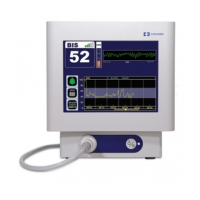
The Bispectral Index is a continuous processed EEG parameter that correlates to the
patient’s level of hypnosis, where 100=awake and 0=flat line EEG. BIS was designed to
correlate with “hypnotic” clinical endpoints (sedation, lack of awareness, and memory) and
to track changes in the effects of anesthetics on the brain. BIS is displayed as a number in
the upper left corner of the screen and is plotted over time on the BIS Trend Graph. When
signal quality is too low to accurately calculate a BIS value, the BIS number is not displayed.
3.10.2 Artifact Detection
The BIS VISTA Monitoring System is designed to provide only highly reliable data. It is
therefore programmed not to display data that has been corrupted by artifact. Artifact bars
appear on the display whenever artifact is detected. In addition, a message appears whenever
the signal cannot be processed due to excessive artifact.
3.10.3 System Self-Checks
The BIS VISTA monitor has several self-checking features to ensure that the system is
operating properly. These include:
System Check
Initiated when the unit is started up, this test makes certain that system software and
hardware components are functioning properly.
Equipment and Connection Checks
The system checks continuously to be sure that the BISx, the PIC, and patient sensors are
operating properly and have not become disconnected.
DSC Self-Test
The DSC Self-Test tests the digital signal acquisition and conversion functions of the BISx.
It is a thorough test of the entire signal processing chain inside the BISx. It does not test the
PIC or sensor. The DSC Self-Test may be initiated in the Diagnostics Menu (see Section 7).
Sensor Integrity Check
This test begins each time that a sensor is connected to the PIC. It checks to make certain
that a valid, unexpired sensor is in use.
Impedance Check (Sensor Check)
Electrode impedance is tested when the BISx and PIC are connected and is monitored
continuously unless the user has turned impedance checking off in the menu system.
Caution:
Continuous impedance checking may need to be disabled if the 1
nanoampere 128 Hz impedance check signal interferes with other
equipment, e.g., evoked potential monitors.


 To Next Page