Developer Information
80
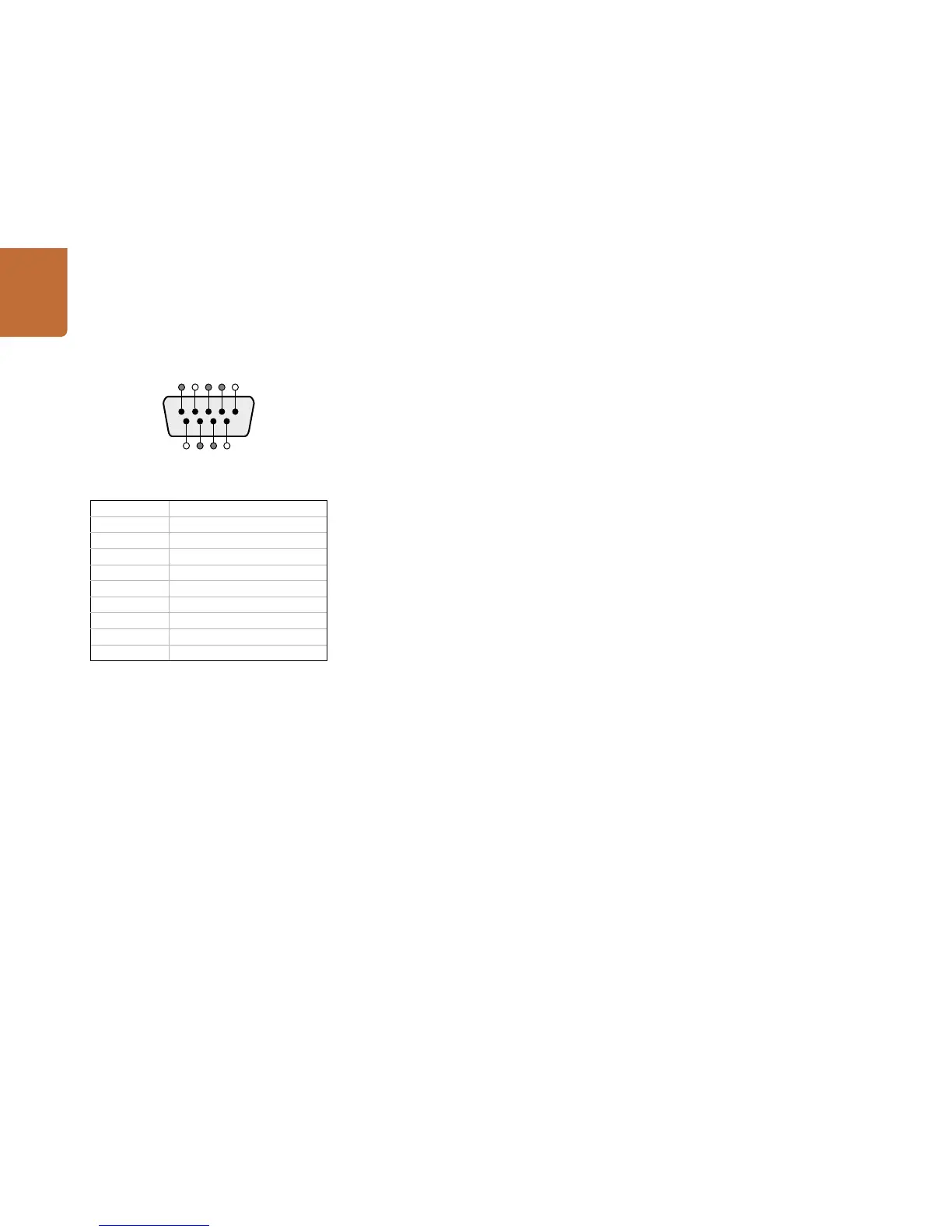
Videohub RS-422 Router Control pin connections.
Pin Function
1 Ground
2 Tx- (Data sent by router)
3 Rx+ (Data received by router)
4 Ground
5 NC (No connect)
6 Ground
7 Tx+ (Data sent by router)
8 Rx- (Data received by router)
9 Ground
Videohub RS-422 Router Control
5 4 3 2 1
9 8 7 6
Videohub RS-422 Protocol
General
The RS-422 protocol can be used to control many Videohub models as RS-422 slave devices, for router
crosspoint switching. This feature is available on any Videohub model with an "RS-422 Control" port.
In "Leitch Server" mode, these Videohub models implement the router (server) side of the Leitch Serial
Pass-Through Protocol as specified in section 4 of Leitch document SPR-MAN revision D. In "Leitch Client"
mode, the Videohub implements the controller (client) side of the Leitch terminal protocol.
This document describes the commands and parameters in the protocol that are relevant and supported
by Videohub. Other commands and parameters specified in the Leitch protocol are accepted but ignored.
The RS-422 serial port is configured as 9600 N81.
The protocol is line-oriented, with a maximum length of 250 characters per command. Each command
from the client should be terminated with a carriage-return (\r). Each response from the server will be
terminated with a carriage-return and line-feed (\r\n).
Sources, destinations and levels are always specified in base-16, numbered from zero. Levels are always
between 0 and 15 (“F”) . Videohubs only have one valid level - level zero.
On connecting to the serial port, the client should send a carriage-return. The Videohub Server will
respond with a > character prompt, which is not followed by a carriage-return or line-feed. Receiving the
prompt indicates that a connection has been established. The same prompt will be issued after each
command received by the Videohub Server.
In the following documentation, commands in orange and values in blue must be typed literally, including
any spaces. In the following example of an immediate command using destination port 7 and source
port 3,
@ X:0/destination,source would be entered as: @ X:0/6,2





 To Next Page