

 Need help?
Do you have a question about the BRP ROTAX 916 i A Series and is the answer not in the manual?
Information provided by BRP-Rotax regarding the manual's purpose and scope.
Describes the manual's structure aligning with GAMA Specification #1.
Explains the purpose of the Operators Manual and its intended audience.
Lists and defines abbreviations and terms used in the manual.
Discusses the importance of reading safety information and applying common workshop rules.
Provides crucial safety guidelines for operating the engine and aircraft.
Details the documents forming instructions for continued airworthiness.
Explains the components of the engine type description.
Explains the importance of the engine serial number when inquiring or ordering parts.
BRP-Rotax reserves the right to modify design, specifications, or features.
Specifications are given in SI metric with US customary equivalents.
Explains symbols used to emphasize important information.
Specifies the intended use of the engine and warnings related to improper application.
Emphasizes the need for qualified pilots, training programs, and engine-specific courses.
Highlights the importance of respecting legal requirements and local rules for flight operations.
Notes that instrumentation is not included in the engine package and requires manufacturer verification.
Stresses the importance of keeping an accurate engine log book and adhering to maintenance schedules.
States that engine servicing must be performed by authorized distributors or certified technicians.
Provides essential guidelines for engine operation, including fluid levels and limits.
Advises against leaving the aircraft unattended with the engine running and securing equipment.
Lists the various documents that form the engine's technical documentation.
Explains how to determine the status of manuals and download current versions.
Notes that single pages can be replaced instead of the entire document.
Explains the components of the engine type designation (e.g., ROTAX 916 iSc 3 A).
Details the operating limits for certified engines, including critical altitude.
Provides guidance on the selection and application of coolant.
Gives instructions for the selection of correct fuel and notes on vapor formation.
Refers to information for selecting suitable lubricants and oil viscosity.
Monitors operating limits, notes not to exceed them, and carry out instructions for abnormal operation.
Specifies the minimum and maximum engine speed limits.
Outlines take-off and continuous performance limits and critical altitude.
Defines the maximum operating altitude and notes on altitude warning lamps.
Defines limits for engine operation at zero gravity and negative "g" conditions.
States the static roll angle limit, warranting lubrication in every flight situation.
Specifies limits for manifold temperature and extended manifold temperature.
Details the impact of extended manifold temperature on power performance.
Provides target manifold pressure at a specific temperature and a "not to exceed" value.
Mentions a boost pressure peak limit at a specific engine speed and duration.
Specifies normal operating oil pressure and limits at cold start.
Lists oil temperature limits at engine start, take-off, and normal operation.
Defines coolant temperature limits at ground idle and normal operation.
States the exhaust gas temperature limit.
Explains EGT-Split and provides limits based on fuel consumption.
Lists ambient temperature limits at ground idle and normal operation.
Specifies fuel pressure limits at the fuel rail and acceptable exceedance.
Describes advantages of conventional coolant mixed with water and its application.
Details abnormal operation related to the Engine Management System (EMS) and warning lamps.
Describes failures of Generator 1 and Generator 2, and their effects.
Explains failures of the 14 V (EMS) and 28 V (AC) output sides of the converter.
Discusses potential breakage or blockage of the throttle valve actuation.
Provides emergency procedures for engine fire or fire in the engine compartment.
Covers insufficient electrical supply and insufficient fuel supply during engine start.
Addresses insufficient electrical or fuel supply and low oil temperature during start.
Explains how to use the electric starter for in-flight engine re-start if windmilling speed is insufficient.
Advises shutting down the engine if the sprag clutch fails to decouple from the starter.
Instructs to adapt engine power settings and enter limit exceedances in the logbook.
Provides guidance on reducing engine power and switching AUX-pump for fuel pressure issues.
Details pilot actions for persistent warning lamps on the ground and in flight.
Explains the function and required actions for the 14 V (EMS) caution lamp.
Describes the function and required actions for the 28 V (AC) caution lamp.
Explains the caution lamp status related to start/backup battery switch activation.
Describes the engine's behavior and switching to Generator 2 if Generator 1 fails.
Explains Generator 2 failure detection and its impact on airframe power supply.
Details engine stoppage if both generators fail and related conditions.
Explains the cause and consequences of a 14 V (EMS) output failure on the AC-DC converter.
Describes the impact of a 28 V (AC) output failure on the airframe's electrical power.
Addresses potential breakage or blockage of the throttle valve actuation linkage.
Instructs to carry out emergency procedures as prescribed in the aircraft flight manual.
Details the procedure for deactivating the ECU to shut off the engine.
Explains what to do if the Display CAN Bus A or B fails.
States that the Aircraft Manufacturer is responsible for defining a procedure for loss of power.
Covers insufficient electrical or fuel supply and low oil temperature during start.
Explains the use of the electric starter for in-flight engine re-start.
Advises shutting down the engine due to risk of fire and starter overheating.
Instructs to adapt engine power settings and log any limit exceedances.
Provides guidance on reducing engine power and switching AUX-pump for fuel pressure issues.
Details safety and operational checks to ensure engine reliability and efficiency.
Outlines essential checks for operating media and oil level before flight.
Provides a step-by-step procedure for starting the engine, including pre-heating and fuel pump activation.
Details the warming up period and throttle valve adjustments after engine start.
Describes ground testing, full throttle checks, and reaching specific engine speeds.
Outlines steps for shutting down the engine, including checking instruments and deactivating ECU/fuel pumps.
Emphasizes conducting checks on a cold engine and ensuring ignition is off.
Details the procedure for verifying and replenishing the coolant level.
Advises conducting checks on a cold engine due to hot engine parts.
Instructs to check for oil, coolant, and fuel leaks.
Details the procedure for checking the oil level in the oil tank.
Outlines the steps for engine start, including pre-heating and fuel pump activation.
Details connecting terminals to power ECU Lane A and Lane B.
Explains the connection of external power supply for EMS ground activation.
Specifies checking if warning indicators illuminate and extinguish after approximately 3 seconds.
Instructs to set the linearized throttle position according to the diagram.
Details checking caution lamp states for AC-DC converter and power after engine start.
Explains the procedure for starting the engine, including connecting terminals and persistence until 1500 rpm.
Instructs to set linearized throttle position for idle operation.
Advises checking instruments, warning indicators, and operational limits compliance.
Details checking caution lamp states for AC-DC converter and power after engine start.
Explains increasing engine speed to activate generator switching.
Details checking engine instruments and compliance with limits, performing Lane and Ignition checks.
Describes checking caution lamp states after engine has reached operational speed.
Details checking engine instruments and adjusting throttle valve during warm-up.
Outlines checking engine instruments and setting throttle to WOT for maximum performance.
Describes checking engine instruments and compliance with operational limits during lane and ignition checks.
Instructs to set linearized throttle position to achieve specific engine speeds.
Details disconnecting terminals to turn off ECU Lane A.
Advises checking engine speed display via CAN A/B.
Details connecting terminals to power ECU Lane A.
Instructs to await warning indicator A to extinguish and note the time.
Details disconnecting terminals to turn off ECU Lane B.
Advises checking engine speed display via CAN A/B.
Details connecting terminals to power ECU Lane B.
Instructs to await warning indicator B to extinguish and note the time.
Instructs to set linearized throttle position for reaching engine speed for fuel pump check.
Advises checking instruments, warning indicators, and operational limits.
Instructs to set throttle valve to 100% and reach engine speed >4700 rpm.
Details disconnecting terminals to turn off ECU Lane A.
Details checking engine instruments and compliance with operational limits during lane A/B checks.
Details connecting terminals to power ECU Lane A.
Instructs to await warning indicator A to extinguish and note the time.
Details disconnecting terminals to turn off ECU Lane B.
Details checking engine instruments and compliance with operational limits after lane A deactivation.
Details connecting terminals to power ECU Lane B.
Instructs to await warning indicator B to extinguish and note the time.
Instructs to set linearized throttle position for reaching engine speed for fuel pump check.
Verifies fuel pump operation and ensures no power loss during deactivation of one pump.
Advises checking instruments and operational limits before shutting down the engine.
Instructs to set linearized throttle position for the engine to run at idle.
Advises allowing the engine to cool down before shut-off, or performing a cooling run.
Details disconnecting terminals to turn off ECU Lane A and Lane B.
Information on performance and fuel consumption summarized in the ROTAX Model.
Explains parameters used in performance and fuel consumption data.
Provides performance graphs related to power, fuel flow, and throttle position.
Ambient conditions given by pressure and temperature.
Engine conditions given by engine speed and throttle position.
Defines the critical altitude for the engine.
Power observed at propeller shaft, accounting for fuel, temperatures, and tolerances.
Fuel flow at given ambient/engine conditions with tolerance range.
Plenum pressure correlates to engine power and indicates air supply issues.
Plenum temperature correlates to engine power and indicates air supply issues.
Explains ECO mode for economy and POWER mode for performance.
Contains basic specifications and technical data of the engine.
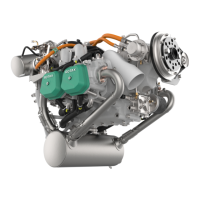
Lists key features of the engine, such as configuration and lubrication system.
Provides specific technical data including bore, stroke, and displacement.
Identifies and labels engine components in diagrams.
Shows the cylinder arrangement of the engine.
Specifies the direction of propeller shaft rotation when viewed from the front.
Describes the engine's cooling system, including coolant flow and expansion tank.
Details the fuel system, including fuel flow and pressure regulation.
Explains the dry sump lubrication system, oil flow, and components.
Covers the system responsible for supplying electrical power to the EMS and airframe.
Details the EMS main functionality, including ignition control, fuel injection, and fault detection.
Explains the electronic ignition system controlled by the ECU for electronic signal generation.
Details the electronic fuel injection system controlled by the ECU for accurate fuel metering.
Describes maintenance and display interfaces (CAN bus) for diagnostic activities and parameter visualization.
Explains the availability and use of BUDS Software for reading ECU logs and troubleshooting.
Explains the air intake system and how boost pressure is controlled.
Describes the turbocharger and exhaust system components and exhaust flow.
Details the propeller gearbox reduction ratio and power transmission components.
Provides specific technical data including bore, stroke, and displacement.
Describes the engine's liquid cooling system for cylinder heads and ram-air cooling for cylinders.
Explains the coolant flow path, forced by a water pump.
Details the coolant suction from the expansion tank to the water pump.
States the location of the Coolant Temperature Sensor (CTS).
Explains fuel flow through rails, regulator, and injectors, ensuring constant pressure differential.
Describes the oil flow from the tank, through the filter, to lubrication points and back.
Explains that the turbocharger is lubricated via a separate oil line from the main oil pump.
Specifies the location of the oil temperature sensor.
Specifies the location of the oil pressure sensor.
Identifies the stator as part of the internal power supply.
Identifies the fusebox as part of the electric system, containing regulators.
Identifies the stator as part of the internal power supply.
Identifies the fusebox as part of the electric system.
Identifies the 24 V AC/DC converter as part of the electric system.
Describes the two generators, their mounting, and the fuse box's role in energy management.
Explains system behavior in case of malfunction of Generator 1 and its impact on EMS power supervision.
Details the EMS main functionality, including ignition control, fuel injection, and fault detection.
Explains the electronic ignition system controlled by the ECU for electronic signal generation.
Details the electronic fuel injection system controlled by the ECU for accurate fuel metering.
Describes maintenance and display interfaces (CAN bus) for diagnostic activities and parameter visualization.
Explains the availability and use of BUDS Software for reading ECU logs and troubleshooting.
Identifies the air filter connection point.
Describes the connection between the turbocharger and the intercooler.
Describes the connection between the intercooler and the pop-off valve.
Describes the connection between the pop-off valve and the throttle body.
Identifies the turbocharger.
Identifies the intercooler.
Identifies the pop-off valve.
Identifies the throttle body.
Identifies the pressure control valve.
Identifies the wastegate actuator assembly.
Identifies the airbox.
Identifies the intake manifold.
Describes the air path from the compressor to the cylinders.
Describes the function of the overboost valve in relieving excessive pressure.
Details the AAPTS sensors for engine ambient temperature and pressure, and their mounting.
Specifies the location of the boost pressure sensor.
Specifies the location of the manifold air pressure sensors.
Specifies the location of the manifold air temperature sensors.
Identifies the muffler.
Identifies the exhaust pipes.
Identifies the exhaust manifold.
Identifies the turbocharger in relation to the exhaust system.
Explains the location of sensors for reading exhaust gas temperature.
Specifies the reduction ratio between the crankshaft and propeller shaft.
Lists components involved in power transmission from crankshaft to propeller.
Describes the hydraulic governor for constant speed propellers.
Details safety precautions and general preventive measures for preservation.
Outlines procedures for returning the engine to operation after preservation.
Discusses environmental corrosion and measures for combating it.
Instructs to fill out a form for reporting relevant occurrences involving engine malfunction.
Refers to the official ROTAX website for authorized distributors.
States that all old/used parts, liquids, and agents should be disposed of according to local ordinances.
Packaging disposal is the customer's responsibility according to country regulations.
Provides disposal instructions for engine oil, coolant, and fuel.
Instructs to return old/used parts to ROTAX Authorized Distributors or Service Centers.
Advises observing safety and disposal instructions of the manufacturer for chemical agents.
Extended warranty program for Rotax 4-stroke aircraft engines.
Rotax Care adds three years or Time Between Overhaul (TBO), whichever comes first.
Rotax Care covers all engine parts and services by certified technicians.
Adds 36/42 months or TBO to standard warranty coverage.
Rotax Care coverage can be transferred to a new owner.
Explains the process for activating warranty coverage through registration.
Emphasizes the quality, value, and trust of genuine Rotax parts.
States that parts meet strict quality standards for exact fit and performance.
Mentions that parts meet DOA/POA and quality standards (EASA/ASTM).
Covers the first 24 months or 100 hours of operation, whichever occurs first.
States that warranty is nullified if non-genuine parts cause an event.


 To Next Page


 General