Operation
40 Operator’s Manual
4.5 Managing Alarms and Alarm Limits
WARNING:
Do not pause the audible alarm or decrease its volume if patient safety could
be compromised.
WARNING:
Check alarm limits to ensure they are appropriate for each patient being
monitored with each use. Ensure alarm limits do not exceed the standard
thresholds set by the institution.
WARNING:
Ensure the speaker is clear of any obstruction. Failure to do so could result
inaudible alarm tone.
When the monitoring system detects certain conditions that require user
attention, the monitoring system enters an alarm state.
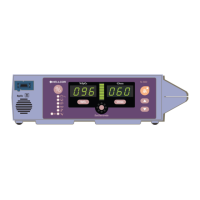
The monitoring system uses both visual and audible indicators to identify high-
priority, medium-priority, and low-priority alarms. Audible alarms include
pitched tones, beeps, and a buzzing tone. High priority alarms take precedence
over medium- and low-priority alarms. Reference Troubleshooting, p. 8-73.
Table4-2.Alarm Conditions
Priority Rate Color Messages
High Sounds every 4 s Red
Steady message,
Fast flashing numeric
SpO
2 Loss of Pulse
Critically Low-Battery condition
Medium Sounds every 8 s Yellow
Steady message,
Slow flashing numeric
High Pulse Rate limits violated
Low Pulse Rate limits violated
High SpO
2 limits violated
Low SpO
2 limits violated
Low
Sounds every 16 s
Steady yellow SpO
2 Cable/Sensor Disconnect
SpO
2 Sensor Off
Low Battery
Technical System Error: EEE 001




 To Next Page