2 • Description
Doc. 031851-05 12/04 2-13
• The eluent/sample mixture is pumped through the guard and separator
columns, where the ions are separated by the ion exchange process (that is,
different sample ions migrate through the columns at different rates,
depending upon their interactions with the ion exchange sites).
• The eluent/sample mixture flows through the suppressor. There, detection
sensitivity is enhanced by suppressing the conductivity of the eluent and
enhancing the conductivity of the analyte. Regenerant flows continuously
through the suppressor, restoring the ion exchange sites to their original state.
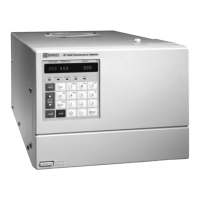
• The eluent/sample mixture then flows through the DS5, where the analytes
are detected and a signal is produced and sent to Chromeleon software.
• Finally, the eluent flows out of the cell and is directed into the regenerant
reservoir, where it pressurizes the regenerant and forces it into the suppressor.
2.2.1 Displacement Chemical Regeneration (DCR)
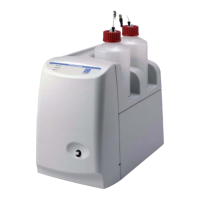
Displacement Chemical Regeneration (DCR) is the process that
regenerates the ability of the MMS III suppressor to suppress eluent. In
DCR, the eluent/sample mixture that exits the cell is pumped into the
regenerant reservoir. The eluent pressurizes the reservoir and pushes the
regenerant into the suppressor. However, because the eluent is a different
density than the regenerant, it remains separate.
In the anion DCR process (see Figure 2-8
), the eluent/sample mixture is
lighter than the regenerant and it remains on the top, forcing the
regenerant to the bottom of the reservoir and out into the suppressor.
In the cation DCR process, the eluent/sample mixture is heavier than the
regenerant and it flows to the bottom of the reservoir, displacing the
regenerant and pushing regenerant out of the reservoir and into the
suppressor.


 To Next Page