| 29
Using Reddy with Sharck Probes
Introduction
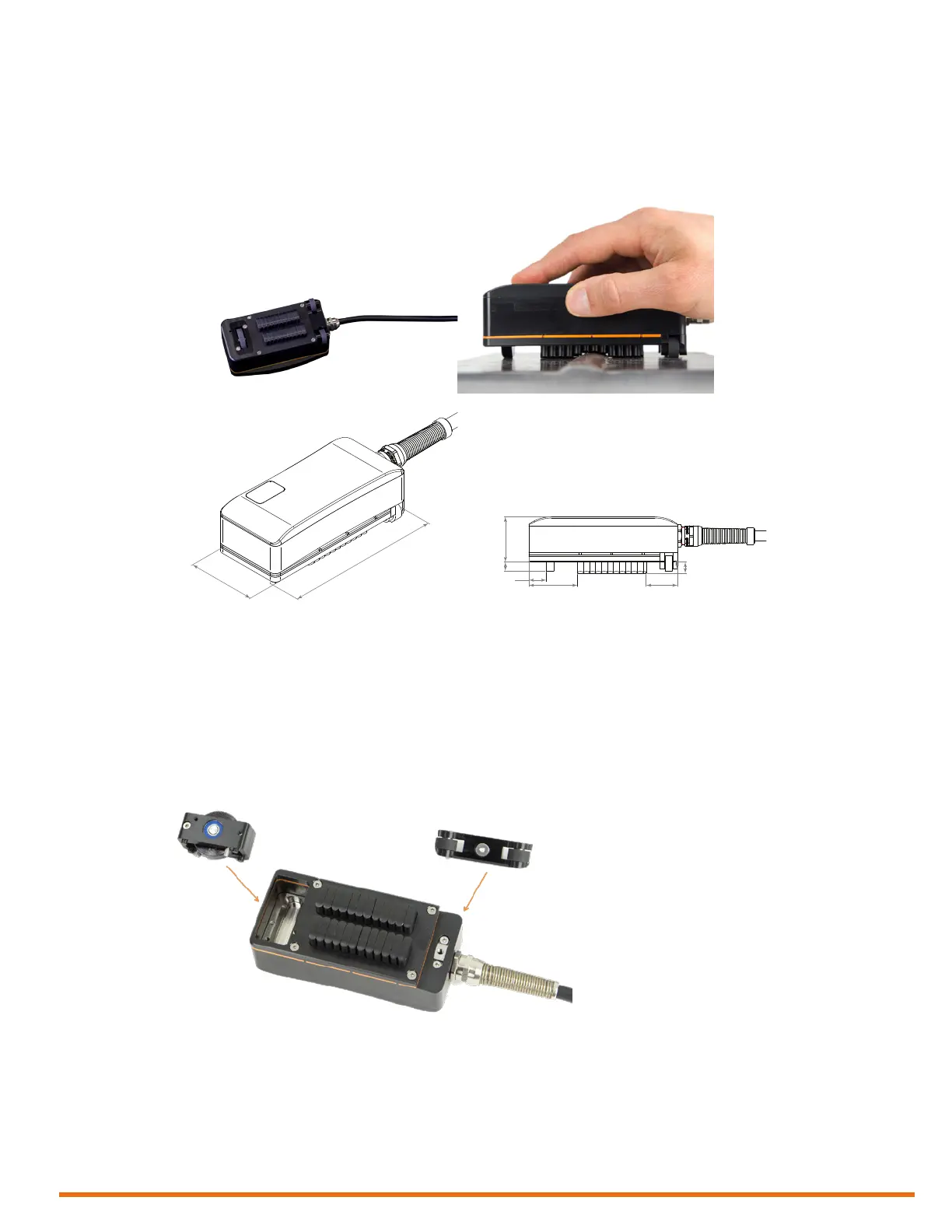
The medium Sharck
™
probe used in this appendix contains two rows of 11 independent ngers. This
array probe (SHARCK-W053-R-N05S) offers a coverage or active area of 53 mm (2.1 in). Other sizes of
Sharck array probes are also available.
Figure 5–1 Medium Shark probe
55 mm
125 mm
38 mm
7.5 mm
14.6 mm
40.9 mm
9.4 mm
26.4 mm
All the ngers of Sharck probes (patent pending) contain a three-coil assembly operating in a specic
transmit-receive mode, called tangential eddy current array or TECA
™
. TECA was developed to detect
and size the length and depth of axial surface-breaking linear indications in carbon steel. Sharck probes
are also capable of detecting transverse cracks (perpendicular to the scan axis). The operating frequencies
of the probes are 20 kHz and 80 kHz.
All Sharck probes are equipped with a high-resolution magnetic wheel encoder (20.53 points/mm).
SHARCK-W053-R-N05S comes with a 12-pin encoder connector for Reddy and a standard 5 m cable.
The encoder (and guiding wheels) are easily removable for cleaning and maintenance.
Figure 5–2 Removable Sharck encoder and guiding wheels
For details about Sharck probes (description, specications, and typical performance), refer to the
documentation supplied with your probes and the 4-page brochure.


 To Next Page