CHAPTER 4 COLLECT
4-13
COLLECTING THE REMAINING BOXES
7. Go to the point you marked on the pavement called "B1 250". Set the Dipstick down with
the rear "moon" foot directly on top of the circle at step 250. Draw a 1-ft (300-mm) circle
around the start/end point. You can do this by just setting the Dipstick foot on the start/end
spot and holding a crayon next to the other foot of the Dipstick and turn it in a circle.
When you have finished making this circle, walk across to the left wheelpath and make a
similar 1-ft (300-mm) circle at "B1 256".
8. Collect a new Run called "B2" just like the first box, but taking you another 250 steps
down the highway.
9. Continue to collect additional Boxes in a similar manner until you reach the point on the
highway that you want to use as the "end" of today’s data. The boxes do not have to be
250 steps long, nor do they all need to be the same length. However, we have found that
it is easier to keep track of what you are doing if you always try to use a standard collection
"box", and make notes whenever you vary from the standard.
10. Note that if the highway bends around a curve instead of staying perfectly straight, one of
the wheelpaths will be longer than the other is. In this case, continue to always use 90
angles when you go around a corner. The short transverse legs will all be the same lengths
because the wheelpaths are a constant distance apart, but the left (or right) wheelpath may
be a few steps longer than the other wheelpath.
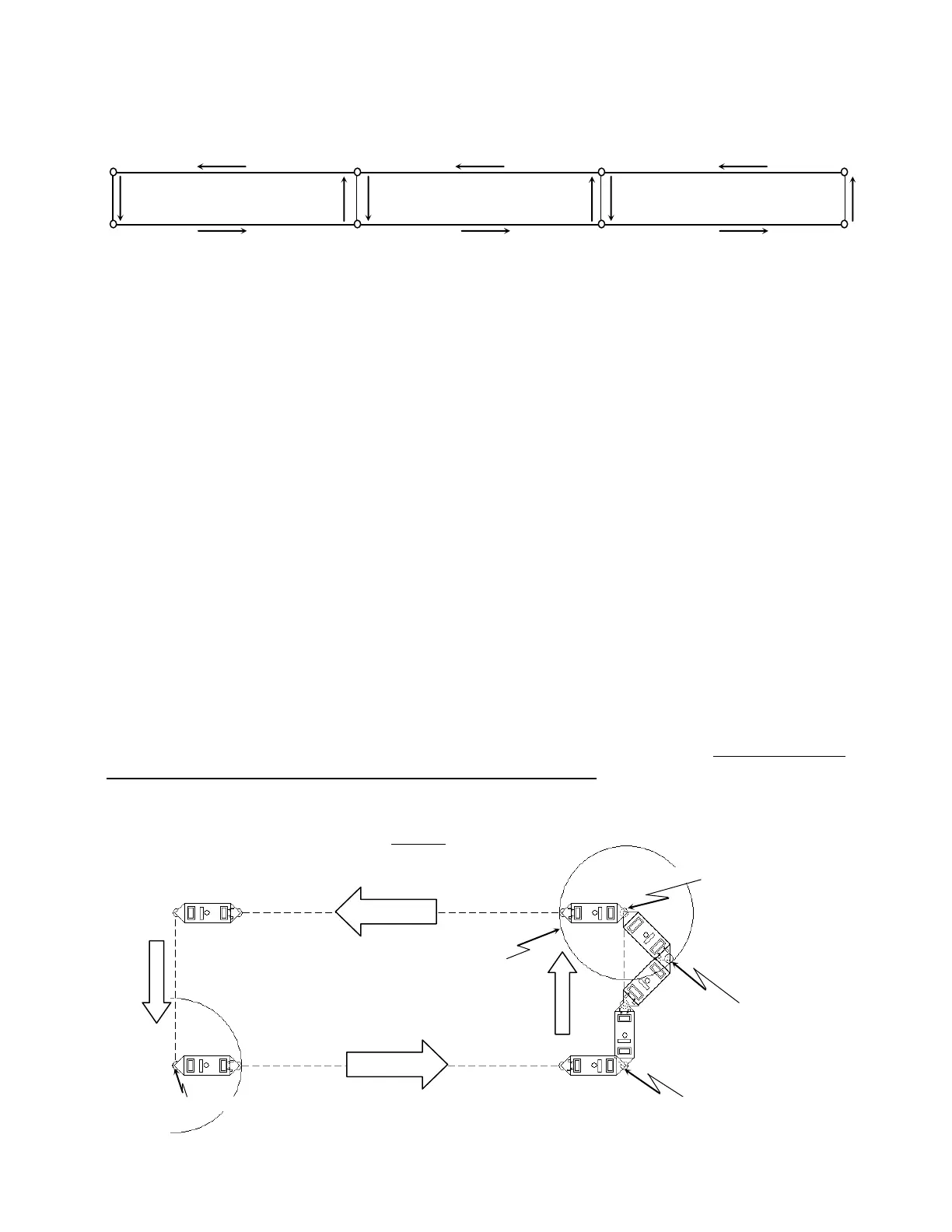
You may have wondered why you need to draw the 1-ft (300-mm) circles around the corners
of the boxes. These circles will help you to match up the wheelpath profiles so they hit exactly on
the correct point. When you are "closing the loop" by making the last step on Box1, if the
highway is not perfectly straight, or if you have turned at 89 instead of 90, or if the distance
between wheelpaths is not an integer multiple of 1 ft, (300 mm) then the last step will not land
exactly on the start point. If you need the two long legs of the box to be parallel at an arbitrary
distance apart, (not an integer number of steps apart) say for measuring in wheelpaths, here's how
to make the short transverse legs land exactly on top of the opposite wheelpath:
Point 250 Box 1/Start/end Box 2
Point 250 Box 2/Start/end Box 3
Point 256 Box 1/Point 506 Box
2
Point 256 Box 2/Point 506 Box
3
3. Draw this 12 inch/300 mm circle next
2. Draw a small circle around the Moon Foot here too
4. Then as you walk the 2
nd
leg,
step off tangent to this circle here.
1. Draw a small circle around the Moon Foot here



 To Next Page