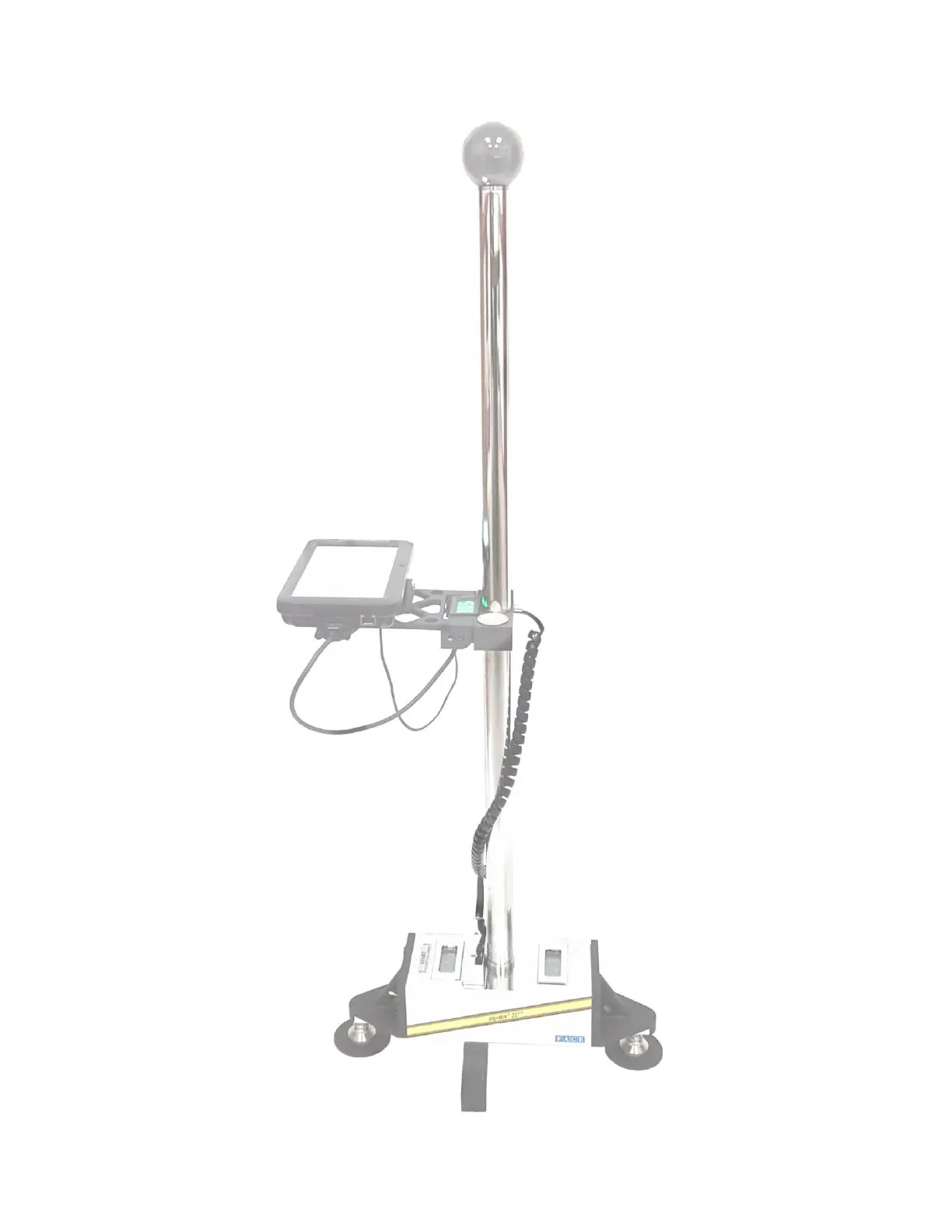
Appendix B Road Dipstick
®
Capabilities
B-1
The Dipstick was invented and developed specifically for measuring the roughness of highways
and the flatness and levelness of floors. However, because of its inherent ability to measure
elevation differences very precisely, the Dipstick has been found to have other uses that can be
very valuable. Here is a short list of some of the possible uses of the Dipstick:
1. The Dipstick produces the most accurate and precise elevation profiles possible. Whenever
various profiling devices are compared on roads, highways, and bridges, invariably the
Dipstick profile is what they are all compared to.
2. The Dipstick and its accompanying software can compute a host of highway roughness
indices. You can have the International Roughness Index or IRI, Half-Car IRI, Rut
Depth,Gap under the Straight Edge, California Profilograph emulation, Mayes Meter
emulation, RMSVA, and others. Many of these reports can be produced directly on the on-
board computer. The others can be done on any Windows desktop PC.
3. The Dipstick can quickly and easily measure the actual as-built slope of a tilted surface such
as a ramp or drain.
4. The Dipstick can quickly and easily measure the camber of girders and beams both before
and after loading. The difference between them is the amount of bending the beam has
undergone. The built-in software can calculate this for you instantly and print the results out
as a table showing the amount of deflection at every point.
5. The Dipstick can be used to set the elevations of bridge-deck rails. It has been shown that
the finished bridge deck surface follows the contours of the temporary rail upon which the
bridge deck screeds ride. The smoothness of the finished curved surface depends
substantially on the smoothness of the curve of the rails. The Dipstick can provide a table of
corrections, either visible on the screen of the Dipstick's computer, or printed out, for the
crew to make to bring the rail to the desired curve.
6. The Dipstick can be used to make nondestructive measurements of the thickness of fills and
coatings, such as skim coats and asphalt overlays. Since the Dipstick is capable of
calculating and displaying the difference between any two lines, if one line is run on the
subgrade before the skim coat or filler is applied, and one line is run at the same location
afterwards, the difference between the two is equal to the thickness of the overlay. The high
degree of precision and accuracy of the Dipstick (better than 0.0005"/0.0127mm) and the fact
that the difference or thickness is calculated and displayed every 1 foot/300 mm along the
measurement line, makes the Dipstick a useful tool for this purpose.
7. The Dipstick can be used to make precise elevation surveys within a limited area for
specialized reasons, such as the mounting of certain types of industrial or laboratory-type
equipment.
8. The Dipstick can be used to produce a similar but more detailed elevation survey that
produces a 3-D picture of the surface which can be very useful in certain applications.



 To Next Page