CHAPTER 5 PROCESS
5-5
ASCII Elevations
You may create ASCII Elevation Files from the data you have already collected by using
REPORT/ASCII ELEVATION FILE. The Elevation file will be saved in the active Job folder with the
name of the Run, as shown in the picture below. The file name will look like this: Runname.ELV
Don't be disturbed by the file extension
".ELV". You can open this file in MS
Excel or in MS Word or Wordpad or any
other spreadsheet or word-processing
program. If you prefer, you can change
the extension from "RDG" to "TXT" or
even "XLS".
ASCII Readings
You may create ASCII Reading Files from the data you have already collected, by using REPORT/ASCII
READING FILE. The Readings file will be saved in the active Job folder with the name of the Run. The
file name will look like this: Runname.RDG
Don't be disturbed by the file extension ".RDG". You can open this file in MS Excel or in MS Word or
Wordpad or any other spreadsheet or word-processing program. If you prefer, you can change the
extension from "RDG" to "TXT" or even "DOC".
IRI
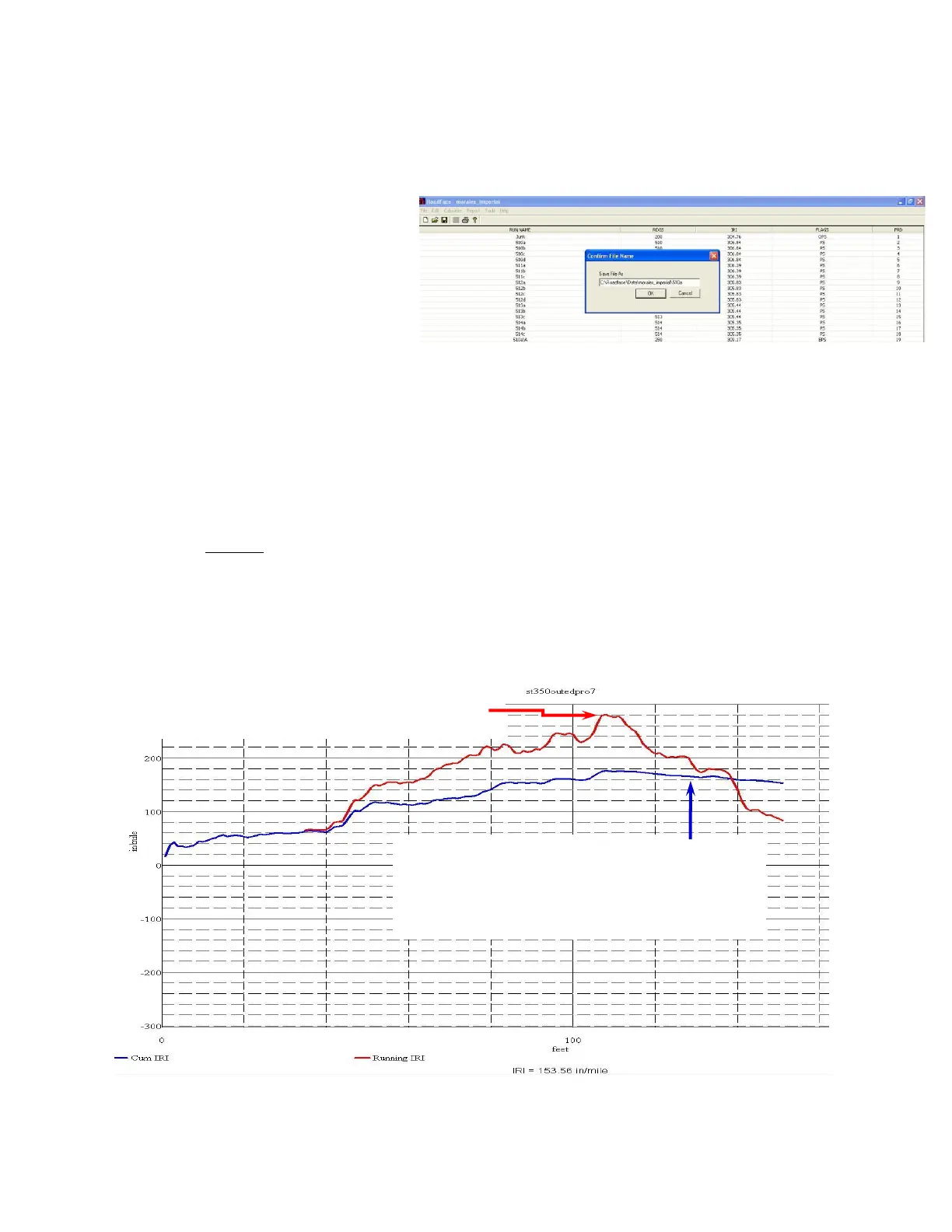
If you select one Run and use REPORT/IRI, you will get a graph which shows the cumulative value of
IRI at each point on the profile, as well as the 50-ft running IRI. As the profile gets longer and longer,
the cumulative IRI becomes very stable and does not react strongly to discontinuities in the pavement
surface. If the profile is very long, even a bad pothole will not affect the cumulative IRI very much. But
the 50-ft (15 m) Running IRI will show the "local roughness" at each point on the profile. Because it
only calculates the IRI based on the last 50 steps, any change in surface roughness will really stand out.
The IRI is based on the motion of a single wheel of a notional automobile, so it is sometimes called
the "Quarter Car IRI".
The Running IRI is based only on the last 50 steps
So it is more sensitive to individual flaws
The Cumulative IRI is based on all data
So it tends to smooth out after many steps.
It represents the “overall roughness” of the profile
and is much less sensitive to a single flaw



 To Next Page