Appendix C Elevation Studies & 3-D Dipstick Topo Maps
C-2
a. "Out-and-Back" lines
This is the simplest method, and is often very satisfactory to achieve the desired result, if all you need is data for certain
specific locations. (Why measure the whole surface if you don't need to?) Here's an example showing how this
technique might be used: One major aircraft manufacturer measures the deflection of runway and taxiway pavement by
starting from a point that is sufficiently remote from the aircraft that it is assumed to be unaffected by the presence or
absence of the aircraft. Using a starting point elevation of 0.000, they walk a line from that point to a point right next to
one of the wheels, and reverse direction on the same line, returning back to the starting point. Then they remove the
aircraft and collect another set of data in the identical location. The only difference is that in the second Run, the aircraft
has been removed. After computing the Bias for each of the two Runs, the runs are segmented to retain the first half of
each run. These profiles then represent the elevations of the profile between the starting point and the aircraft's wheel
location, both before and after removing the aircraft. The two segmented Runs are then selected and the menu item
CALCULATE/DIFFERENCE is used. This creates a profile that represents the precise deflection of the pavement due to the
weight of the aircraft.
b. The "Rake" or "Comb" pattern
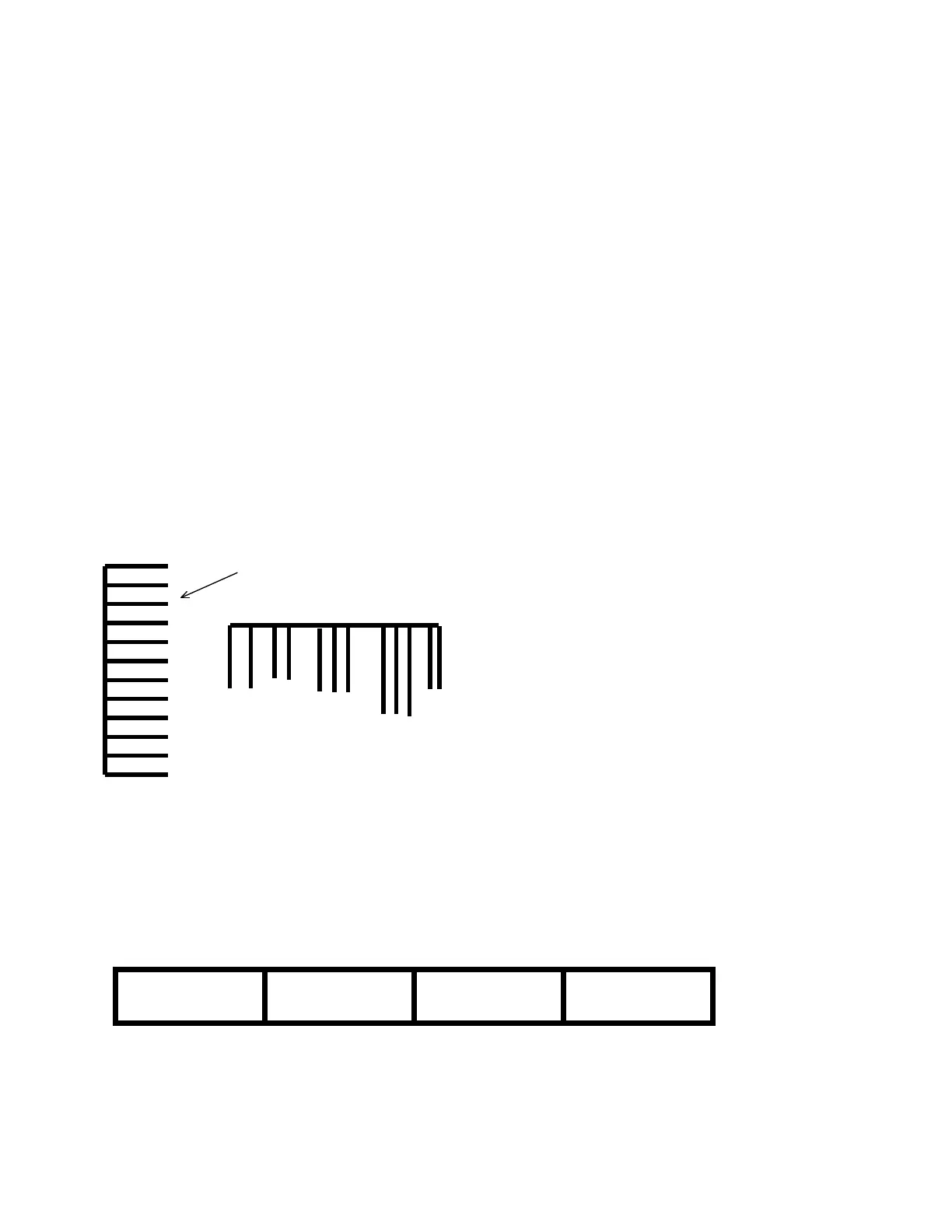
We call it the "Rake" or "Comb" method because the layout pattern looks like the tines of a garden rake, or the teeth of a
comb. There is a "Base" line, which is typically the longest line, and there are the "tines" or "Teeth" lines, which all
start from the base line. If the tines are short, you won't have to measure the tines "out and back". The base line should
always be measured "out and back."
Although the teeth or tine lines do not have to be parallel or the same length, we recommend that you make the pattern
symmetric, even, and parallel, unless you have a reason for not doing so. Collecting the data in even, regular patterns
will make it much easier to make 3-D graphs.
The "Comb" or "Rake"
Uneven Line Lengths
c. The "Box" method
Boxes are quite a bit more efficient than either the "Rake" or "Comb" in terms of data collection and analysis time,
particularly if you need to cover a large area without collecting data at every point.
For covering a large area, you can collect the data in overlapping boxes. The boxes may be touching each other or may
be any convenient distance from each other, but you will need to link each of the boxes with a line, in order to get the
relative elevations of the several boxes right.



 To Next Page