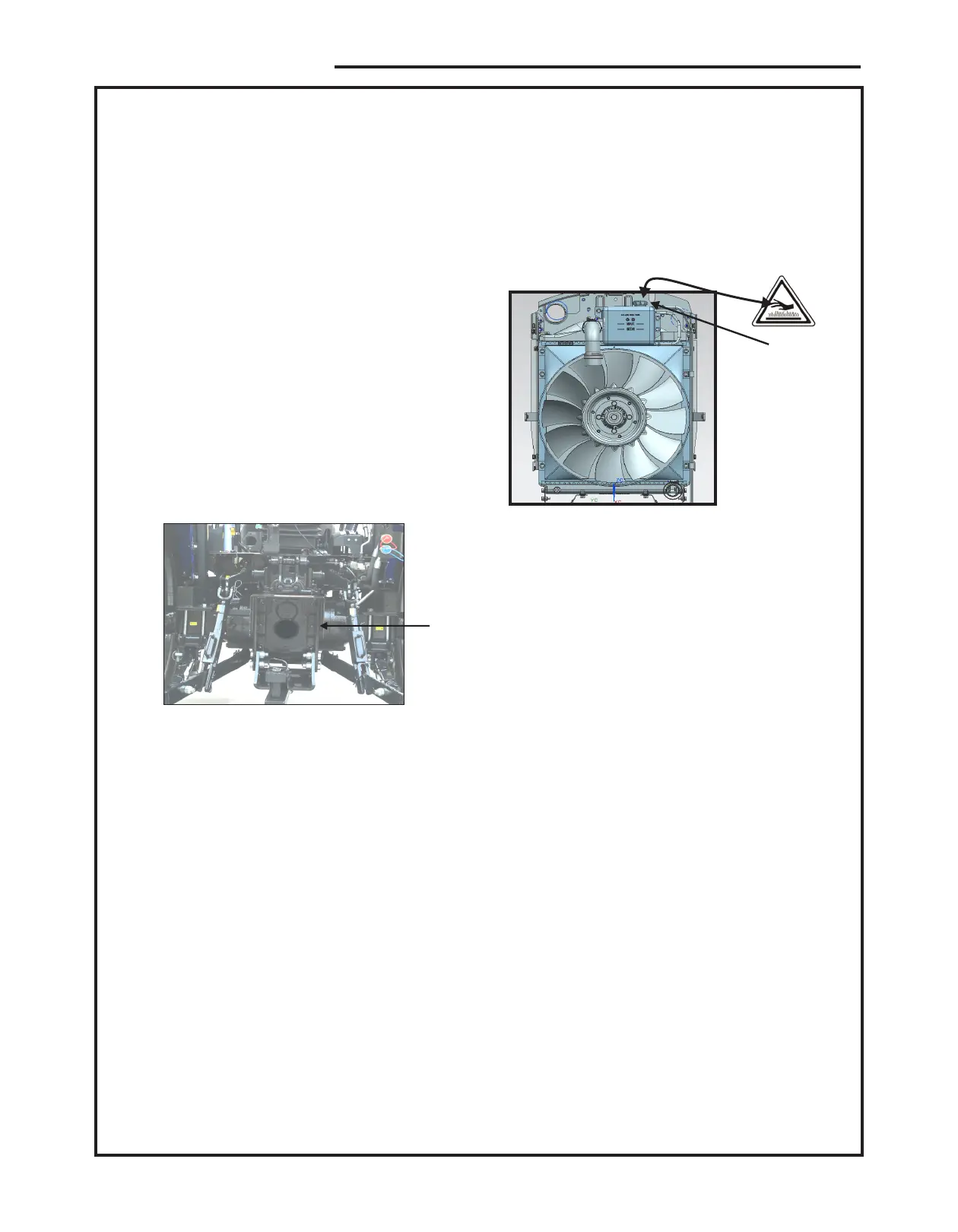
2. Do not remove radiator cap while coolant is hot.
When cool, slowly rotate cap to the rst stop and
allow sufcient time for excess pressure to
escape before removing the cap completely. If the
tractor has a coolant recovery tank, add coolant or
water to the tank, not the radiator. (See "Checking
Coolant Level" in "DAILY CHECK" in "PERIODIC
SERVICE" section.)
3. Always stop the engine before refueling. Avoid
spills and overlling.
4. Do not smoke when working around battery or
when refueling. Keep all sparks and ames away
from battery and fuel tank. The battery presents
an explosive hazard, because it gives off
hy d r o gen a nd o x yge n esp e c ial l y wh e n
recharging.
5. Keep rst aid kit and re extinguisher handy at all
times.
6. Disconnect the battery's ground cable before
working on or near electric components.
7. To avoid the possibility of battery explosion,
do7not use or charge the rellable type battery if
the uid level is below the LOWER (lower limit
level) mark. Check the uid level regularly and
add distilled water as required so that the uid
level is between the UPPER and LOWER levels.
8. Do not attempt to mount a tire on a rim. This should
be done by a qualied person with the proper
equipment.
9. Always maintain the correct tire pressure. Do not
inate tyres above the recommended pressure
shown in the operator's manual.
1
1. Radiator Cap Hot
Hot
2.6. Servicing The Tractor
Before servicing the tractor, park it on a rm, at and
level surface, set the parking brake, lower all
implements to the ground, place the gear shift
lever in neutral, stop the engine and remove the
key.
1. Allow the tractor time to cool off before working on
or near the engine, muffler, radiator, etc.
Figure-11
SAFE OPERATION
16
7. If the tractor drive wheels are stuck, shift to
reverse gear and back out, to prevent from lifting
the front wheels off the ground and possibly rolling
the tractor over backwards.
8. Slow moving vehicles on highways are dangerous.
Use a slow moving (SMV) sign in conjunction with
red lights, tail lights, and flashing warning lights.
9. Dim the tractor lights when meeting a vehicle at night.
Ensure the lights are adjusted to avoid blinding the
driver of an upcoming vehicle (applicable only twin
beam Head lamps are fitted).
10. Always check overhead clearance, especially when
working in confined spaces.
11. Engage the clutch slowly when driving out of a ditch,
gully or up a steep hillside. Disengage the clutch
promptly if the front wheels rise off the ground.
2.5. Operating The PTO
1. Ensure the PTO guard is always installed and
place the PTO shaft cap when the PTO is not
being used.
2. If PTO is running, shut off the engine and wait for
the PTO shaft to stop turning before getting off the
tractor to connect or disconnect PTO driven
equipment.
3. Apply the parking brake and block the front and
rear wheels when operating stationary PTO driven
equipment.
4. To avoid injury never clean, unclog, adjust or
service PTO driven equipment while the tractor
engine is running.
5. Never wear loose clothing when operating the
PTO or near equipment that is rotating.
manufacturer's handbook. Certain implements
require special operating techniques.
6. During regeneration process PTO should be in
OFF condition. For regeneration details refer
Chapter-4, DPF Regeneration strategies and
conditions.
1
1. PTO Guard
Figure-10



 To Next Page