37
1
2
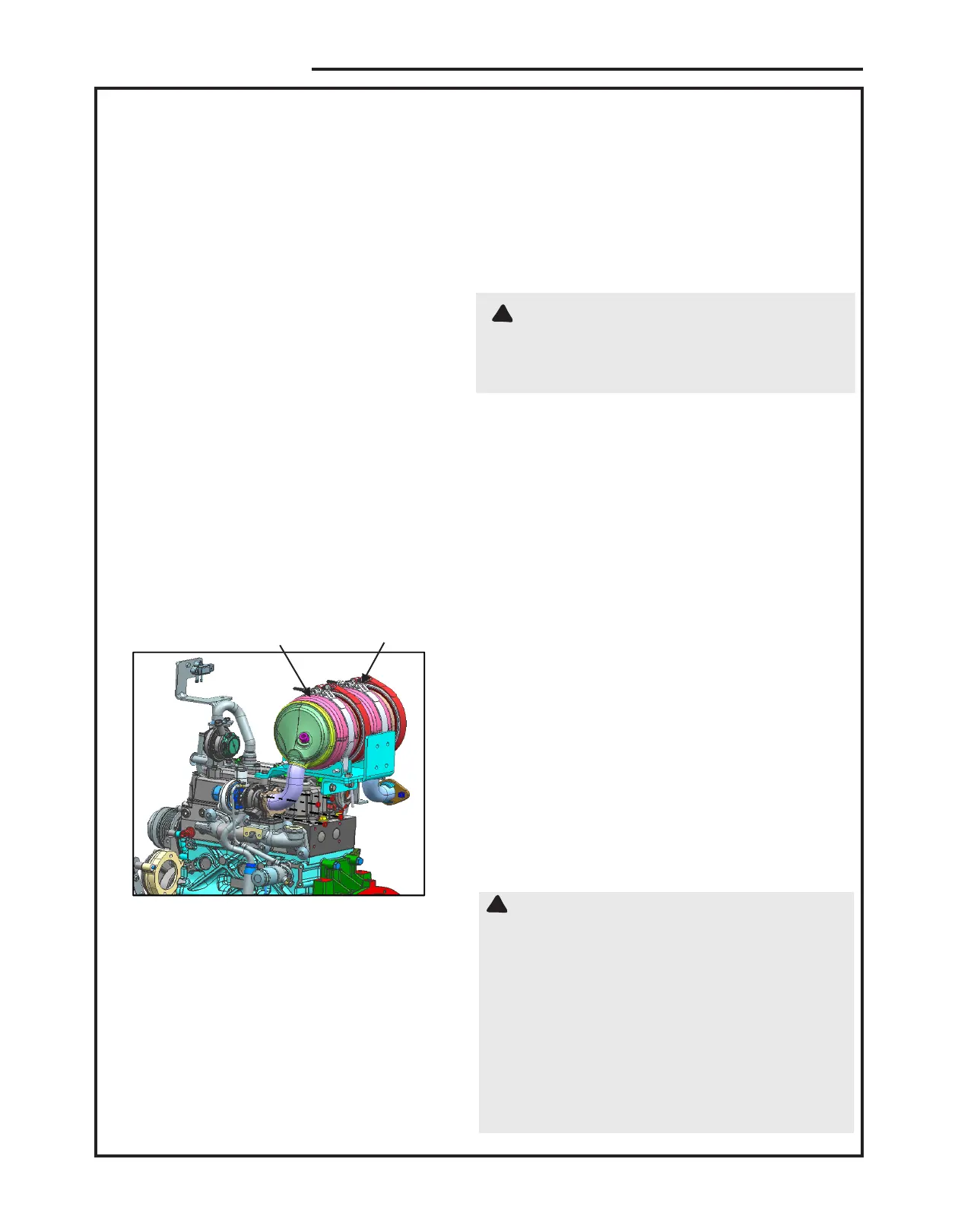
Figure-38
1. DOC 2. DPF
4.1. DPF Regeneration strategies
The engine, including the emission control system,
shall be operated, used and maintained in accordance
with instructions provided in manual to maintain the
emissions performance of the engine within the
requirements applicable to engine's category.
Tampering
No deliberate tampering with or misuse of the engine
emissions control system shall take place; in
particular, with regard to deactivating exhaust gas
recirculation (EGR) or exhaust after treatment
system.
4.2 Avoid Hot Exhaust
Servicing machine or attachments with engine
running can result in serious personal injury. Avoid
exposure and skin contact with hot exhaust gases and
components.
Exhaust parts and streams become very hot during
operation. Exhaust gases and components reach
temperatures hot enough to burn people, ignite or melt
common material.
Exhaust Gas After Treatment System:
4.2.1 Diesel Oxidation Catalyst (DOC) and Diesel
Particulate Filter (DPF)
The engine is equipped with after-treatment emission
control devices DOC and DPF. DOC is used to reduce
hydrocarbons, carbon monoxide and some particulate
matter. On the downstream of DOC, DPF is mounted
which traps and holds remaining particulate matters.
This trapped soot and other particles gets burnt in DPF
by regeneration process.
CHAPTER - 4 DPF REGENERATION
!
To avoid unnecessary soot build-up of diesel
particulates or soot in the exhaust system:
Ÿ Utilize automatic DPF cleaning mode
(regeneration)
Ÿ Avoid unnecessary idling.
Ÿ Use of recommended engine oil.
Ÿ Use only ultra-low sulphur fuel. (EN 590 2014)
DPF REGENERATION
!
Caution : Soot on DPF keeps on loading over
period of time, which directly results in change in back
pressure. This soot can be burnt in DPF using various
methods. The burning of soot in DPF is known as
regeneration.
4.2.2. Passive Regeneration
Periodically, the exhaust filter experiences higher
temperature levels simply through the engine
operating at higher loads. During these times, the
higher exhaust temperature cleans a small amount of
soot build-up in the DPF. Conversely, unnecessary
idling can cause additional DPF soot to accumulate.
For the best possible engine operation which requires
the least amount of operator interaction, work engine
at higher load conditions whenever possible and keep
idling to a minimum.
4.2.3. Active Regeneration
If DPF cannot perform contin uous passive
regeneration due to low load operations, soot needs to
be burnt strategically by ECU. Active regeneration is a
phenomenon in which thermal management and post
injection strategies are implemented. This helps in
attaining very high exhaust gas temperatures before
DPF. Increased in temperature beyond 500 deg C.
would ultimately lead to soot burning. In order to have
active regeneration ECU utilizes different triggering
points like number of operational hours and differential
pressure sensor input.
CAUTION During active regeneration, post
injection is used and fuel is burnt directly inside the
DPF (burnt by chemical reaction inside the DOC).
Through this heat, regeneration occurs inside the
DPF, but the combustion increases the temperature of
exhaust gas to close to 600 deg C. Stay away from
exhaust gas. Extremely hot exhaust gas may burn
you. Be careful that neither people nor flammable
material are near the exhaust gas outlet.
Post injection can cause the fuel consumption to
increase by a small amount.
Make sure that you do a daily check of the oil level.



 To Next Page