61
Pullout the dipstick and wipe it with a clean cloth. Insert
the dipstick as shown in figure 20, pushing it fully in and
check that the oil reaches the upper mark on the
dipstick when it is removed again from the transmission
aperture.
6.14 Hydraulic Oil Filter
Unscrew and discard the hydraulic oil filter. Install a
new filter as follows:
Clean the inlet channel and the face of the manifold.
Smear clean oil around the rubber seal of a new filter
and install on the tractor. Screw up until the faces just
meet, then tighten a further ¾ of a turn. Do not over
tighten.
Figure 25. 1. Hydraulic Oil Filter
1
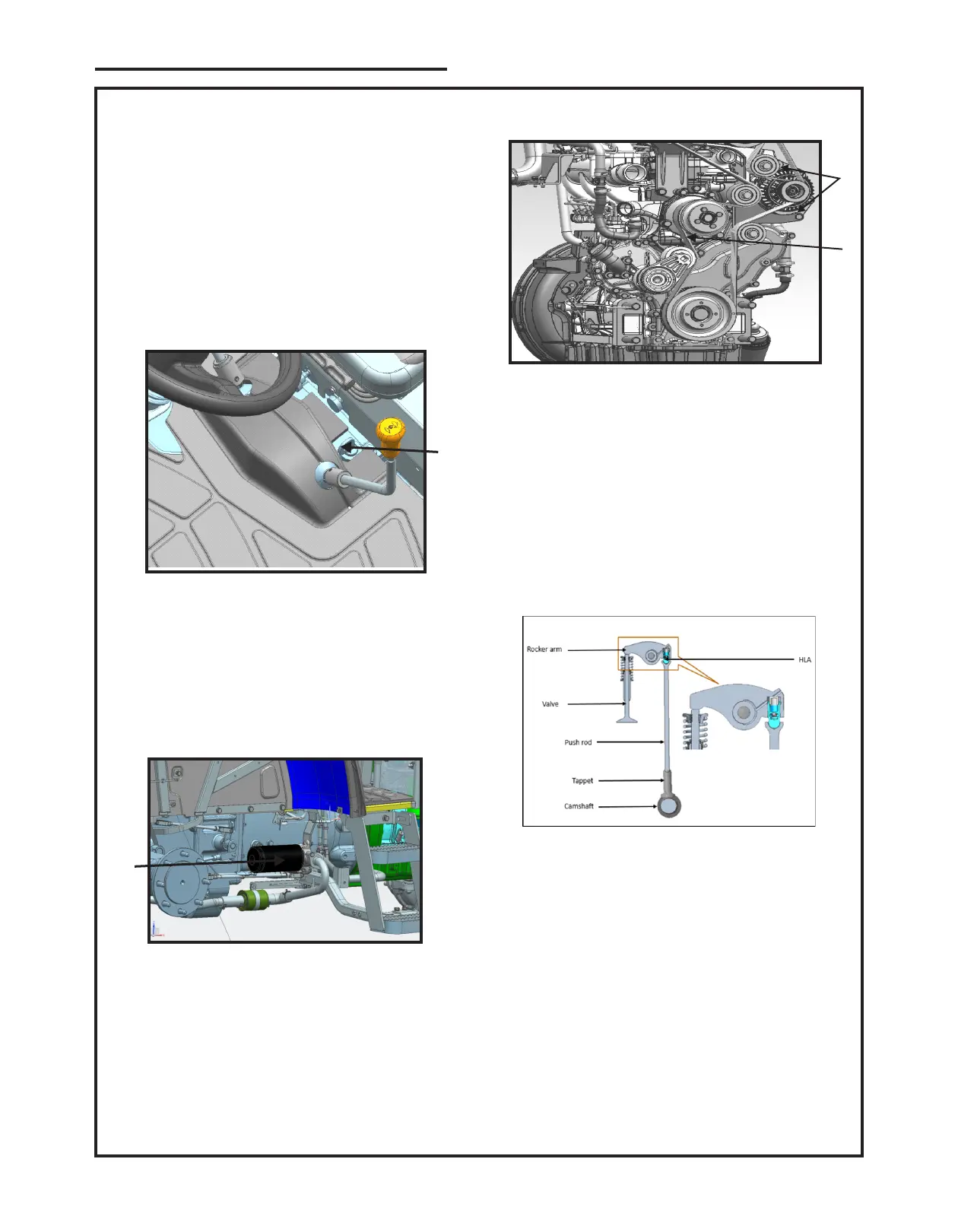
It is equipped with auto-tensioner which automatically
maintains the fan belt tension.
6.16. Hydraulic Lash Adjuster (HLA) Valve Train
All the stage "V" engines will be occupied with
hydraulic lash adjuster valve train which avoids the
tappet setting process during the service period.
Hydraulic lash adjusters (HLA) are specifically
designed to automatically adjust the lash in the valve
train.
2
1
Figure 26. 1. Fan Belt
2. Alternator mounting bolts
Clean the area around the filter. Smear clean engine
oil around the rubber seal of a new filter and install on
the tractor. Screw up until the faces just meet, then
tighten a further ¾ of a turn. Do not over tighten.
Clean the drain plug, remove the filler plug and refill
the engine with clean oil. Replace the filler plug.
Run the engine for a minute or so, to circulate the oil
and then stop the engine. Wait for a short period to
allow the oil to drain back to sump then check the oil
level by means of the dipstick.
Add recommended oil, as necessary, until the oil
reaches the upper mark on the dipstick.
6.13 Transmission Oil Level
Figure 24. Transmission oil level
1. Dipstick
1
6.15 Fan/Alternator Belt Tension (Auto-tensioner)
LUBRICATION AND MAINTENANCE CHART
HLA valve train is developed for stage V engines to
achieve the same performance as mechanical valve
train and at the same time it should improve the
packaging freedom.
Do's
Ÿ Oil passages from sump to head should be free
from burrs and imperfections in order ensure no
loose particles are entering HLA.
Ÿ At engine start up some valves can be noisy, due to
presence of air in high pressure chambers of lash
adjusters. This phenomenon is not dangerous and
can be cured in maximum 20 minutes after engine
start up. The engine has not to run at high speed
during this start-up phase (maximum 1000 rpm).
Figure 27.
Hydraulic Lash Adjuster (HLA) Valve Train



 To Next Page