50
WARNING : Owners should ensure that all
steering components are maintained in a reliareliable
and satisfactory condition to ensure safe operation
and comply with legal requirements.
5.18 REAR WHEEL TRACK ADJUSTMENT
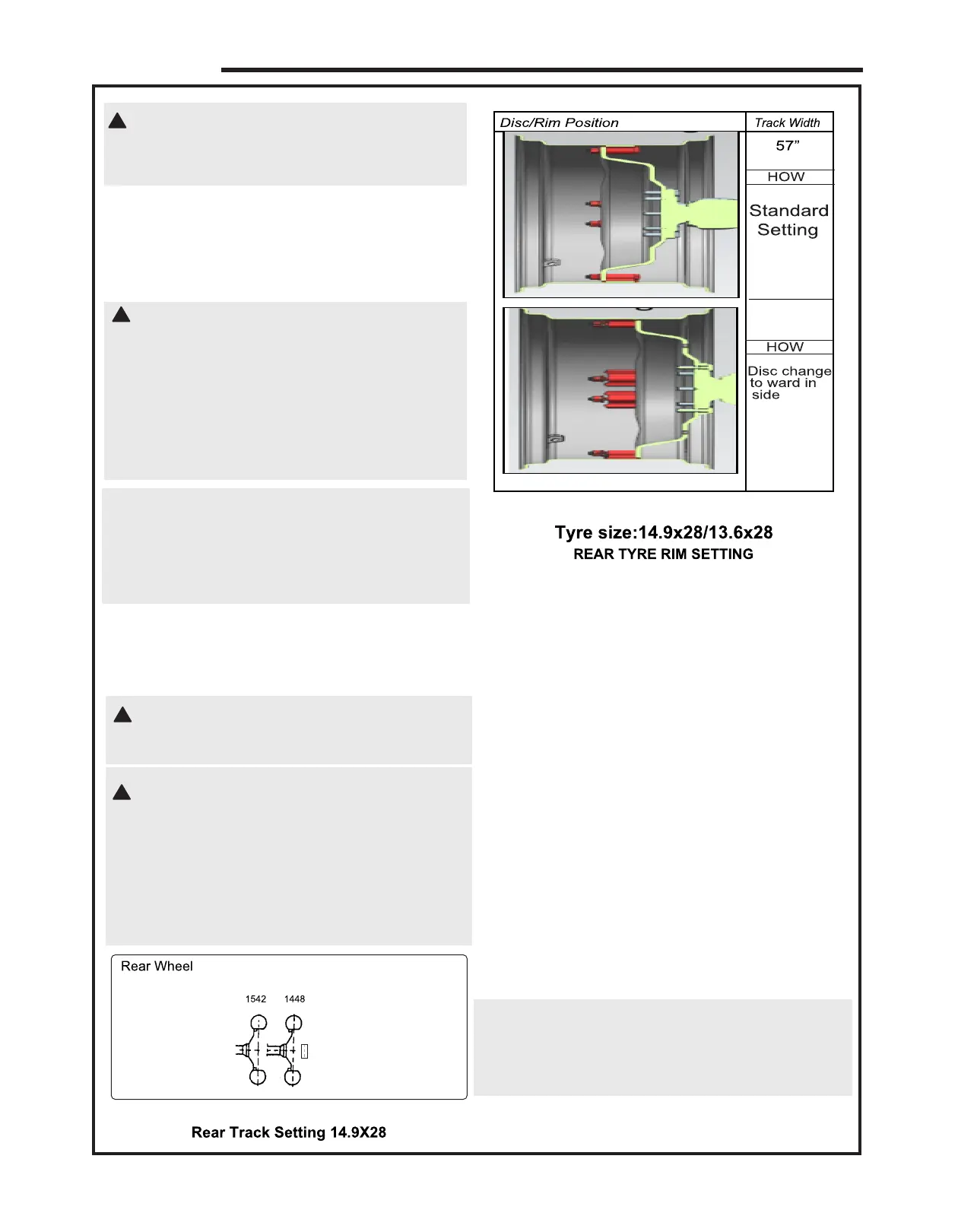
Rear wheel track adjustment is effected by changing
the wheel rim relative to the center disc, the rim and/or
the disc relative to the axle hub or by interchanging the
rear wheels.
WARNING : A tractor with narrow wheel settings
may not be as stable under the same conditions as a
tractor with wide wheel settings. Use the maximum
width possible which is compatible with your
operation, especially on rough ground, slopes or
across ditches.
The sectional drawings shown in illustrate the wheel
rim and disc positions relative to the hub at various
track settings.
NOTE : When interchanging left and right-hand wheel
assemblies, ensure the “V” of the tire tread remains
pointing in the direction of forward travel.
With certain options and/or tire sizes, the smaller track
settings may not be attainable due to minimal
clearance between tires and fenders or equipment.
!
!
When refitting or adjusting a wheel, tighten the bolts to
the following torques then recheck after driving the
tractor for 200 yards (182 m.) after 1 hour and 8 hours
operation and thereafter at 50 hour intervals.
WARNING: Never operate the tractor with a
loose wheel rim or disc. Always tighten nuts to the
specified torque and at the recommended intervals.
WARNING : Your tractor is equipped with lights
which meet lighting regulations when operating or
travelling on the public highway. If the wheel track
setting is adjusted beyond the initial factory position
then you may be required to reposition the lights or fix
auxiliary lighting to comply with legal requirements.
Additionally, before travelling on the highway, ensure
that the overall tractor width does not exceed the
maximum permitted in your country.
!
Figure-61
!
60.4”
Figure-62
5.19 TRACTOR WEIGHING
For maximum performance in heavy draft conditions
weight should be added to the tractor in the form of
liquid ballast, cast iron weights or a combination of
both. Front end ballast may be required for stability
and steering control when weight is transferred from
the front to the rear wheels as the implement is raised
by the tractor three-point linkage.
As a general guide, tractors should be ballasted so
that approximately one third of the total tractor weight
(less implement) is on the front wheels.
When a rear mounted implement is raised to the
transport position, the weight on the front wheels
should be at least 20% of total tractor weight.
Add additional front end ballast, as required, for
stability during operation and transport. Ballasting of
the front end may not always provide adequate
stability if the tractor is operated at high speed on
rough terrain. Reduce tractor speed and exercise
caution under these conditions.
When using front mounted implements, add weight to
the rear wheels to maintain traction and stability.
IMPORTANT : Only sufficient weight should be added
as is necessary to provide traction and stability.
Adding more weight than necessary results in
unnecessary loads being imposed on the tractors and
a higher fuel consumption.
OPERATION



 To Next Page