FLAMIC S.R.L. 5 Via dell’Artigianato, 36035 Marano Vicentino (Vicenza) - Italy
7
Dough sheeter SF450 - SF500 - SF600 Operation and maintenance manual (translation of original instructions) – Ed. 10/2016
Rev.02 10/2017
All rights reserved. Reproduction in whole or in part of this manual is prohibited.
• the incorporation of the machine or its parts into a complex assembly, if this where to cause new or
increased risks compared to the machine if used on its own as it was supplied.
• failure to comply with laws and regulations in the country in which the machine is used
• exceptional events and force majeure beyond the control of Flamic s.r.l.
1.4 TERMINOLOGY
In order to improve the understanding of the manual, below we have defined some of the terms and expressions
used in it:
OPERATOR: person assigned to use the machine or its parts.
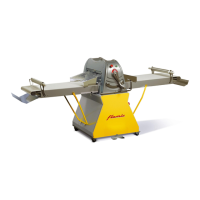
MACHINE, DOUGH SHEETER: the subject of this manual
USE OF THE MACHINE: every operation performed or that can be performed with/on the machine within the
permissible limits and stated in this manual. The term assumes the meaning of the relevant subject that is dealt
with from time to time (for example, production, maintenance, cleaning etc.).
CUSTOMER: natural or legal person who purchased the machine from Flamic s.r.l.
USER: natural or legal person that actually uses the machine, in particular for production purposes
MANUFACTURER of the machine, FLAMIC:
Flamic s.r.l. Via dell’Artigianato, 5 36035 Marano Vicentino (VICENZA) - Italy
PPE: personal protective equipment (e.g. gloves, shoes, glasses etc.)
INGREDIENTS: food products/substances (e.g. animal/vegetable fats, flour etc.) added to dough during the
rolling process in order to obtain a new mass of sufficiently homogeneous dough.
DOUGH: homogeneous easily malleable mixture at room temperature (obtained mainly from processes external to
the machine, but also in certain cases with the addition of ingredients to be incorporated in the mixture with the
machine itself) to undergo progressive rolling in order to obtain a sheet of dough/pastry of the required thickness.
SHEET, DOUGH SHEET: dough sheet made using the machine during the various rolling stages by passing the
dough forward / backward between two rollers, the distance between which (rolling thickness) is adjusted by the
operator according to requirements.
DOUGH PIECES/SHAPES: pieces of regularly shaped dough (triangular, circular, etc.) produced by the cutting
unit to be sent for subsequent processing outside the machine.
ROLLERS (THICKNESSING): powered opposing metal cylinders with a mutually opposite rotational movement
which, by compressing the dough in the various forward / backward steps and from time to time by varying the
gap between them, enables the sheet of the required thickness to be obtained.
ROLLING THICKNESS: the distance (gap) between the rollers.
BENCH, TABLE, SURFACE: machine element consisting essentially of a flat structure with two cylinders at
each end on which a conveyor belt moves. In this manual, this term refers to the assembly consisting of the
structure, cylinders, conveyor belt, residue collection tray (under-table), catch pan, table support etc.
CONVEYOR BELT, BELT: mobile component, the function of which is to receive the dough from the rollers
and to forward it to the subsequent rolling stage by reversing its direction of movement.
SCRAPER: plastic plate, the edge of which is in contact with a roller, parallel to its axis and whose function is to
keep the roller as free as possible from residues of dough, flour etc. by producing a “scraping” action. There are
two scrapers for each roller
BASE, FRAME: metal structure that supports the other parts of the machine
CONTROLS SIDE: the side of the machine on which the rolling thickness adjustment handle is located.
RESIDUE COLLECTION TRAY: edged metal sheet located under the table for collecting dust and residues of dough
CATCH PAN: concave stainless steel sheet at the ends of the benches that supports the rolled dough that
would otherwise fall on the floor during processing.
ORDINARY MAINTENANCE: operations carried out to keep the machine in good condition and in working
order that do not require special training or specific skills and that can be carried out by unskilled personnel,
provided that the instructions in this manual are followed.
SPECIAL / EXTRAORDINARY MAINTENANCE: work carried out to keep the machine in good condition and in
working order that do require special training and/or specific skills and that can and must only be carried out by
skilled personnel and (where required by the law and current regulations) professionally trained personnel who
possess the technical and regulatory knowledge to carry them out safely and in a workmanlike manner.
DANGER ZONE,any zone within and/or around the machine in which the presence of an exposed person
constitutes a risk to the health or safety of that person.
EXPOSED PERSON, any person wholly or partially in a danger zone.



 To Next Page