FLAMIC S.R.L. 5 Via dell’Artigianato, 36035 Marano Vicentino (Vicenza) - Italy
19
Dough sheeter SF450 - SF500 - SF600 Operation and maintenance manual (translation of original instructions) – Ed. 10/2016
Rev.02 10/2017
All rights reserved. Reproduction in whole or in part of this manual is prohibited.
3.3 ELECTRICAL CONNECTIONS
All electrical work in connection with the machine and/or the place in which it is used, must be carried out by
skilled and experienced technicians, who possess the technical and regulatory knowledge to carry it out safely,
in a workmanlike manner and according to the law. If required, they must also issue a declaration of conformity
provided for by law.
When the machine is delivered and anyway before connecting it to the mains power supply, make sure that the
mains voltage is the same as that indicated by the manufacturer on the identification plate (section 2.7) and
in the wiring diagrams.
The machine is supplied with a power cable and usually with a plug. If at the request of the customer, the
machine is supplied without a plug, it is up to the customer to take responsibility for providing a suitable plug for
the electrical outlets on site. Obviously it must also be suitable as regards polarity and current (assign this task
to an experienced electrician) according to the indications and information provided on the wiring diagram and
on the machine identification plate.
Use an earthing system, the working order of which must be checked periodically. Do not connect to gas or
water pipes or to other generic metal parts.
Keep the power cable away from hot and/or moving parts. It should not obstruct the passage of people, animals
or things.
The plug must be easily accessible and clearly visible at all times from any position in which the operator could
find himself/herself, even if only a short time.
For machines using three-phase power, when the machine is first started up, check the direction of rotation of
the motor: the conveyor belts must move according to the start control and reverse device as described in
section 2.4. If this is not the case, invert two phase wires (be careful not to swap a phase wire with the earth
wire, the latter can be recognized because it is yellow-green).
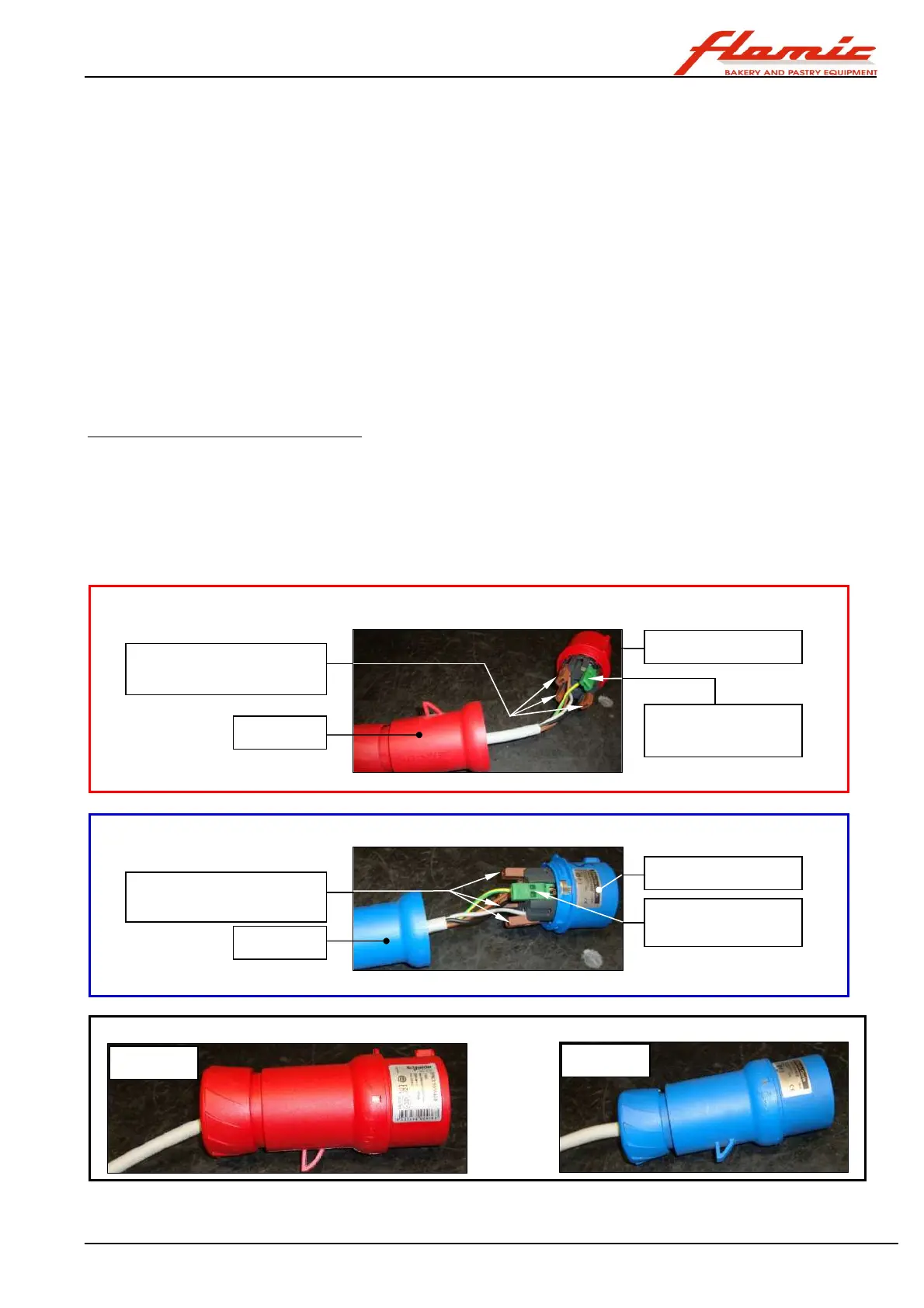
Some indications for doing this are shown in Figure 11:
- Separate the cap of the plug from the terminal block
- Pass the cable through the hole at the top of the cap, then connect the individual conductors to the plug
terminals
- tighten the terminals and close the terminal block with the cap, as shown in Figure 11.
Figure 11 - Power cable plug
.
Terminal block
Terminal block
3-phase 230 V (L1 – L2 – L3) + earth (PE)
Earth wire terminal
Phase wire terminal
blocks
Cap
400 V
230 V
Closed power plugs (3 phase + PE)
3-phase 400 V (L1 – L2 – L3) + earth (PE)
Earth wire terminal
block (PE)
Phase wire terminal
blocks
Cap



 To Next Page