FLAMIC S.R.L. 5 Via dell’Artigianato, 36035 Marano Vicentino (Vicenza) - Italy
17
Dough sheeter SF450 - SF500 - SF600 Operation and maintenance manual (translation of original instructions) – Ed. 10/2016
Rev.02 10/2017
All rights reserved. Reproduction in whole or in part of this manual is prohibited.
3 INSTALLATION AND USE
3.1 INSTRUCTIONS REGARDING THE PLACE OF INSTALLATION
The place in which the machine is to be kept and/or used must comply with the applicable law and provide
adequate protection against impact, damage, deterioration and atmospheric agents. Access routes to the place
of installation must be of a size and type to allow the machine to pass easily without the risk of causing injury to
people or damage to the machine itself. The floor, supporting structures and walls must have characteristics that
are compliant with laws and regulations, also in consideration of the overall load that is to be supported and
relative safety coefficients. The floor and walls of the room must be easy to clean and, if it necessary, to
disinfect and disinfest. The floor must be flat, not sloping, solid and free from holes and bumps.
The electrical system and the equipotential protection circuit (ground) of the site must comply with current laws
and regulations. They must be installed, maintained and, if required by law, inspected by authorised and
professionally qualified technicians who are able to issue a declaration of conformity.
Suitable safety devices must be installed on the upstream power supply panel to provide overcurrent and short
circuit protection and, if necessary, against phase-phase, phase-neutral (if applicable) and phase-ground
failures.
3.2 TRANSPORT, HANDLING AND POSITIONING
Depending on the destination and the contractual agreements, the machine will be shipped:
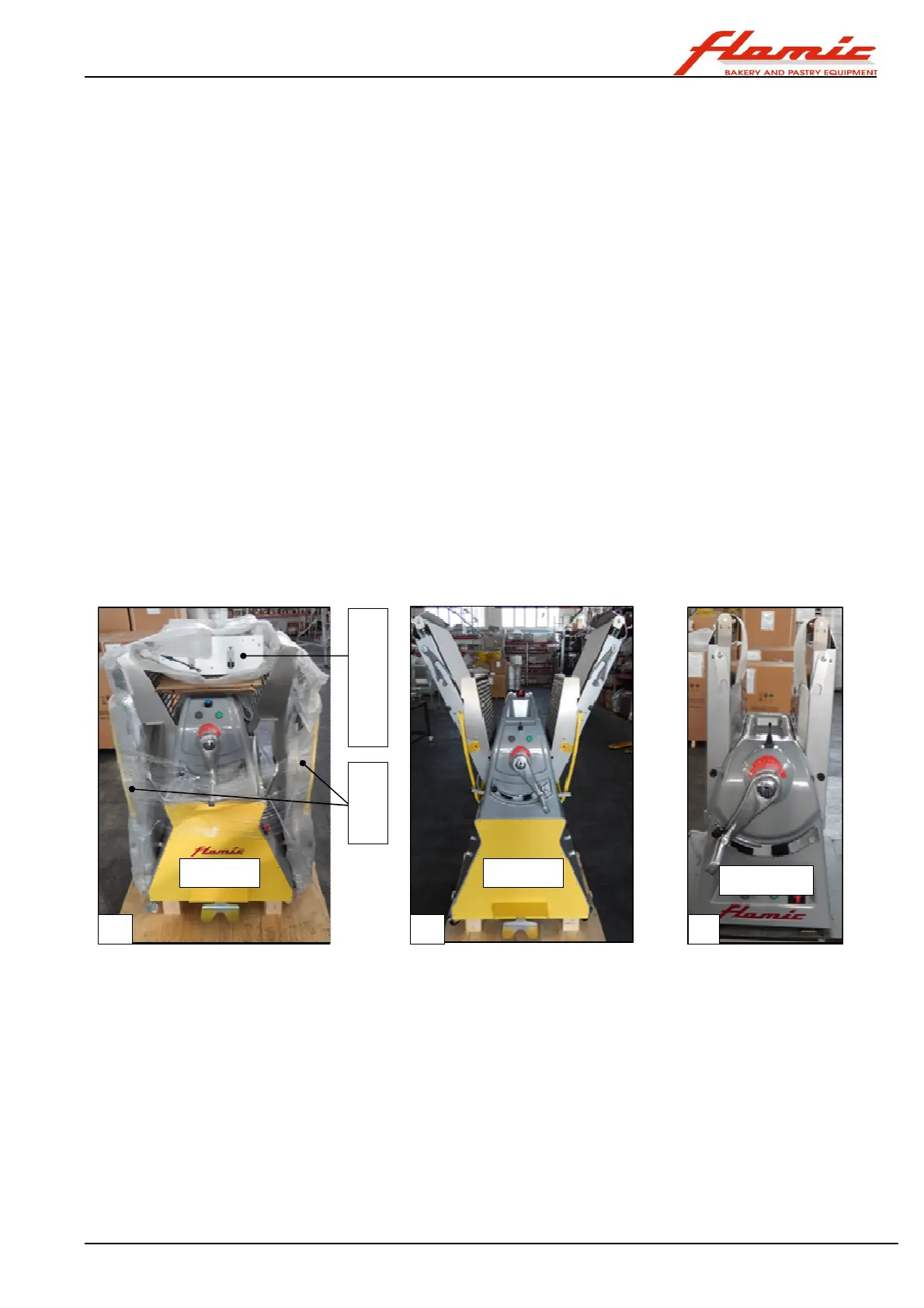
- wrapped in “bubble wrap”, stretch film and fixed to a pallet (see example in Figure 8/A)
- without wrapping materials, fixed to a pallet (see example in Figure 8/B)
- only wrapped in “bubble wrap” and stretch film (without pallet)
- without wrapping materials, contained in thick gauge cardboard box fixed to a pallet
- (by sea) in a “barrier bag” and a thick gauge cardboard box fixed to a pallet.
The load should be secured to the floor of the transport vehicle using suitably positioned wooden blocks and/or
lashed above 2/3 of its height to fastening points on the vehicle to prevent it from moving during transport.
To handle the machine when it is on the wooden support (pallet, packaging base with carton etc.) use a forklift
truck having an adequate lifting capacity for the total weight to be lifted (see section 2.6). Insert the forks inside
the end stringers and as close as possible to them to avoid sideways movements (be careful not to damage
parts of the machine).
Figure 8 - Handling the palletised machine using a forklift truck
Remove the machine from its packaging, separate the materials by type (plastic, wood etc.), place them in a
storage area that is only accessible to authorised personnel and arrange for disposal according to current
regulations.
In Italy and other countries, especially in the European Union, waste disposal and environmental
protection regulations are clearly defined by current legislation.
Check that the machine and its parts are intact. If in doubt, consult the manufacturer.
To lift the machine on its own (e.g. to move it from the pallet and place it on to the floor):
- model SF450: the benches must be in the folded position and secured (see section 3.5.1). Place two slings ref.
1 having a suitable lifting capacity (the weight of the machine is indicated in section 2.6, as well as on the
plate), under the crosspieces ref. 2 (one on each side) as shown in Figure 9. Then connect them to lifting
equipment with a hook, such as a crane, hoist, etc.
(do not for any reason connect them to the forks of a
forklift truck).
The distance between the crosspieces ref. 2 and the lifting hook must be at least 2000 mm. The smaller the
angle formed by the slings, the lower is the pressure exerted on the raised tables (lower risk of damage) and
the lower is the possibility of them approaching one another (the lower the risk of the load tipping and falling).



 To Next Page