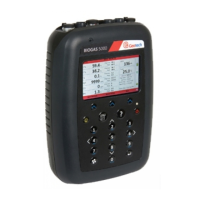
GA5000 gas analyser OMGA5KN4.4
Copyright Geotech Page 55 of 113
In order to assist the operator the GA5000 instrument also indicates the level of
hydrogen present as low, medium or high. If a high hydrogen reading is present then the
CO reading may be affected.
The effect of hydrogen sulphide is eliminated by the use of a H
2
S filter.
CO measurement
The CO measurement is sensitive to hydrogen sulphide. The presence of hydrogen
sulphide can cause the CO reading to elevate (not to be the true value due to the
interfering gas). If the presence of hydrogen sulphide is suspected to be causing false CO
readings, then it is recommended that the external hydrogen sulphide filter is used whilst
obtaining the CO measurement.
The H
2
S filter only needs to be used when you are trying to remove the possible cross
gas effects H
2
S might have on other gas channels. Do not use the filter on all boreholes.
When using the H
2
S filter you will need to increase the gas sample and clean air purge
run-time, as using an H
2
S filter decreases the response time of the analyser.
Note: There is an internal H
2
S filter incorporated in the chemical cell that removes
the H
2
S; however this has a limited life span.
The electrochemical cells used to measure H
2
S and CO do suffer from cross-gas effects.
Such effects are not accurately specified. However, the following table may be useful as
a guide; it represents how many ppm would be read by a cell if 100 ppm of the
interfering gas were applied, with no other cross-contaminates being present in the
sample.
GA5000
*after internal filter depleted.
Note: Other gases could cause cross-gas effects. If you suspect a cross sensitivity
problem please contact the Technical Support Team at Geotech on
+44(0)1926 338111.
8.8.2 Cross-gas effects on methane, carbon dioxide and oxygen
Methane is measured using dual beam infrared absorption. Analysers are calibrated using
certified methane mixtures and will give correct readings provided there are no other
hydrocarbon gases present within the sample (e.g. ethane, propane, butane, etc.). If
there are other hydrocarbons present, the methane reading will be elevated (never
lower) than the actual methane concentration being monitored.
The extent to which the methane reading is affected depends upon the concentration of
the methane in the sample and the concentration of the other hydrocarbons. The effect
is totally non-linear and difficult to predict.
Note: The effect can be reduced by using an H
2
S filter as it can reduce higher
order hydrocarbons. When using the H
2
S filter you will need to increase the


 To Next Page