Published 08-25-09, Control # 077-04 4-1
RT9130E SERVICE MANUAL BOOM
SECTION 4
BOOM
DESCRIPTION
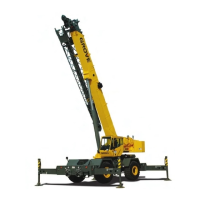
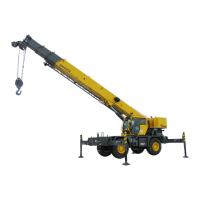
One boom is available on the crane; a five section, full
power, sequenced and synchronized, 12.8 to 48.5 m (42 to
159.3 foot) boom. The boom assembly utilizes a mega form
design. The five section boom utilizes two sequenced
telescope cylinders for telescoping and retracting of the
boom plus cable synchronization for the extension and
retraction of the fly section. Boom lift is provided by a single
lift cylinder and boom elevation is from - 3 degrees to +78
degrees.
Lattice Extension
The 11 to 18 m (36 to 59 ft.) offsettable bifold lattice
swingaway extension stows alongside base boom section.
Offsets are 0°, 20°, and 40°.
Optional Lattice Extension
11 to 18 m (36 - 59 ft.) hydraulically offsettable bifold lattice
swingaway extension stows alongside base boom section.
Offsets are from 0° to 40°.
Optional Lattice Extension Inserts
The 8 m (2 x 26 ft.) lattice extension inserts install between
the boom nose and bifold extension, non-stowable. A
standard auxiliary boom nose (rooster sheave) is available
for the boom to simplify single part cable usage. The rooster
sheave is installed on the main boom nose and is secured by
pins that pass through the rooster sheave and main boom
nose.
Boom Control Switches
The following switches and indicators are located in the
crane’s superstructure cab and are used together to control
the boom telescope function.
Boom Auto/Manual Telescope Mode
Switches
The boom auto/manual telescope mode switch is located on
the right armrest. The switch is a two-position rocker switch
placarded auto and manual. This switch has a lock to
prevent accidental activation.
When the switch is in the AUTO mode, the boom sections
extend in a predetermined sequence when telescoping the
boom; the inner mid extends 75% and stops, then the center
mid extends to 75% and stops, then the inner mid extends to
100%, the center mid extends to 100%, and then the outer
mid and fly section extend in a synchronized fashion. The
sections retract in the same manner in reverse order.
When in the manual mode, the red LED square in the switch
will illuminate. The boom telescope section select switch is
positioned to either the center mid or inner mid position in
order to extend or retract the selected section until it is
returned to the proper position for normal boom
synchronization to occur.
Center Mid/Inner Mid Boom Telescope
Sections Select Switch
The center mid/inner mid boom telescope section select
switch is located on the right armrest. This switch is a three
position rocker switch that is used in conjunction with the
boom auto/manual telescope mode switch. When the boom
mode switch is positioned to manual, the boom telescope
section select switch is positioned to either of the two
positions. When placed in the upper position, the center mid
can be extended. When the center mid is fully extended, the
outer mid and fly can be controlled. The red LED square will
illuminate when the switch is positioned in either the inner
mid or center mid position.
Luffing Jib Switches
The luffing jib raise/lower switch is located on the left
armrest. It is a three position, momentary switch (LOWER/
OFF/RAISE) that will energize a solenoid to raise or lower
the jib, if the jib ON/OFF switch is on.
The luffing jib two position on/off switch is located on the left
armrest. When in the ON position and used in conjunction
with the luffing jib RAISE/LOWER switch, the switch will
allow operation of the luffing jib. When in the ON position, the
red LED square will illuminate. It has a lock to prevent
accidental activation.
THEORY OF OPERATION
Boom Extension
Boom extension and retraction is accomplished with two
telescope cylinders, five extension cables, and two retraction
cables. The lower telescope cylinder is a two stage cylinder.
The rod for the first stage is secured to the rear of the boom
base section and the barrel of the first stage is secured to the
inner mid boom section by a trunnion. The second stage of
the first telescope cylinder barrel is secured to the rear of the
center mid boom section by a trunnion. The rod end of the
upper telescope cylinder is attached to the rear of the center
mid and the barrel is secured to the outer mid boom section
by a trunnion. The extension cables are secured to the back
of the fly section and run around extension sheaves on the
front of the upper telescope cylinder to the front of the
second stage barrel of the lower telescope cylinder.


 To Next Page