To avoid aliasing, the bandwidth of the incoming signal must be limited to
less than half the sampling rate. A low-pass filter with a sharp cutoff at the
Nyquist rate would reject all frequencies above that, thus eliminating aliasing,
while letting all other frequencies through unattenuated. However,
sharp-cutoff filters do not have the desired characteristics for accurate
time-interval measurements or for viewing pulses without distortion. A
sharp-cutoff filter will have very large preshoot, overshoot, and ringing in its
step response.
To view pulses with minimum distortion and make accurate time interval
measurements on them requires a filter with the following characteristics:
•
The step response should be monotonic, with no preshoot or overshoot.
•
There should be no ringing in the step response or impulse response.
•
The group delay should be constant. This simply means that all
frequencies in the signal should be delayed by the same amount of time. If
the higher-frequency components of a step are delayed more or less than the
lower-frequency components, the step will be distorted.
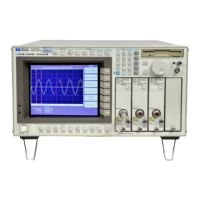
A Gaussian filter meets all these requirements, so the response of the
HP 54720 and its plug-ins is designed to have an approximately Gaussian
response. Figure 13-26 shows the magnitude response of a Gaussian filter in
the frequency domain.
Measurements
Time-interval measurements
13–53


 To Next Page