Reconstruction
To introduce the concept of reconstruction, let’s return to a familiar example:
measuring rise time. If the rise time of the measuring system (oscilloscope
and probe) is less than 1/3 the rise time of the signal to be measured, the
error in measuring the rise time will be less than 5 percent. The bandwidth is
approximately 0.35 divided by the rise time. Therefore, if you used an
oscilloscope with a 1-GHz bandwidth, you could measure a 1-ns rise time
with an error of less than 5 percent. The Shannon sampling theorem states
that if you sample the same signal at 4 GSa/s, you are assured of having all
the information contained in the signal up to 1 GHz with plenty of margin. As
a result, you could measure the rise time with an error of less than 5 percent.
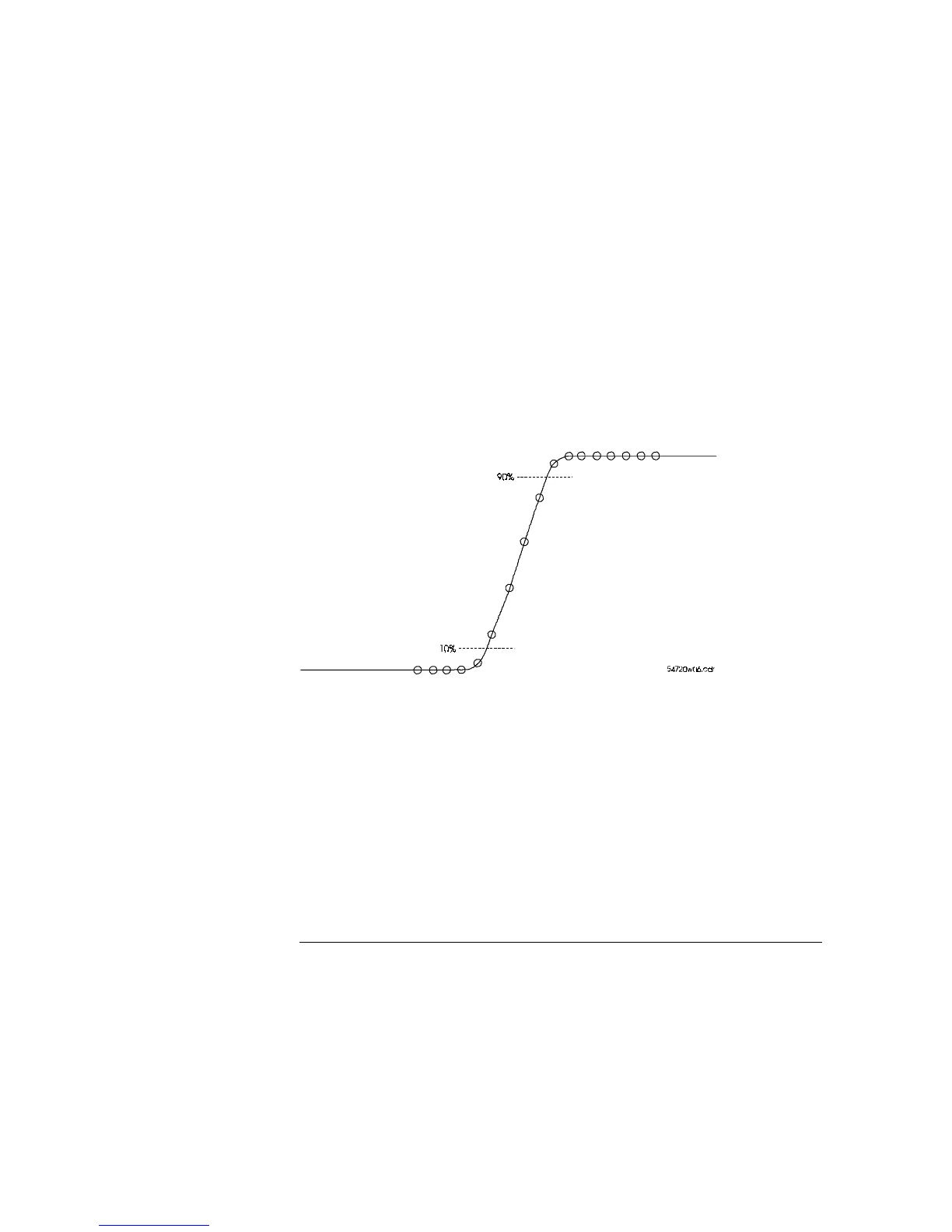
At first this conclusion may seem counter intuitive. At 4 GSa/s, the time
between samples is 250 ps. On an edge with a 1-ns rise time, that means
there are only 4 samples located on the edge as shown in figure 13-27.
Rising Edge with at Least Four Samples Between 10% and 90% Points
Figure 13–27
Measurements
Time-interval measurements
13–56


 To Next Page