
 Need help?
Do you have a question about the Hypertherm Powermax 65 and is the answer not in the manual?
 General
| Brand | Hypertherm |
|---|---|
| Model | Powermax 65 |
| Category | Welding System |
| Language | English |
Explains the compliance of Hypertherm's CE-marked equipment with EN60974-10 for electromagnetic compatibility.
Details user responsibilities for installing and using the plasma equipment to achieve electromagnetic compatibility.
Guides users on assessing potential electromagnetic problems in the surrounding environment before installation.
Provides strategies for reducing electromagnetic emissions from the cutting equipment.
Discusses the importance and methods of earthing the workpiece to reduce emissions and ensure safety.
Outlines routine maintenance procedures for the cutting equipment to ensure proper function.
Provides recommendations for the positioning and management of cutting cables.
Explains the consideration of equipotential bonding for all metallic components in the installation.
Discusses selective screening and shielding of cables and equipment to alleviate interference.
Highlights important information regarding genuine Hypertherm parts and user responsibility for safe use.
Details Hypertherm's warranty terms, including periods and exclusions for power supplies and torches.
Outlines Hypertherm's commitment to defending against patent infringement claims related to product use.
Specifies limitations on Hypertherm's liability for damages arising from product use.
States that national and local codes take precedence over manual instructions.
Defines the aggregate limit of Hypertherm's liability for claims related to product use.
Requires the user to maintain adequate insurance coverage for product use.
Outlines the conditions and procedures for transferring warranty rights to a successor.
Crucial safety guidelines and precautions for operating the system.
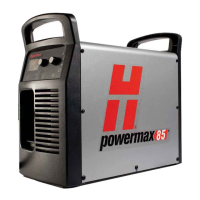
Overview of the Powermax65 and Powermax85 system capabilities and features.
Detailed electrical and performance specifications for the Powermax65.
Detailed electrical and performance specifications for the Powermax85.
Physical dimensions for the Duramax 75° hand torch.
Physical dimensions for the Duramax 15° hand torch.
Physical dimensions for the Duramax 180° full-length machine torch.
Physical dimensions for the Duramax 180° mini machine torch.
Performance metrics for cutting with the Powermax65, including capacity and speed.
Performance metrics for cutting with the Powermax85, including capacity and speed.
Explanation of product markings and symbols for compliance and identification.
Reference guide to standard IEC symbols used on the equipment.
Instructions for unboxing and verifying the contents of the system.
Procedures for filing claims for shipping damage or defective/missing merchandise.
List of items included in the system package for verification.
Guidance on selecting an appropriate location for the power supply for optimal ventilation and stability.
Guidance on ensuring the correct electrical supply and fuse protection for system operation.
Procedure for installing a safety line-disconnect switch for quick power cutoff.
Essential guidelines for proper system grounding for safety and electromagnetic interference reduction.
Details on connecting the Powermax65 to various single-phase and three-phase power sources.
Instructions for installing an appropriate power cord for 1-phase operation.
Procedure for installing a plug on the three-phase power cord according to codes.
Details on connecting the Powermax85 to various single-phase and three-phase power sources.
Step-by-step instructions for installing a single-phase power cord.
Guidance on selecting and using appropriate extension cords based on length and voltage.
Table detailing recommended wire gauges (AWG/mm²) for extension cords by length and voltage.
Requirements for generators used with Powermax systems for optimal performance.
Instructions for connecting and ensuring the quality of the gas supply for optimal performance.
Guidance on using a filtration system to clean contaminants from the gas supply.
Procedure for physically connecting the gas supply hose to the power supply.
Table showing minimum required inlet gas pressure based on torch lead length.
Explains the availability of Duramax torches and the scope of this section.
Factors affecting consumable lifespan and general guidelines for hand and mechanized cutting.
Information on the CopperPlus electrode, offering extended consumable life for Duramax torches.
Steps and diagrams for setting up the Duramax series handheld torches.
Guidance on selecting the correct consumables for hand torch cutting, gouging, and FineCut applications.
Illustrations and part numbers for various hand torch consumables.
Procedure for correctly installing the shield, retaining cap, nozzle, electrode, and swirl ring.
Overview of the steps required before using either style of machine torch.
Instructions for converting a full-length machine torch to a mini configuration.
Instructions for mounting the Duramax machine torch onto cutting equipment.
Guidance on selecting consumables for mechanized cutting with shielded or unshielded options.
Illustrations and part numbers for various machine torch consumables.
Procedure for installing consumables into the machine torch.
Procedure for aligning the machine torch perpendicular to the workpiece for vertical cuts.
Instructions for connecting an optional remote-start pendant for machine torch operation.
Instructions for connecting a machine interface cable for automation and arc transfer signals.
Procedure for connecting and disconnecting the torch lead using the FastConnect system.
Explanation of how to interpret and use cut charts for mechanized consumables and materials.
Guidelines for compensating kerf width based on material thickness and consumables.
Details on 85A shielded consumables and associated cutting parameters.
Details on 65A shielded consumables and associated cutting parameters.
Details on 45A shielded consumables and associated cutting parameters.
Details on FineCut consumables and their specific cutting parameters.
Details on 85A unshielded consumables and associated cutting parameters.
Details on 65A unshielded consumables and associated cutting parameters.
Details on 45A unshielded consumables and associated cutting parameters.
Description of the power supply's controls, buttons, LEDs, and display interface.
Step-by-step guide for connecting power, gas, and torch, then starting the system.
Instructions and safety warnings for operating the handheld plasma torch.
Practical advice for improving cutting performance and technique with the hand torch.
Technique for initiating cuts from the edge of the material for consistent results.
Procedure for piercing material before starting a cut, including safety warnings.
Technique and parameters for performing gouging operations with the plasma torch.
Troubleshooting guide for common problems encountered during hand cutting operations.
Guidance for operating the system with a machine torch, including setup and optimization.
Explanation of factors affecting cut quality like angle, dross, and straightness.
Troubleshooting guide for common issues encountered during machine cutting operations.
Essential steps and precautions before performing troubleshooting procedures.
List of required tools and measurement equipment for system diagnostics.
General methodology and sequence for diagnosing and resolving system issues.
Procedure for visually inspecting the exterior of the power supply for damage.
Procedure for visually inspecting internal components for loose connections or damage.
Steps for performing basic resistance measurements for initial diagnostics.
Procedure to test the functionality and resistance of the main power switch.
Description and usage instructions for the Hypertherm IGBT tester.
How to interpret indicator LEDs and perform device tests with the IGBT tester.
Steps required to electrically isolate and prepare an IGBT for testing.
Procedure for testing IGBTs using the Hypertherm tester and interpreting results.
Circuit diagram for constructing a custom IGBT tester.
Procedure for testing IGBTs using a non-Hypertherm tester and its LED indicator.
Diagram showing internal component layout and connections for CSA power supplies.
Diagram showing internal component layout and connections for CE power supplies.
List and explanation of system fault codes displayed on the operator and service screens.
Instructions on how to access the diagnostic service screen for detailed fault information.
Explanation of the fault icons that may appear on the LCD display in operator mode.
Procedure for performing a cold restart to clear system faults.
Categorized list of faults with suggested solutions and corresponding troubleshooting tests.
Detailed procedures for performing system diagnostic tests.
Procedure to test the incoming AC voltage and power switch functionality.
Procedure to measure resistance across DC power buss components.
Procedure to test the output diodes using an ohmmeter in diode test mode.
Procedure to diagnose temperature sensor faults on the inverter and PFC modules.
Procedure to check the DC voltages supplied by the flyback circuit.
Procedure to diagnose faults related to the torch stuck open condition.
Procedure to test the torch trigger and start signal functionality.
Procedure to test the torch cap sensor switch.
Procedure to test the electronic regulator for continuous airflow.
Procedure to test the pressure sensor readings and associated voltage output.
Procedure to diagnose and test the system fan's operation and voltage.
Procedure to test the auxiliary switch functionality on CSA units.
Instructions for accessing internal components by removing the power supply cover and Mylar barrier.
Procedure for correctly installing the Mylar barrier within the power supply.
Procedure for reinstalling the power supply cover and securing it with screws.
Steps for replacing the 3-phase power cord on CSA and CE models.
Steps for replacing the 1-phase power cord on CSA models.
Procedure for replacing the work lead connector on the power supply.
Instructions for removing and replacing the internal cooling fan.
Procedure for replacing the air filter element within the filter bowl.
Procedure for replacing the entire air filter subassembly.
Detailed steps for removing and replacing the power board on 380/400V CE models.
Detailed steps for removing and replacing the power board on 200-600V CSA models.
Procedure for installing the digital signal processor board onto the power board.
Steps to reinstall the Mylar barrier and the outer power supply cover.
Procedure for removing and replacing the main control board.
Instructions for replacing components mounted on the heat sink.
List and diagrams of replacement parts for the power supply unit.
Exploded view of the front panel components with part numbers.
Exploded view of the rear panel components with part numbers.
Diagram showing internal components on the power board side for CSA units.
Diagram showing internal components on the power board side for CE units.
Diagram showing internal components on the fan side of the power supply.
Diagrams and part numbers for components mounted on the heat sink.
List of replacement parts for the Duramax 75° handheld torch.
List of replacement parts for the Duramax 15° handheld torch.
List of consumable parts for handheld plasma torches.
List of replacement parts for the Duramax 180° full-length machine torch.
List of replacement parts for the Duramax 180° mini machine torch.
List of consumable parts for machine plasma torches.
List of optional accessories and their corresponding part numbers.
List of safety-critical components requiring genuine Hypertherm parts for warranty and certification.
List of recommended spare parts to maintain system readiness and minimize downtime.
Timing diagram illustrating the sequence of operations during cutting.
Second part of the timing diagram detailing operational sequences.
Detailed electrical schematic for CSA compliant systems.
Detailed electrical schematic for CE compliant systems.



 To Next Page

