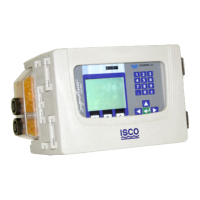
4210 Flow Meter
Section 4 Optional Equipment
4-13
ions that may be present in the solution. It is essential to prevent
grease from fouling this membrane. The glass membrane pro-
duces an electrical potential proportional to hydrogen ion
activity.
The other electrode, called the reference electrode, completes the
circuit between the glass electrode and the solution.
The Isco pH probe combines both electrodes in a single housing
and also contains an amplifier to reduce the extremely high
impedance of the circuit. This improves the reaction of the probe
to stray capacitance and reduces interference caused by electrical
noise in the vicinity.
pH measurement is affected significantly by temperature, like
any other chemical reaction. Consequently, temperature compen-
sation is provided in the flow meter. The Isco pH probe has a
built-in temperature sensor that is exposed for faster response.
The pH probe connects to a 201 Module that plugs into the
Parameter Port on the flow meter. The probe has a 25 ft. (7.6 m)
cable. For greater distances, contact the factory. The maximum
distance between the module and the flow meter is 1,000 ft.
(304.8 m).
Note
Do not connect an Isco pH probe and temperature probe to the
201 module at the same time. The “Temperature Probe” input
on the 201 module is for use ONLY with non-Isco pH probes
that do not have built-in temperature sensing. The Isco pH
probe contains its own integral temperature sensor, which, if
connected in parallel with a separate temperature probe, will
cause erroneous readings.
When the ion-selective electrode and the reference electrode are
connected to a high-impedance voltmeter and submerged in
solution, ions move to the surface of the membrane. The elec-
trical charge on the ions creates a potential difference across the
barrier between the solution and the membrane. This potential,
or voltage difference, is proportional to the activity of the ions in
solution.
The potential, when read by a sensitive voltmeter, translates into
a reading of pH. With an Isco flow meter, the voltage is sent first
to a preamplifier inside the probe to reduce the impedance of the
circuit and improve the signal-to-noise ratio, and then on to the
parameter module to allow greater operating distance from the
flow meter. The flow meter determines the pH value and displays
it.
4.10.2 pH Probe Calibration The 4210 provides a two- or three-point calibration for the pH
probes with commercially-prepared calibrated buffer solutions.
Calibrations of 4 and 7, 7 and 10, and 4, 7, and 10 are all pos-
sible. For accurate readings, you must clean and re-calibrate the
probe on a regular basis. How often you need to do this depends
on the condition of your flow stream.


 To Next Page