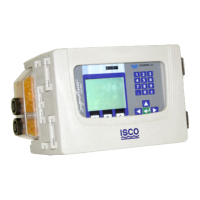
4210 Flow Meter
Section 3 Installation
3-8
software algorithm to reject occasional readings that deviate sub-
stantially from normal. However, if the waves are severe, the
flow meter will not function and will indicate a “no echo” con-
dition.
Wavelength – You can determine the wavelength of sound by
dividing the velocity of the sound by the frequency. The fre-
quency of the 4210 is about 40 kHz. The length of a 40 kHz sound
wave is found by dividing 1,125 by 40,000 which is 0.02815 feet
or 0.3378 inches.
Under ideal conditions it is possible to detect the same wave
front of the returning echo. However, any noise or abnormal
attenuation (excessive decrease) may cause the flow meter to
detect an earlier or a later wave. When the attenuation of the
returned echo does not match the gain slope of the amplifier, the
circuit will eventually detect a different cycle of the returned
echo as the distance changes. The impact of this wave-detect
error is determined by the wavelength. Higher frequencies
(shorter wavelengths) produce smaller echo-detect errors.
However, higher frequencies are absorbed more rapidly,
decreasing the maximum distance that you can measure with the
same amount of power. The frequency of 40 kHz was selected for
the 4210 as a suitable compromise.
Since the sound travels the distance twice (going and coming),
the observed error is one-half of the wavelength or 0.014 foot.
The 4210 uses a rectified detect circuit that can detect either the
positive or negative peak. This allows the flow meter to limit the
error of proper wave detection to increments of one-half wave-
length. This error is 0.007 foot.
Wind – Wind can blow the sound away or significantly reduce
the intensity of the returned echo. Narrow beam angles, advan-
tageous for measuring small flow streams, are a disadvantage in
this situation. Likewise, greater distances to the surface of the
flow stream are more affected by wind.
Obviously, some of these factors have significant impact on the
accuracy of the 4210 Flow Meter. You should make installations
with care.
3.5 Accessories Spreader Bar – The Spreader Bar is an expandable pipe that
serves as an equipment hanger inside a manhole. Outward
spring pressure holds it securely against the walls of the
manhole, like a shower curtain rod. You then suspend the 4210
from the bar.
Ultrasonic Cable Clamp – The cable clamp is used with the
Spreader Bar to secure the mounting of the ultrasonic level
sensor.
Ultrasonic Wall Mount Bracket – This device lets you install
the ultrasonic level sensor on a convenient nearby wall over a
flow stream, such as the side of a bridge, or other structure.


 To Next Page