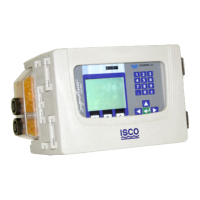
4210 Flow Meter
Appendix C General Safety Procedures
C-4
• Wear a safety harness with a stout rope attached.
• Do not smoke.
• Avoid touching yourself above the collar until you have
cleaned your hands.
C.4.4 Emergencies Every member of the crew should be instructed on procedures to
be followed in cases of an emergency. It is the duty of each crew
chief to have a list of emergency phone numbers, including the
nearest hospital and ambulance service, police precinct, fire
station, and rescue or general emergency number.
C.4.5 Field Equipment The following equipment should be available for use:
Blowers Gloves
Breathing apparatus Hard Hats
Coverall Harnesses
First aid kits Manhole irons
Emergency flashers Pick axes
Flashlight Rain slickers
Mirror Ropes
Gas detectors Safety vests
Gas masks Traffic cones
Waders”
C.4.6 Lethal Atmospheres in
Sewers
The following is an article written by Dr. Richard D. Pomeroy,
and published in the October 1980 issue of “Deeds & Data” of the
WPCF. Dr. Pomeroy is particularly well known for his studies,
over a period of nearly 50 years, in the field of the control of
hydrogen sulfide and other odors in sewers and treatment plants.
He has personally worked in a great many functioning sewers. In
the earlier years he did so, he admits, with little knowledge of
the grave hazards to which he exposed himself.
“It is gratifying that the subject of hazards to people working in
sewers is receiving much more attention than in past years, and
good safety procedures are prescribed in various publications on
this subject. It is essential that people know and use correct pro-
cedures.
“It is less important to know just what the hazardous compo-
nents of sewer atmospheres are, as safety precautions should in
general be broadly applicable, but there should be a reasonable
understanding of this subject. It is disturbing to see statements
in print that do not reflect true conditions.
“One of the most common errors is the assumption that people
have died from a lack of oxygen. The human body is able to
function very well with substantially reduced oxygen concentra-
tions. No one worries about going to Santa Fe, New Mexico, (elev.
2,100 meters), where the partial pressure of oxygen is equal to
16.2% (a normal atmosphere is about 21%) oxygen. “When first
going there, a person may experience a little ‘shortness of breath’
following exercise.


 To Next Page